Refine search
Actions for selected content:
26079 results in Abstract analysis
A closed dimensionless linear set
-
- Journal:
- Proceedings of the Edinburgh Mathematical Society / Volume 6 / Issue 2 / October 1939
- Published online by Cambridge University Press:
- 20 January 2009, pp. 105-108
-
- Article
-
- You have access
- Export citation
Characterisations of Generalised Uniserial Algebras. III
-
- Journal:
- Proceedings of the Edinburgh Mathematical Society / Volume 15 / Issue 1 / June 1966
- Published online by Cambridge University Press:
- 20 January 2009, pp. 37-42
-
- Article
-
- You have access
- Export citation
Completeness of the L1-space of closed vector measures
-
- Journal:
- Proceedings of the Edinburgh Mathematical Society / Volume 33 / Issue 1 / February 1990
- Published online by Cambridge University Press:
- 20 January 2009, pp. 71-78
-
- Article
-
- You have access
- Export citation
J. E. Humphreys, Linear Algebraic Groups (Springer-Verlag, Berlin, 1975), xv + 247 pp., $18.90.
-
- Journal:
- Proceedings of the Edinburgh Mathematical Society / Volume 20 / Issue 4 / September 1977
- Published online by Cambridge University Press:
- 20 January 2009, p. 366
-
- Article
-
- You have access
- Export citation
Regions of the n-sphere and related integrals
-
- Journal:
- Proceedings of the Edinburgh Mathematical Society / Volume 21 / Issue 2 / September 1978
- Published online by Cambridge University Press:
- 20 January 2009, pp. 129-133
-
- Article
-
- You have access
- Export citation
-
In this note the volumes of certain regions in the n-sphere will be found in two ways: (a) by using a symmetry argument, (b) by expressing the volumes as repeated integrals over the (n-l)-cube. By considering the 4 and 5 spheres and equating the integrals obtained by method (b) to the solution obtained by method (a) we evaluate integrals of the form

for certain values of a, b and c; it does not appear easy (if indeed it is possible) to evaluate these integrals by direct methods.
PEM volume 22 issue 2 Cover and Front matter
-
- Journal:
- Proceedings of the Edinburgh Mathematical Society / Volume 22 / Issue 2 / June 1979
- Published online by Cambridge University Press:
- 20 January 2009, pp. f1-f2
-
- Article
-
- You have access
- Export citation
Some remarks on countably barrelled and countably quasibarrelled spaces
-
- Journal:
- Proceedings of the Edinburgh Mathematical Society / Volume 15 / Issue 4 / December 1967
- Published online by Cambridge University Press:
- 20 January 2009, pp. 295-296
-
- Article
-
- You have access
- Export citation
E. Spiegel and C. J. O'Donnell Incidence Algebras (Pure and Applied Mathematics Vol. 206, Marcel Dekker, 1997), ix + 335 pp., 0 8247 0036 8, US$125.
-
- Journal:
- Proceedings of the Edinburgh Mathematical Society / Volume 42 / Issue 2 / June 1999
- Published online by Cambridge University Press:
- 20 January 2009, p. 426
-
- Article
-
- You have access
- Export citation
Convolution theorems of Titchmarsh type on discrete Rn
-
- Journal:
- Proceedings of the Edinburgh Mathematical Society / Volume 32 / Issue 3 / October 1989
- Published online by Cambridge University Press:
- 20 January 2009, pp. 449-457
-
- Article
-
- You have access
- Export citation
-
This paper contains results related to Titchmarsh's convolution theorem and valid for
 , the additive group of Rn with the discrete topology. The method of proof consists in transferring the problem to Rn with the usual topology by a procedure which has been used earlier, for instance in Helson [3].
In Section 1, the classical support theorems are generalized to
. In [1], Titchmarsh's convolution theorem [6] on R was generalized to convolutions of functions belonging to certain weighted Lp-spaces on R. Section 2 contains a corresponding generalization to weighted l2(Rd).It should be observed that convolutions of elements f and g in l1(
) can be interpreted as convolutions of bounded discrete measures on Rn. Hence, in that case the support theorem (Theorem 4.33 of Hörmander [5]) is directly applicable to give the results of our Theorems 1 and 3. So the novelty in our theorems lies in the fact that they apply for instance to the case when it is only assumed f, g ∈l2(), together with support conditions. It is not known whether it suffices to assume f∈l1(), g∈lp(), when p > 2.
 , the additive group of
 S. Donkin The q-Schur algebra (London Mathematical Society Lecture Note Series vol. 253, Cambridge, 1998), x + 179 pp., 0 521 64558 1 (paperback), £24.95 (US$39.95).
-
- Journal:
- Proceedings of the Edinburgh Mathematical Society / Volume 43 / Issue 2 / June 2000
- Published online by Cambridge University Press:
- 20 January 2009, pp. 445-446
-
- Article
-
- You have access
- Export citation
Professor D. M. Y. Sommerville, M.A., D.Sc, F.R.S.E.
-
- Journal:
- Proceedings of the Edinburgh Mathematical Society / Volume 4 / Issue 1 / March 1934
- Published online by Cambridge University Press:
- 20 January 2009, pp. 57-60
-
- Article
-
- You have access
- Export citation
On the Solutions of Mathieu's Differential Equation, and their Asymptotic Expansions
-
- Journal:
- Proceedings of the Edinburgh Mathematical Society / Volume 41 / February 1922
- Published online by Cambridge University Press:
- 20 January 2009, pp. 26-48
-
- Article
-
- You have access
- Export citation
On the Second Solutions of Lamé's Equation
-
- Journal:
- Proceedings of the Edinburgh Mathematical Society / Volume 16 / February 1897
- Published online by Cambridge University Press:
- 20 January 2009, pp. 57-60
-
- Article
-
- You have access
- Export citation
-
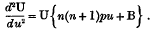
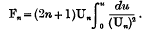
I consider here the second solutions corresponding to the solutions of the above equation (when n is an integer) in finite terms for special values of B. If Un be such a solution, and Fn the corresponding second solution, we know that
I. G. Macdonald Symmetric functions and Hall polynomials (2nd edition) (Clarendon Press, Oxford, 1995), x + 475 pp, 0 19 853489 2, £55.
-
- Journal:
- Proceedings of the Edinburgh Mathematical Society / Volume 40 / Issue 1 / February 1997
- Published online by Cambridge University Press:
- 20 January 2009, pp. 210-211
-
- Article
-
- You have access
- Export citation
Office-Bearers
-
- Journal:
- Proceedings of the Edinburgh Mathematical Society / Volume 12 / February 1893
- Published online by Cambridge University Press:
- 20 January 2009, p. 1
-
- Article
-
- You have access
- Export citation
The place of Dirac's Equation in Five-Dimensional Riemannian Geometry
-
- Journal:
- Proceedings of the Edinburgh Mathematical Society / Volume 7 / Issue 4 / October 1946
- Published online by Cambridge University Press:
- 20 January 2009, pp. 174-182
-
- Article
-
- You have access
- Export citation
V. G. Boltyanskii , Envelopes (Popular Lectures in Mathematics, Pergamon Press, Oxford, 1964), ix+76 pp., 15s.
-
- Journal:
- Proceedings of the Edinburgh Mathematical Society / Volume 15 / Issue 2 / December 1966
- Published online by Cambridge University Press:
- 20 January 2009, pp. 163-164
-
- Article
-
- You have access
- Export citation
PEM volume 15 issue 3 Cover and Front matter
-
- Journal:
- Proceedings of the Edinburgh Mathematical Society / Volume 15 / Issue 3 / June 1967
- Published online by Cambridge University Press:
- 20 January 2009, pp. f1-f2
-
- Article
-
- You have access
- Export citation
Contributions to genetic algebras II
-
- Journal:
- Proceedings of the Edinburgh Mathematical Society / Volume 18 / Issue 4 / December 1973
- Published online by Cambridge University Press:
- 20 January 2009, pp. 273-279
-
- Article
-
- You have access
- Export citation
A Cyclic Inequality
-
- Journal:
- Proceedings of the Edinburgh Mathematical Society / Volume 12 / Issue 3 / June 1961
- Published online by Cambridge University Press:
- 20 January 2009, pp. 139-147
-
- Article
-
- You have access
- Export citation
-
For any positive integer n and positive real variables x1, x2, …, xn write

where xr is defined for all integers r by the relations

If

and

it is known that (1, 3, 4)

and

