Refine search
Actions for selected content:
26079 results in Abstract analysis
PEM volume 44 Cover and Front matter
-
- Journal:
- Proceedings of the Edinburgh Mathematical Society / Volume 44 / February 1925
- Published online by Cambridge University Press:
- 20 January 2009, pp. f1-f5
-
- Article
-
- You have access
- Export citation
Explicit expressions for Sturm-Liouville operator problems
-
- Journal:
- Proceedings of the Edinburgh Mathematical Society / Volume 30 / Issue 2 / June 1987
- Published online by Cambridge University Press:
- 20 January 2009, pp. 301-309
-
- Article
-
- You have access
- Export citation
-
Throughout this paper H will denote a complex separable Hilbert space and L(H) denotes the algebra of all bounded linear operators on H. If T lies in L(H), its spectrum σ(T) is the set of all complex numbers z such zI–T is not invertible in L(H) and its compression spectrum σcomp(T) is the set of all complex numbers z such that the range (zI-T)(H) is not dense in H ([3, p. 240]). This paper is concerned with the Sturm–Liouville operator problem
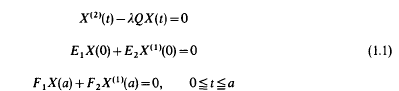
where λ is a complex parameter and X(t), Q, Ei, Fi for i = l,2, and t∈[0,a], are bounded operators in L(H). For the scalar case, the classical Sturm-Liouville theory yields a complete solution of the problem, see [4], and [7]. For the finite-dimensional case, second order operator differential equations are important in the theory of damped oscillatory systems and vibrational systems ([2, 6]). Infinite-dimensional differential equations occur frequently in the theory of stochastic processes, the degradation of polymers, infinite ladder network theory in engineering [1, 17], denumerable Markov chains, and moment problems [10, 20]. Sturm-Liouville operator problems have been studied by several authors and with several techniques ([12, 13, 14, 15, 16]).
Taqdir Husain, The Open Mapping and Closed Graph Theorems in Topological Vector Spaces (Oxford Mathematical Monographs, Clarendon Press: Oxford University Press, 1965), x + 108 pp., 30s.
-
- Journal:
- Proceedings of the Edinburgh Mathematical Society / Volume 16 / Issue 1 / June 1968
- Published online by Cambridge University Press:
- 20 January 2009, p. 81
-
- Article
-
- You have access
- Export citation
A property of Cesàro-Perron integrals
-
- Journal:
- Proceedings of the Edinburgh Mathematical Society / Volume 6 / Issue 3 / August 1940
- Published online by Cambridge University Press:
- 20 January 2009, pp. 160-165
-
- Article
-
- You have access
- Export citation
-
It is well known that if f(t) is (a) integrable in the Lebesgue sense, or more generally (b) integrable in the Perron sense, over every interval (α, β) interior to (a, b), and if

exists, then f(t) is integrable in the Perron sense over (a, b) to the value (1·1).
Ivan Niven, Diophantine Approximations (Interscience Tracts in Pure and Applied Mathematics, No. 14, John Wiley & Sons, New York), viii+68 pp., 36s.
-
- Journal:
- Proceedings of the Edinburgh Mathematical Society / Volume 13 / Issue 4 / December 1963
- Published online by Cambridge University Press:
- 20 January 2009, p. 344
-
- Article
-
- You have access
- Export citation
Index According to Subjects
-
- Journal:
- Proceedings of the Edinburgh Mathematical Society / Volume 3 / Issue 4 / August 1933
- Published online by Cambridge University Press:
- 20 January 2009, pp. 302-304
-
- Article
-
- You have access
- Export citation
On a problem of Baayen and Kruyswijk
-
- Journal:
- Proceedings of the Edinburgh Mathematical Society / Volume 16 / Issue 2 / December 1968
- Published online by Cambridge University Press:
- 20 January 2009, pp. 145-149
-
- Article
-
- You have access
- Export citation
PEM volume 41 issue 1 Cover and Back matter
-
- Journal:
- Proceedings of the Edinburgh Mathematical Society / Volume 41 / Issue 1 / February 1998
- Published online by Cambridge University Press:
- 20 January 2009, pp. b1-b2
-
- Article
-
- You have access
- Export citation
On the solvability of semilinear differential equations at resonance
-
- Journal:
- Proceedings of the Edinburgh Mathematical Society / Volume 43 / Issue 1 / February 2000
- Published online by Cambridge University Press:
- 20 January 2009, pp. 103-112
-
- Article
-
- You have access
- Export citation
-
In this paper we use the Leray–Schauder continuation method to study the existence of solutions for semilinear differential equations Lu + g(x, u) = h, in which the linear operator L on L2(Ω) may be non-self-adjoint, the L2(Ω)-function h belongs to N⊥(L), the nonlinear term g(x, u) ∈ O(|u|α) as |u| → ∞ for some 0 ≤ α < 1 and satisfies

for all v ∈ N(L) – {0}, where
 and
and 
 and
and 
Embedding Theorems for Groups
-
- Journal:
- Proceedings of the Edinburgh Mathematical Society / Volume 13 / Issue 2 / December 1962
- Published online by Cambridge University Press:
- 20 January 2009, pp. 153-157
-
- Article
-
- You have access
- Export citation
A Problem of Robert Simson's
-
- Journal:
- Proceedings of the Edinburgh Mathematical Society / Volume 31 / February 1912
- Published online by Cambridge University Press:
- 20 January 2009, pp. 94-96
-
- Article
-
- You have access
- Export citation
Generalisations of nilpotency of rings
-
- Journal:
- Proceedings of the Edinburgh Mathematical Society / Volume 18 / Issue 4 / December 1973
- Published online by Cambridge University Press:
- 20 January 2009, pp. 265-272
-
- Article
-
- You have access
- Export citation
Erratum
-
- Journal:
- Proceedings of the Edinburgh Mathematical Society / Volume 38 / Issue 2 / June 1995
- Published online by Cambridge University Press:
- 20 January 2009, p. i
-
- Article
-
- You have access
- Export citation
A. Zygmund, Trigonometric Series (Cambridge University Press, 2nd ed., 1959) Two Volumes. Volume I, xii + 383 pp., Volume II, vii + 354 pp., 84s. per volume..
-
- Journal:
- Proceedings of the Edinburgh Mathematical Society / Volume 12 / Issue 1 / June 1960
- Published online by Cambridge University Press:
- 20 January 2009, pp. 57-58
-
- Article
-
- You have access
- Export citation
w. G. Cochran, Sampling Techniques (John Wiley & Sons, 2nd edition, 1963), ix+413 pp., 72s.
-
- Journal:
- Proceedings of the Edinburgh Mathematical Society / Volume 13 / Issue 4 / December 1963
- Published online by Cambridge University Press:
- 20 January 2009, pp. 342-343
-
- Article
-
- You have access
- Export citation
The Theorems as far as Proposition 32, of the first book of Euclid's Elements, proved from First Principles
-
- Journal:
- Proceedings of the Edinburgh Mathematical Society / Volume 2 / February 1883
- Published online by Cambridge University Press:
- 20 January 2009, pp. 40-45
-
- Article
-
- You have access
- Export citation
The Treatment of Proportion in Elementary Geometry
-
- Journal:
- Proceedings of the Edinburgh Mathematical Society / Volume 16 / February 1897
- Published online by Cambridge University Press:
- 20 January 2009, pp. 99-110
-
- Article
-
- You have access
- Export citation
The problem of the in-and-circumscribed polygon for a plane quartic curve
-
- Journal:
- Proceedings of the Edinburgh Mathematical Society / Volume 4 / Issue 3 / August 1935
- Published online by Cambridge University Press:
- 20 January 2009, pp. 121-137
-
- Article
-
- You have access
- Export citation
P. T. Johnstone, Notes on logic and set theory (Cambridge University Press, Cambridge, 1987) 120 pp., cloth: 0 521 33502 7, £20; paper: 0 521 33692 9, £6.95.
-
- Journal:
- Proceedings of the Edinburgh Mathematical Society / Volume 31 / Issue 2 / June 1988
- Published online by Cambridge University Press:
- 20 January 2009, p. 336
-
- Article
-
- You have access
- Export citation
On the limit cycles of polynomial differential systems with homogeneous nonlinearities
-
- Journal:
- Proceedings of the Edinburgh Mathematical Society / Volume 43 / Issue 3 / October 2000
- Published online by Cambridge University Press:
- 20 January 2009, pp. 529-543
-
- Article
-
- You have access
- Export citation
