Refine search
Actions for selected content:
26079 results in Abstract analysis
On the Fractional Infinite Series for cosecx, secx, cotx, and tanx
-
- Journal:
- Proceedings of the Edinburgh Mathematical Society / Volume 22 / February 1903
- Published online by Cambridge University Press:
- 20 January 2009, pp. 14-20
-
- Article
-
- You have access
- Export citation
-
The infinite products for sinx and cosx are most conveniently obtained in a rigorous way from the well-known factorial expressions for sinnθ and cosnθ which, when n is an even integer, take the forms

θ being put equal to
 and n made infinitely great.
 and n made infinitely great.
Homotopy associativity of sphere extensions
-
- Journal:
- Proceedings of the Edinburgh Mathematical Society / Volume 32 / Issue 3 / October 1989
- Published online by Cambridge University Press:
- 20 January 2009, pp. 459-472
-
- Article
-
- You have access
- Export citation
-
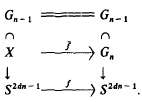
Throughout this paper, we work in the category of (p-localized) spaces having the homotopy type of connected CW-complexes of finite type with base point. We consider a principal bundle

where Gn = SU(n), U(n) or Sp(n) and d = 1, 1 or 2 respectively. In this case, the bundle is obtained as an induced bundle by a mapping f of base space S2dn−1 from the classical group extension as follows:
On a Class of Surfaces
-
- Journal:
- Proceedings of the Edinburgh Mathematical Society / Volume 29 / February 1910
- Published online by Cambridge University Press:
- 20 January 2009, pp. 65-74
-
- Article
-
- You have access
- Export citation
The Vibration of a Particle about a Position of Equilibrium—Part IV: The Convergence of the Trigonometric Series of Dynamics
-
- Journal:
- Proceedings of the Edinburgh Mathematical Society / Volume 41 / February 1922
- Published online by Cambridge University Press:
- 20 January 2009, pp. 141-145
-
- Article
-
- You have access
- Export citation
-
It has been shown in the previous three parts of this work, that the whole question of the convergence of the series solution, for the particular dynamical system under consideration, has turned upon the cubic equation
Before proceeding to generalize the results it will be shown how this cubic equation may be derived in a slightly different fashion.
A note on the Gaussian cardinal-interpolation operator
-
- Journal:
- Proceedings of the Edinburgh Mathematical Society / Volume 40 / Issue 1 / February 1997
- Published online by Cambridge University Press:
- 20 January 2009, pp. 137-149
-
- Article
-
- You have access
- Export citation
-
Suppose λ is a positive number, and let
 , x∈Rd, denote the d-dimensional Gaussian. Basic theory of cardinal interpolation asserts the existence of a unique function
  , x∈Rd, satisfying the interpolatory conditions
  , k∈Zd, and decaying exponentially for large argument. In particular, the Gaussian cardinal-interpolation operator
  , given by
  , x∈Rd,
  , is a well-defīned linear map from ℓ2(Zd) into L2(Rd). It is shown here that its associated operator-norm is
  , implying, in particular, that
  is contractive. Some sidelights are also presented.
 , x∈R
, x∈R , x∈R
, x∈R , k∈Z
, k∈Z , given by
  , x∈R
, x∈R , is a well-defīned linear map from ℓ
 , implying, in particular, that
  is contractive. Some sidelights are also presented.
Solution with Axial Symmetry of Einstein's Equations of Teleparallelism
-
- Journal:
- Proceedings of the Edinburgh Mathematical Society / Volume 3 / Issue 1 / March 1932
- Published online by Cambridge University Press:
- 20 January 2009, pp. 37-45
-
- Article
-
- You have access
- Export citation
A Generalization of Circulants
-
- Journal:
- Proceedings of the Edinburgh Mathematical Society / Volume 1 / Issue 3 / July 1928
- Published online by Cambridge University Press:
- 20 January 2009, pp. 177-181
-
- Article
-
- You have access
- Export citation
The Approximate Solution of Dual Integral Equations by Variational Methods
-
- Journal:
- Proceedings of the Edinburgh Mathematical Society / Volume 11 / Issue 2 / November 1958
- Published online by Cambridge University Press:
- 20 January 2009, pp. 115-126
-
- Article
-
- You have access
- Export citation
-
The classic application of dual integral equations occurs in connexion with the potential of a circular disc (e.g. Titchmarsh (9), p. 334). Suppose that the disc lies in z = 0, 0≤ρ≤1, where we use cylindrical coordinates (p, z). Then it is required to find a solution of

such that on z = 0

Separation of variables in conjunction with the conditions that ø is finite on the axis and ø tends to zero as z tends to plus infinity yields the particular solution
 .
.
 .
.Note on Attraction
-
- Journal:
- Proceedings of the Edinburgh Mathematical Society / Volume 11 / February 1892
- Published online by Cambridge University Press:
- 20 January 2009, p. 84
-
- Article
-
- You have access
- Export citation
Willard van Orman Quine, Set Theory and its Logic (Harvard University Press, London: Oxford University Press, 1964), xv + 359 pp., 48s.
-
- Journal:
- Proceedings of the Edinburgh Mathematical Society / Volume 14 / Issue 2 / December 1964
- Published online by Cambridge University Press:
- 20 January 2009, pp. 171-172
-
- Article
-
- You have access
- Export citation
On the Theory of Continued Fractions
-
- Journal:
- Proceedings of the Edinburgh Mathematical Society / Volume 35 / February 1916
- Published online by Cambridge University Press:
- 20 January 2009, pp. 46-58
-
- Article
-
- You have access
- Export citation
Bernard Epstein, Partial Differential Equations—An Introduction (McGraw-Hill, New York, 1962), x+273 pp., 74s.
-
- Journal:
- Proceedings of the Edinburgh Mathematical Society / Volume 13 / Issue 2 / December 1962
- Published online by Cambridge University Press:
- 20 January 2009, p. 193
-
- Article
-
- You have access
- Export citation
Obituary
-
- Journal:
- Proceedings of the Edinburgh Mathematical Society / Volume 14 / Issue 1 / June 1964
- Published online by Cambridge University Press:
- 20 January 2009, p. 87
-
- Article
-
- You have access
- Export citation
On quasi-orthodox semigroups with inverse transversals
-
- Journal:
- Proceedings of the Edinburgh Mathematical Society / Volume 40 / Issue 3 / October 1997
- Published online by Cambridge University Press:
- 20 January 2009, pp. 505-514
-
- Article
-
- You have access
- Export citation
Local Electromagnetic Fields
-
- Journal:
- Proceedings of the Edinburgh Mathematical Society / Volume 44 / February 1925
- Published online by Cambridge University Press:
- 20 January 2009, pp. 85-89
-
- Article
-
- You have access
- Export citation
-
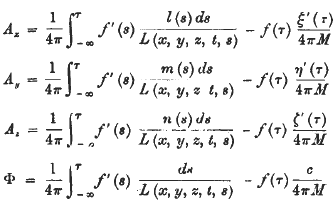
§ 1. The radiation of electromagnetic charges from a moving point.
Let the electric charge associated with a moving point Q at time s be f(s). This charge is supposed to vary on account of the radiation of electric charges from Q in a variable direction, which, at time s, has direction cosines l (s), m (s), n (s) Using ξ(s), η(s), ζ(s) to denote the coordinates of Q at time s, and defining the effective time τ by means of the equation

the electromagnetic field may be specified by means of the potentials
where

PEM volume 26 Back matter and figures
-
- Journal:
- Proceedings of the Edinburgh Mathematical Society / Volume 26 / February 1907
- Published online by Cambridge University Press:
- 20 January 2009, pp. b1-b19
-
- Article
-
- You have access
- Export citation
M. Dimassi and J. Sjöstrand Spectral asymptotics in the semi-classical limit (LMS Lecture Note Series no. 268, Cambridge, 1999), xi + 227 pp., 0 521 66544 2 (paperback), $24.95.
-
- Journal:
- Proceedings of the Edinburgh Mathematical Society / Volume 43 / Issue 2 / June 2000
- Published online by Cambridge University Press:
- 20 January 2009, p. 448
-
- Article
-
- You have access
- Export citation
Some sufficient conditions for the absolute Cesàro summability of series
-
- Journal:
- Proceedings of the Edinburgh Mathematical Society / Volume 6 / Issue 1 / May 1939
- Published online by Cambridge University Press:
- 20 January 2009, pp. 51-56
-
- Article
-
- You have access
- Export citation
-
denote the n-th Cesàro mean of order k for the series aΣan, that is,
where
and let
R. Schmidt Subgroup lattices of groups (de Gruyter Expositions of Mathematics Vol. 14, de Gruyter, Berlin, New York1994) 576 pp., 3 11 011213 2, £139.38.
-
- Journal:
- Proceedings of the Edinburgh Mathematical Society / Volume 38 / Issue 2 / June 1995
- Published online by Cambridge University Press:
- 20 January 2009, pp. 357-358
-
- Article
-
- You have access
- Export citation
Finite travelling waves for semilinear parabolic systems
-
- Journal:
- Proceedings of the Edinburgh Mathematical Society / Volume 42 / Issue 1 / February 1999
- Published online by Cambridge University Press:
- 20 January 2009, pp. 83-93
-
- Article
-
- You have access
- Export citation
-
In this paper, finite travelling waves for the semilinear parabolic systems

are studied, where di > 0, ei > 0, mij ≥ 0 for all 1 ≤ i,j ≤ n, and
 for all 1 ≤ i ≤ n. Let M = (mij)n × n and A = I – M. It will be proved that (*) has finite travelling waves if and only if all principal minors of A are positive. Moreover, some asymptotic behaviours of finite travelling waves will be obtained.
 for all 1 ≤ i ≤ n. Let M = (m