Refine search
Actions for selected content:
26079 results in Abstract analysis
Against a current pseudo-definition of varying velocity
-
- Journal:
- Proceedings of the Edinburgh Mathematical Society / Volume 12 / February 1893
- Published online by Cambridge University Press:
- 20 January 2009, p. 33
-
- Article
-
- You have access
- Export citation
A. O. Gel'fond, and Yu. v. Linnik, Elementary Methods in the Analytic Theory of Numbers, translated by D. E. Brown (Pergamon Press, 1966), xi + 232 pp., 63s.
-
- Journal:
- Proceedings of the Edinburgh Mathematical Society / Volume 16 / Issue 1 / June 1968
- Published online by Cambridge University Press:
- 20 January 2009, pp. 87-88
-
- Article
-
- You have access
- Export citation
An inversion theorem for the Stieltjes transform of distributions
-
- Journal:
- Proceedings of the Edinburgh Mathematical Society / Volume 29 / Issue 2 / June 1986
- Published online by Cambridge University Press:
- 20 January 2009, pp. 171-185
-
- Article
-
- You have access
- Export citation
PEM volume 20 issue 3 Cover and Back matter
-
- Journal:
- Proceedings of the Edinburgh Mathematical Society / Volume 20 / Issue 3 / March 1977
- Published online by Cambridge University Press:
- 20 January 2009, p. b1
-
- Article
-
- You have access
- Export citation
Office-Bearers
-
- Journal:
- Proceedings of the Edinburgh Mathematical Society / Volume 30 / February 1911
- Published online by Cambridge University Press:
- 20 January 2009, p. 1
-
- Article
-
- You have access
- Export citation
PEM volume 34 issue 1 Cover and Front matter
-
- Journal:
- Proceedings of the Edinburgh Mathematical Society / Volume 34 / Issue 1 / February 1991
- Published online by Cambridge University Press:
- 20 January 2009, pp. f1-f2
-
- Article
-
- You have access
- Export citation
On Small Deformation of Sub-Spaces of a Flat Space
-
- Journal:
- Proceedings of the Edinburgh Mathematical Society / Volume 3 / Issue 2 / July 1932
- Published online by Cambridge University Press:
- 20 January 2009, pp. 77-86
-
- Article
-
- You have access
- Export citation
Spectral measures on spaces not containing l∞
-
- Journal:
- Proceedings of the Edinburgh Mathematical Society / Volume 24 / Issue 1 / February 1981
- Published online by Cambridge University Press:
- 20 January 2009, pp. 41-45
-
- Article
-
- You have access
- Export citation
Note on Triangle Transformations
-
- Journal:
- Proceedings of the Edinburgh Mathematical Society / Volume 13 / February 1894
- Published online by Cambridge University Press:
- 20 January 2009, pp. 112-114
-
- Article
-
- You have access
- Export citation
On Generating Functions
-
- Journal:
- Proceedings of the Edinburgh Mathematical Society / Volume 2 / Issue 2 / June 1930
- Published online by Cambridge University Press:
- 20 January 2009, pp. 71-82
-
- Article
-
- You have access
- Export citation
-
It is well known that the polynomial in x,
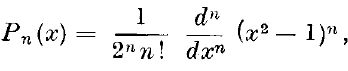
has the following properties:—
(A) it is the coefficient of tn in the expansion of (1–2xt+t2)–½;
(B) it satisfies the three-term recurrence relation

(C) it is the solution of the second order differential equation

(D) the sequence Pn(x) is orthogonal for the interval (— 1, 1),
i.e. when

Several other familiar polynomials, e.g., those of Laguerre Hermite, Tschebyscheff, have properties similar to some or all of the above. The aim of the present paper is to examine whether, given a sequence of functions (polynomials or not) which has one of these properties, the others follow from it : in other words we propose to examine the inter-relation of the four properties. Actually we relate each property to the generating function.
PEM volume 5 issue 2 Cover and Front matter
-
- Journal:
- Proceedings of the Edinburgh Mathematical Society / Volume 5 / Issue 2 / June 1937
- Published online by Cambridge University Press:
- 20 January 2009, pp. f1-f2
-
- Article
-
- You have access
- Export citation
On the use of Dimensional Equations
-
- Journal:
- Proceedings of the Edinburgh Mathematical Society / Volume 11 / February 1892
- Published online by Cambridge University Press:
- 20 January 2009, p. 7
-
- Article
-
- You have access
- Export citation
-
The second law of motion may be expressed as a dimensional equation in the form

where the meanings of the quantities are obvious.
If we cut out the factor m from each side, we may write this in the usual form

The general solution is

where

On certain result involving Areal and Trilinear co-ordinates
-
- Journal:
- Proceedings of the Edinburgh Mathematical Society / Volume 11 / February 1892
- Published online by Cambridge University Press:
- 20 January 2009, pp. 8-18
-
- Article
-
- You have access
- Export citation
On the Use of Dimensional Equations in Physics
-
- Journal:
- Proceedings of the Edinburgh Mathematical Society / Volume 9 / February 1890
- Published online by Cambridge University Press:
- 20 January 2009, pp. 30-36
-
- Article
-
- You have access
- Export citation
C. T. J. Dodson and T. Poston Tensor geometry: the geometric viewpoint and its uses (Pitman, 1979), xiii + 598 pp. £24.00; paperback, £9.95.
-
- Journal:
- Proceedings of the Edinburgh Mathematical Society / Volume 26 / Issue 1 / February 1983
- Published online by Cambridge University Press:
- 20 January 2009, p. 118
-
- Article
-
- You have access
- Export citation
The Anharmonic Ratios of 4 points in a straight line
-
- Journal:
- Proceedings of the Edinburgh Mathematical Society / Volume 28 / February 1909
- Published online by Cambridge University Press:
- 20 January 2009, pp. 14-22
-
- Article
-
- You have access
- Export citation
-
The anharmonic ratio of four points A, B, C, D depends on the order in which they are taken. The A.I.G.T. “Syllabus,” following Cremona, defines the symbol (ABCD) to stand for
 , when A is conjugate to B and C to D. Thus, taking λ to denote the value of this double-ratio, we have
 , when A is conjugate to B and C to D. Thus, taking λ to denote the value of this double-ratio, we have
The determination of Green's Function by means of Cylindrical or Spherical Harmonics
-
- Journal:
- Proceedings of the Edinburgh Mathematical Society / Volume 18 / February 1900
- Published online by Cambridge University Press:
- 20 January 2009, pp. 33-83
-
- Article
-
- You have access
- Export citation
P. S. Aleksandrov, Combinatorial Topology, Vols. i and ii (Graylock Press, Rochester, N.Y., 1956, 57), pp., 225pp., $11.45.
-
- Journal:
- Proceedings of the Edinburgh Mathematical Society / Volume 11 / Issue 3 / May 1959
- Published online by Cambridge University Press:
- 20 January 2009, p. 189
-
- Article
-
- You have access
- Export citation
Michel Loève, Probability Theory (D. van Nostrand Co., London, 3rd ed., 1963), xvi + 685 pp., 115s.
-
- Journal:
- Proceedings of the Edinburgh Mathematical Society / Volume 14 / Issue 2 / December 1964
- Published online by Cambridge University Press:
- 20 January 2009, p. 170
-
- Article
-
- You have access
- Export citation
Optimal functions for a periodic uncertainty principle and multiresolution analysis*
-
- Journal:
- Proceedings of the Edinburgh Mathematical Society / Volume 42 / Issue 2 / June 1999
- Published online by Cambridge University Press:
- 20 January 2009, pp. 225-242
-
- Article
-
- You have access
- Export citation
