Refine search
Actions for selected content:
26079 results in Abstract analysis
The global dimension theorem for weighted convolution algebras
-
- Journal:
- Proceedings of the Edinburgh Mathematical Society / Volume 41 / Issue 2 / June 1998
- Published online by Cambridge University Press:
- 20 January 2009, pp. 393-406
-
- Article
-
- You have access
- Export citation
On the numerical values of the roots of the equation cosx = x
-
- Journal:
- Proceedings of the Edinburgh Mathematical Society / Volume 9 / February 1890
- Published online by Cambridge University Press:
- 20 January 2009, pp. 80-83
-
- Article
-
- You have access
- Export citation
Formulæ for Sums Involving a Reduced Set of Residues Modulo n
-
- Journal:
- Proceedings of the Edinburgh Mathematical Society / Volume 13 / Issue 4 / December 1963
- Published online by Cambridge University Press:
- 20 January 2009, pp. 347-349
-
- Article
-
- You have access
- Export citation
UNBOUNDED 2-HYPEREXPANSIVE OPERATORS
-
- Journal:
- Proceedings of the Edinburgh Mathematical Society / Volume 44 / Issue 3 / October 2001
- Published online by Cambridge University Press:
- 20 January 2009, pp. 613-629
-
- Article
-
- You have access
- Export citation
Stability of linear delay equations under a small noise
-
- Journal:
- Proceedings of the Edinburgh Mathematical Society / Volume 29 / Issue 2 / June 1986
- Published online by Cambridge University Press:
- 20 January 2009, pp. 233-254
-
- Article
-
- You have access
- Export citation
C. A. Rogers, Packing and Covering (Cambridge Tracts in Mathematics and Mathematical Physics, No. 54, Cambridge University Press, 1964), viii + 109 pp., 30s.
-
- Journal:
- Proceedings of the Edinburgh Mathematical Society / Volume 14 / Issue 3 / June 1965
- Published online by Cambridge University Press:
- 20 January 2009, p. 247
-
- Article
-
- You have access
- Export citation
A configuration of lines in three dimensions
-
- Journal:
- Proceedings of the Edinburgh Mathematical Society / Volume 18 / Issue 2 / December 1972
- Published online by Cambridge University Press:
- 20 January 2009, pp. 105-123
-
- Article
-
- You have access
- Export citation
-
In 1849, Cayley and Salmon discovered that a general cubic surface in projective space of three dimensions over the complex numbers has twenty-seven lines on it. They remarked that all the properties of the twenty-seven lines would not become apparent until a better notation than they had given was found. This notation was discovered by Schläfli in 1858 in the double-six theorem (henceforth referred to as
 given five skew linesa1, …, a5with a single transversal b6such that no four of the ai lie in a regulus, the four ai excluding aj have a second transversal bj and the five lines b1, …, b5thus obtained have a transversal a6—the completing line of the double-six. The other fifteen lines of the cubic surface are then
  , where ai bj is the plane containing ai and bj.
 given five skew linesa
 , where a
The Centre of Gravity of a Circular Arc
-
- Journal:
- Proceedings of the Edinburgh Mathematical Society / Volume 16 / February 1897
- Published online by Cambridge University Press:
- 20 January 2009, p. 46
-
- Article
-
- You have access
- Export citation
On infinite groups of Fibonacci type
-
- Journal:
- Proceedings of the Edinburgh Mathematical Society / Volume 29 / Issue 2 / June 1986
- Published online by Cambridge University Press:
- 20 January 2009, pp. 225-232
-
- Article
-
- You have access
- Export citation
-
Let Fn = 〈 a1,a2,…,an〉 denote the free group of rank n, and let θ denote the automorphism of Fn which permutes the generators cyclically, in other words:

A sufficient condition for the second derived factor group to be finite
-
- Journal:
- Proceedings of the Edinburgh Mathematical Society / Volume 30 / Issue 1 / February 1987
- Published online by Cambridge University Press:
- 20 January 2009, pp. 83-89
-
- Article
-
- You have access
- Export citation
Some examples of critical points for the total mean curvature functional
-
- Journal:
- Proceedings of the Edinburgh Mathematical Society / Volume 43 / Issue 3 / October 2000
- Published online by Cambridge University Press:
- 20 January 2009, pp. 587-603
-
- Article
-
- You have access
- Export citation
A distributional generalised Stieltjes transformation
-
- Journal:
- Proceedings of the Edinburgh Mathematical Society / Volume 20 / Issue 1 / March 1976
- Published online by Cambridge University Press:
- 20 January 2009, pp. 15-22
-
- Article
-
- You have access
- Export citation
-
The generalised Stieltjes transform of a function f(t) ∈ L(0, ∞) is defined by

The integral converges for complex s in the region Ω, where Ω is the s-plane cut from the origin along the negative real axis.
A proof of the uniform convergence of the Fourier series, with notes on the differentiation of the series
-
- Journal:
- Proceedings of the Edinburgh Mathematical Society / Volume 12 / February 1893
- Published online by Cambridge University Press:
- 20 January 2009, pp. 39-50
-
- Article
-
- You have access
- Export citation
An Analogue for Strong Summability of Abel's Summability Method
-
- Journal:
- Proceedings of the Edinburgh Mathematical Society / Volume 9 / Issue 1 / October 1953
- Published online by Cambridge University Press:
- 20 January 2009, pp. 28-34
-
- Article
-
- You have access
- Export citation
-
Given a series Σan, we define
 , by the relation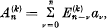
where
 is the binomial coefficient
  . Let
. Let  . If
. If  , the series Σan is said to be summable (C; k) to the sum s. If k > 0, p ≥ 1 and if, as n → ∞,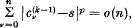
we say that the series Σan is summable [C; k, p] to the sum s, or that the series is strongly summable (C; k) with index p to the sum s. If
 denotes the difference
  , it is known that necessary and sufficient conditions for summability [C; k, p], k > 0, p ≥ 1, to the sum s, are that Σan be summable (C; k) to the sum s and that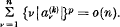
 , by the relation
 is the binomial coefficient
  . Let
. Let  . If
. If  , the series Σa
 denotes the difference
  , it is known that necessary and sufficient conditions for summability [C; k, p], k > 0, p ≥ 1, to the sum s, are that Σa
Gauss' Theorem in a General Space-time
-
- Journal:
- Proceedings of the Edinburgh Mathematical Society / Volume 4 / Issue 3 / August 1935
- Published online by Cambridge University Press:
- 20 January 2009, pp. 144-158
-
- Article
-
- You have access
- Export citation
-
In classical mechanics Gauss' Theorem for a gravitational field states that, if S is a closed surface and N the component of gravitational force along the outward normal, then

where β is the Newtonian constant of gravitation and M is the total mass inside S. This result has recently been extended to general relativity by E. T. Whittaker,1 who, however, considered only the case of a statical gravitational field, the line-element of which is given by2

where the coefficients U and αμν are independent of t. It is not immediately clear from his work whether the results are extensible to more general space-times.
On the Resolution of Integral Algebraic Expressions into Factors
-
- Journal:
- Proceedings of the Edinburgh Mathematical Society / Volume 25 / February 1906
- Published online by Cambridge University Press:
- 20 January 2009, p. 132
-
- Article
-
- You have access
- Export citation
R. A. Mollin Quadratics (CRC Press, Boca Raton-New York-London-Tokyo, 1996), xx + 387 pp., 08493 39839, $74.95.
-
- Journal:
- Proceedings of the Edinburgh Mathematical Society / Volume 40 / Issue 1 / February 1997
- Published online by Cambridge University Press:
- 20 January 2009, pp. 214-215
-
- Article
-
- You have access
- Export citation
A Generalisation of a Theorem of Mercer
-
- Journal:
- Proceedings of the Edinburgh Mathematical Society / Volume 2 / Issue 2 / June 1930
- Published online by Cambridge University Press:
- 20 January 2009, pp. 108-110
-
- Article
-
- You have access
- Export citation
-
§ 1. It is well known that, if
 , the convergence of sn to a limit implies the convergence of tn to the same limit. The converse theorem, that the convergence of tn implies the convergence of sn, is false. Mercer1 proved, however, that if
  , then both sn and tn tend to l. This theorem has recently been extended in various directions.2 In the present note the case of Abel limits is considered.
 , the convergence of s
 , then both s
Logarithmetics of Finite Quasigroups (I)
-
- Journal:
- Proceedings of the Edinburgh Mathematical Society / Volume 9 / Issue 2 / November 1954
- Published online by Cambridge University Press:
- 20 January 2009, pp. 74-81
-
- Article
-
- You have access
- Export citation
Differential inclusions with state constraints
-
- Journal:
- Proceedings of the Edinburgh Mathematical Society / Volume 32 / Issue 1 / February 1989
- Published online by Cambridge University Press:
- 20 January 2009, pp. 81-98
-
- Article
-
- You have access
- Export citation
