Refine search
Actions for selected content:
26079 results in Abstract analysis
Group algebras of some generalised soluble groups
-
- Journal:
- Proceedings of the Edinburgh Mathematical Society / Volume 18 / Issue 1 / June 1972
- Published online by Cambridge University Press:
- 20 January 2009, pp. 1-5
-
- Article
-
- You have access
- Export citation
A local mean value theorem for the complex plane
-
- Journal:
- Proceedings of the Edinburgh Mathematical Society / Volume 16 / Issue 4 / December 1969
- Published online by Cambridge University Press:
- 20 January 2009, pp. 329-331
-
- Article
-
- You have access
- Export citation
-
The equation

need not have a solution z in the complex plane, even when ƒ is entire. For example, let ƒ(z) = ez, z1 = z0+2kπi. Thus the classical mean value theorem does not extend to the complex plane. McLeod has shown (2) that if ƒ is analytic on the segment joining z1 and z0, then there are points w1 and w2 on the segment such that
 where
where 
The purpose of this article is to give a local mean value theorem in the complex plane. We show that there is at least one point z satisfying (1), which we will call a mean value point, near z1 and z0 but not necessarily on the segment joining them, provided z1 and z0 are sufficiently close. The proof uses Rouché's Theorem (1).
 where
where 
The Laplace Transform of the Modified Bessel Function K(t±mx) where m = 1, 2, 3, …, n
-
- Journal:
- Proceedings of the Edinburgh Mathematical Society / Volume 13 / Issue 4 / December 1963
- Published online by Cambridge University Press:
- 20 January 2009, pp. 325-329
-
- Article
-
- You have access
- Export citation
The Semi-Algebra Generated by a Compact Linear Operator
-
- Journal:
- Proceedings of the Edinburgh Mathematical Society / Volume 14 / Issue 3 / June 1965
- Published online by Cambridge University Press:
- 20 January 2009, pp. 177-196
-
- Article
-
- You have access
- Export citation
Symmedians of a Triangle and their concomitant Circles
-
- Journal:
- Proceedings of the Edinburgh Mathematical Society / Volume 14 / February 1895
- Published online by Cambridge University Press:
- 20 January 2009, pp. 37-103
-
- Article
-
- You have access
- Export citation
Characterisations of the right multipliers for L1(G,A)
-
- Journal:
- Proceedings of the Edinburgh Mathematical Society / Volume 22 / Issue 3 / October 1979
- Published online by Cambridge University Press:
- 20 January 2009, pp. 181-186
-
- Article
-
- You have access
- Export citation
Office-Bearers
-
- Journal:
- Proceedings of the Edinburgh Mathematical Society / Volume 4 / February 1885
- Published online by Cambridge University Press:
- 20 January 2009, p. 1
-
- Article
-
- You have access
- Export citation
PEM volume 13 Back matter and figures
-
- Journal:
- Proceedings of the Edinburgh Mathematical Society / Volume 13 / February 1894
- Published online by Cambridge University Press:
- 20 January 2009, pp. b1-b27
-
- Article
-
- You have access
- Export citation
On the Limit of the Modulus of a Bounded Regular Function
-
- Journal:
- Proceedings of the Edinburgh Mathematical Society / Volume 14 / Issue 1 / June 1964
- Published online by Cambridge University Press:
- 20 January 2009, pp. 21-24
-
- Article
-
- You have access
- Export citation
-
M. L. Cartwright has given ((2), 180–181) the following theorem, together with a neat proof of it.
Theorem C.Suppose that f(z) is regular and

in the half-strip S

of the complex plane.
Suppose also that for some constant α in α<a<β

as y→∞. Then for every δ>0.

uniformly asy→∞ for α+δ≦x≦β–δ.
A. C. McBride Fractional Calculus and Integral Transforms of Generalized Functions (Research Notes in Mathematics 31, Pitman, 1979), 179 pp., £7·50.
-
- Journal:
- Proceedings of the Edinburgh Mathematical Society / Volume 24 / Issue 2 / June 1981
- Published online by Cambridge University Press:
- 20 January 2009, pp. 150-151
-
- Article
-
- You have access
- Export citation
Some Formulae in connection with the Parabolic Section of the Canonical Quadric
-
- Journal:
- Proceedings of the Edinburgh Mathematical Society / Volume 13 / February 1894
- Published online by Cambridge University Press:
- 20 January 2009, pp. 136-142
-
- Article
-
- You have access
- Export citation
A Generalised Hypergeometric Function
-
- Journal:
- Proceedings of the Edinburgh Mathematical Society / Volume 9 / Issue 3 / July 1956
- Published online by Cambridge University Press:
- 20 January 2009, pp. 151-153
-
- Article
-
- You have access
- Export citation
-
The hypergeometric function1F(a, b; c; z) is analytic in the domain |arg(−z)| < π, and, when |z| < 1, may be represented by the series
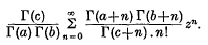
When |z| = 1 in the domain |arg(−z)| <π, this series converges2 to F(a; b; c; z) if R(a+b−c) < 0 (integral values of a, b and c are excluded in the present paper).
M. Audin Spinning Tops (Cambridge Studies in Advanced Mathematics Vol. 51, Cambridge University Press, Cambridge, 1996), viii + 139pp., 0 521 56129 9, (hardback) £25 (US$34.95).
-
- Journal:
- Proceedings of the Edinburgh Mathematical Society / Volume 41 / Issue 1 / February 1998
- Published online by Cambridge University Press:
- 20 January 2009, pp. 211-213
-
- Article
-
- You have access
- Export citation
List of Members
-
- Journal:
- Proceedings of the Edinburgh Mathematical Society / Volume 36 / February 1917
- Published online by Cambridge University Press:
- 20 January 2009, pp. 117-124
-
- Article
-
- You have access
- Export citation
Submodules of Specht modules for Weyl groups
-
- Journal:
- Proceedings of the Edinburgh Mathematical Society / Volume 39 / Issue 1 / February 1996
- Published online by Cambridge University Press:
- 20 January 2009, pp. 43-50
-
- Article
-
- You have access
- Export citation
Finiteness at infinity
-
- Journal:
- Proceedings of the Edinburgh Mathematical Society / Volume 17 / Issue 4 / December 1971
- Published online by Cambridge University Press:
- 20 January 2009, pp. 299-304
-
- Article
-
- You have access
- Export citation
On Determinants with, p-termed elements
-
- Journal:
- Proceedings of the Edinburgh Mathematical Society / Volume 2 / February 1883
- Published online by Cambridge University Press:
- 20 January 2009, p. 4
-
- Article
-
- You have access
- Export citation
Mean value properties of generalised eigenfunctions†
-
- Journal:
- Proceedings of the Edinburgh Mathematical Society / Volume 17 / Issue 2 / December 1970
- Published online by Cambridge University Press:
- 20 January 2009, pp. 155-158
-
- Article
-
- You have access
- Export citation
Theorems on Summation of Series
-
- Journal:
- Proceedings of the Edinburgh Mathematical Society / Volume 27 / February 1909
- Published online by Cambridge University Press:
- 20 January 2009, pp. 64-66
-
- Article
-
- You have access
- Export citation
-
1. Theorem I. If
 , where a and n are positive integers, and if f(n) is a finite single-valued function of n for values of n蠇a, then
 , where a and n are positive integers, and if f(n) is a finite single-valued function of n for values of n蠇a, then
The asymptotic distribution of the eigenvalues of multiparameter Sturm–Liouville systems II
-
- Journal:
- Proceedings of the Edinburgh Mathematical Society / Volume 37 / Issue 2 / June 1994
- Published online by Cambridge University Press:
- 20 January 2009, pp. 301-316
-
- Article
-
- You have access
- Export citation
