Refine search
Actions for selected content:
26079 results in Abstract analysis
On the algebra generated by a Hermitian operator
-
- Journal:
- Proceedings of the Edinburgh Mathematical Society / Volume 18 / Issue 2 / December 1972
- Published online by Cambridge University Press:
- 20 January 2009, pp. 89-91
-
- Article
-
- You have access
- Export citation
On the non-existence of L2 solutions of a class of non-linear differential equations†
-
- Journal:
- Proceedings of the Edinburgh Mathematical Society / Volume 14 / Issue 4 / December 1965
- Published online by Cambridge University Press:
- 20 January 2009, pp. 257-268
-
- Article
-
- You have access
- Export citation
-
In 1950, Wintner (11) showed that if the function f(x) is continuous on the half-line [0, ∞) and, in a certain sense, is “ small when x is large ” then the differential equation

does not have L2 solutions, where the function y(x) satisfying (1) is called an L2 solution if

Properties connected with the Angular Bisectors of a Triangle
-
- Journal:
- Proceedings of the Edinburgh Mathematical Society / Volume 13 / February 1894
- Published online by Cambridge University Press:
- 20 January 2009, pp. 37-102
-
- Article
-
- You have access
- Export citation
On the oscillation of solutions of certain linear differential equations in the complex domain
-
- Journal:
- Proceedings of the Edinburgh Mathematical Society / Volume 30 / Issue 3 / October 1987
- Published online by Cambridge University Press:
- 20 January 2009, pp. 455-469
-
- Article
-
- You have access
- Export citation
-
Our starting point is the differential equation

where A(z) is a transcendental entire function of finite order, and we are concerned specifically with the frequency of zeros of a non-trivial solution f(z) of (1.1). Of course it is well known that such a solution f(z) is an entire function of infinite order, and using standard notation from [7],
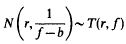
for all , b∈C\{0}, at least outside a set of r of finite measure.
Professor Arthur Erdélyi
-
- Journal:
- Proceedings of the Edinburgh Mathematical Society / Volume 22 / Issue 1 / February 1979
- Published online by Cambridge University Press:
- 20 January 2009, pp. 63-64
-
- Article
-
- You have access
- Export citation
On the Operation of Division
-
- Journal:
- Proceedings of the Edinburgh Mathematical Society / Volume 13 / February 1894
- Published online by Cambridge University Press:
- 20 January 2009, p. 146
-
- Article
-
- You have access
- Export citation
The Apolar Locus of Two Tetrads of Points on a Conic
-
- Journal:
- Proceedings of the Edinburgh Mathematical Society / Volume 36 / February 1917
- Published online by Cambridge University Press:
- 20 January 2009, pp. 84-90
-
- Article
-
- You have access
- Export citation
PEM volume 13 issue 3 Cover and Fornt matter
-
- Journal:
- Proceedings of the Edinburgh Mathematical Society / Volume 13 / Issue 3 / June 1963
- Published online by Cambridge University Press:
- 20 January 2009, pp. f1-f2
-
- Article
-
- You have access
- Export citation
Mario Petrich, Lectures in Semigroups (Wiley, 1977), 164 pp.
-
- Journal:
- Proceedings of the Edinburgh Mathematical Society / Volume 22 / Issue 1 / February 1979
- Published online by Cambridge University Press:
- 20 January 2009, pp. 71-72
-
- Article
-
- You have access
- Export citation
A Version of Hagen's Proof of the “Law of Error.”
-
- Journal:
- Proceedings of the Edinburgh Mathematical Society / Volume 38 / February 1919
- Published online by Cambridge University Press:
- 20 January 2009, pp. 24-26
-
- Article
-
- You have access
- Export citation
-
Hagen's proof (1837), as described in the 8th edition of Mansfield Merriman's “Method of Least Squares,” is based on the assumption that the error may be supposed to consist of the algebraic sum of an infinite number of infinitesimal errors of equal amount ε, each one of which is equally likely to be positive or negative. Thus if 2m is the number of the infinitesimal errors, the probability of the error x ≡ 2p ε occurring is
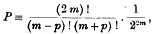
and the maximum value of P occurs when p = 0, and is
 .
.

A mathematician among the molasses barrels: Maclaurin's unpublished memoir on volumes Introduction: Maclaurin's memoir and its place in eighteenth-century Scotland
-
- Journal:
- Proceedings of the Edinburgh Mathematical Society / Volume 39 / Issue 2 / June 1996
- Published online by Cambridge University Press:
- 20 January 2009, pp. 193-240
-
- Article
-
- You have access
- Export citation
D. J. Struik (Editor), A Source Book in Mathematics, 1200–1800 (Harvard University Press; London: Oxford University Press, 1969), pp. xiv + 427, 115s.
-
- Journal:
- Proceedings of the Edinburgh Mathematical Society / Volume 17 / Issue 1 / June 1970
- Published online by Cambridge University Press:
- 20 January 2009, p. 111
-
- Article
-
- You have access
- Export citation
A note on the focal relations of a bicircular quartic
-
- Journal:
- Proceedings of the Edinburgh Mathematical Society / Volume 19 / February 1900
- Published online by Cambridge University Press:
- 20 January 2009, p. 66
-
- Article
-
- You have access
- Export citation
Boundary problems for Riccati and Lyapunov equations
-
- Journal:
- Proceedings of the Edinburgh Mathematical Society / Volume 29 / Issue 1 / February 1986
- Published online by Cambridge University Press:
- 20 January 2009, pp. 15-21
-
- Article
-
- You have access
- Export citation
-
The resolution problem of the system

where U(t), A, B, D and Uo are bounded linear operators on H and B* denotes the adjoint operator of B, arises in control theory, [9], transport theory, [12], and filtering problems, [3]. The finite-dimensional case has been introduced in [6,7], and several authors have studied the infinite-dimensional case, [4], [13], [18]. A recent paper, [17],studies the finite dimensional boundary problem

where t ∈[0,b].In this paper we consider the more general boundary problem

where all operators which appear in (1.2) are bounded linear operators on a separable Hilbert space H. Note that we do not suppose C = −B* and the boundary condition in (1.2) is more general than the boundary condition in (1.1).
PEM volume 42 issue 2 Cover and Back matter
-
- Journal:
- Proceedings of the Edinburgh Mathematical Society / Volume 42 / Issue 2 / June 1999
- Published online by Cambridge University Press:
- 20 January 2009, pp. b1-b2
-
- Article
-
- You have access
- Export citation
On the application of the operational calculus to the expansion of a function in a series of Legendre's functions of the second kind
-
- Journal:
- Proceedings of the Edinburgh Mathematical Society / Volume 7 / Issue 1 / October 1942
- Published online by Cambridge University Press:
- 20 January 2009, pp. 1-2
-
- Article
-
- You have access
- Export citation
-
In the present note we shall obtain the expansion in a series of Legendre functions of the second kind of an integral function φ (ω) represented by Laplace's integral

where f (x) is an analytic function of x, regular in the circle

where an are constants and qn (ω) = in+1Qn (iω).
A geometrical theorem and the resultant of two binary forms
-
- Journal:
- Proceedings of the Edinburgh Mathematical Society / Volume 2 / Issue 1 / January 1930
- Published online by Cambridge University Press:
- 20 January 2009, pp. 55-60
-
- Article
-
- You have access
- Export citation
Geometrical Notes
-
- Journal:
- Proceedings of the Edinburgh Mathematical Society / Volume 3 / February 1884
- Published online by Cambridge University Press:
- 20 January 2009, pp. 38-42
-
- Article
-
- You have access
- Export citation
An application of the spread relation to differential equations
-
- Journal:
- Proceedings of the Edinburgh Mathematical Society / Volume 36 / Issue 2 / June 1993
- Published online by Cambridge University Press:
- 20 January 2009, pp. 211-229
-
- Article
-
- You have access
- Export citation
On the mean convergence of Markov operators
-
- Journal:
- Proceedings of the Edinburgh Mathematical Society / Volume 19 / Issue 2 / September 1974
- Published online by Cambridge University Press:
- 20 January 2009, pp. 205-209
-
- Article
-
- You have access
- Export citation
-
Throughout the paper, T will be a Markov operator on C(X) (X compact T2), i.e. a continuous positive operator such that Te = e (e the unit function). P will be the set of Borel probability measures on X, which we shall often think of as linear functionals on C(X), and
 , where T' is the adjoint of T. Let
 , where T' is the adjoint of T. Let
