Refine search
Actions for selected content:
26079 results in Abstract analysis
The “Fourier” Theory of the Cardinal Function
-
- Journal:
- Proceedings of the Edinburgh Mathematical Society / Volume 1 / Issue 3 / July 1928
- Published online by Cambridge University Press:
- 20 January 2009, pp. 169-176
-
- Article
-
- You have access
- Export citation
-
The generalised Riesz-Fischer theorem states that if

is convergent, with 1 < p ≤ 2, then

is the Fourier series of a function of class
 . When p > 2 the series (2) is not necessarily a Fourier series; neither is it necessarily a Fourier D-series. It will be shown below that it must however be what may be called a “Fourier Stieltjes” series. That is to say, the condition (1) with (p > 1) implies that there is a continuous function F (x) such that
 . When p > 2 the series (2) is not necessarily a Fourier series; neither is it necessarily a Fourier D-series. It will be shown below that it must however be what may be called a “Fourier Stieltjes” series. That is to say, the condition (1) with (p > 1) implies that there is a continuous function F (x) such that
On the foundations of inverse monoids and inverse algebras
-
- Journal:
- Proceedings of the Edinburgh Mathematical Society / Volume 41 / Issue 1 / February 1998
- Published online by Cambridge University Press:
- 20 January 2009, pp. 1-21
-
- Article
-
- You have access
- Export citation
PEM volume 29 Back matter
-
- Journal:
- Proceedings of the Edinburgh Mathematical Society / Volume 29 / February 1910
- Published online by Cambridge University Press:
- 20 January 2009, pp. b1-b8
-
- Article
-
- You have access
- Export citation
Nina K. Bari, A Treatise on Trigonometric Series (Pergamon Press, 1964), Volume I, xxiii+553 pp., 84s.; Volume II, xix+508 pp., 105s.
-
- Journal:
- Proceedings of the Edinburgh Mathematical Society / Volume 15 / Issue 4 / December 1967
- Published online by Cambridge University Press:
- 20 January 2009, pp. 321-322
-
- Article
-
- You have access
- Export citation
The hypercore of a semigroup
-
- Journal:
- Proceedings of the Edinburgh Mathematical Society / Volume 28 / Issue 1 / February 1985
- Published online by Cambridge University Press:
- 20 January 2009, pp. 107-112
-
- Article
-
- You have access
- Export citation
A further necessary and sufficient condition for strong convergence of nonlinear contraction semigroups and of iterative methods for accretive operators in Banach spaces
-
- Journal:
- Proceedings of the Edinburgh Mathematical Society / Volume 38 / Issue 1 / February 1995
- Published online by Cambridge University Press:
- 20 January 2009, pp. 1-12
-
- Article
-
- You have access
- Export citation
Convexity and generalized Bernstein polynomials
-
- Journal:
- Proceedings of the Edinburgh Mathematical Society / Volume 42 / Issue 1 / February 1999
- Published online by Cambridge University Press:
- 20 January 2009, pp. 179-190
-
- Article
-
- You have access
- Export citation
-
In a recent generalization of the Bernstein polynomials, the approximated function f is evaluated at points spaced at intervals which are in geometric progression on [0, 1], instead of at equally spaced points. For each positive integer n, this replaces the single polynomial Bnf by a one-parameter family of polynomials
 , where 0 < q ≤ 1. This paper summarizes briefly the previously known results concerning these generalized Bernstein polynomials and gives new results concerning
  when f is a monomial. The main results of the paper are obtained by using the concept of total positivity. It is shown that if f is increasing then
  is increasing, and if f is convex then
  is convex, generalizing well known results when q = 1. It is also shown that if f is convex then, for any positive integer n
 This supplements the well known classical result that
  when f is convex.
 , where 0 < q ≤ 1. This paper summarizes briefly the previously known results concerning these generalized Bernstein polynomials and gives new results concerning
  when f is a monomial. The main results of the paper are obtained by using the concept of total positivity. It is shown that if f is increasing then
  is increasing, and if f is convex then
  is convex, generalizing well known results when q = 1. It is also shown that if f is convex then, for any positive integer n
 This supplements the well known classical result that
  when f is convex.
H. L. Alder and E. B. Roessler, Introduction to Probability and Statistics (2nd edition) (W. H. Freeman & Co., San Francisco & London, 1962), xii + 289 pp., 32s.
-
- Journal:
- Proceedings of the Edinburgh Mathematical Society / Volume 13 / Issue 3 / June 1963
- Published online by Cambridge University Press:
- 20 January 2009, p. 263
-
- Article
-
- You have access
- Export citation
Generalised quaternion groups and distributively generated near-rings
-
- Journal:
- Proceedings of the Edinburgh Mathematical Society / Volume 18 / Issue 3 / June 1973
- Published online by Cambridge University Press:
- 20 January 2009, p. 234
-
- Article
-
- You have access
- Export citation
Thirty-Eighth Session, 1919–20
-
- Journal:
- Proceedings of the Edinburgh Mathematical Society / Volume 38 / February 1919
- Published online by Cambridge University Press:
- 20 January 2009, pp. v-vi
-
- Article
-
- You have access
- Export citation
A class of finite groups with zero deficiency
-
- Journal:
- Proceedings of the Edinburgh Mathematical Society / Volume 19 / Issue 1 / March 1974
- Published online by Cambridge University Press:
- 20 January 2009, pp. 25-29
-
- Article
-
- You have access
- Export citation
On well-bounded operators of type (B)
-
- Journal:
- Proceedings of the Edinburgh Mathematical Society / Volume 18 / Issue 1 / June 1972
- Published online by Cambridge University Press:
- 20 January 2009, pp. 35-48
-
- Article
-
- You have access
- Export citation
PEM volume 11 issue 3 Cover and Front matter
-
- Journal:
- Proceedings of the Edinburgh Mathematical Society / Volume 11 / Issue 3 / May 1959
- Published online by Cambridge University Press:
- 20 January 2009, pp. f1-f2
-
- Article
-
- You have access
- Export citation
Alternative Proof of a Theorem in Change of Axes
-
- Journal:
- Proceedings of the Edinburgh Mathematical Society / Volume 19 / February 1900
- Published online by Cambridge University Press:
- 20 January 2009, pp. 5-6
-
- Article
-
- You have access
- Export citation
-
If by any change of axes ax2 + 2hxy + by2 by changed into a′x′2 + 2h′x′y′ + b′y′2, then will
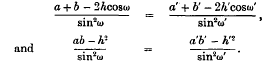
J. M. Hyslop, Real Variable (University Mathematical Texts Series, Oliver and Boyd, 1960), viii + 136 pp., 8s. 6d.
-
- Journal:
- Proceedings of the Edinburgh Mathematical Society / Volume 12 / Issue 3 / June 1961
- Published online by Cambridge University Press:
- 20 January 2009, p. 160
-
- Article
-
- You have access
- Export citation
A sharpening of the Berkson-Glickfeld theorem
-
- Journal:
- Proceedings of the Edinburgh Mathematical Society / Volume 26 / Issue 2 / June 1983
- Published online by Cambridge University Press:
- 20 January 2009, pp. 275-278
-
- Article
-
- You have access
- Export citation
-
It is known that if in a Banach*-algebra with unit the following holds:

then it is a C*-algebra (see [3]).
We shall show that the above theorem can be sharpened in the following way: we replace the submultiplicativity of the norm by the weaker assumption

Observe that under this assumption even the existence of exp(ih) is not at all obvious, but it will be proved to be true below. Our main result is Theorem 2 which depends on Theorem 1. Our last remark is the equivalent-norm-version of the statement.
Radicals of rings and their subrings
-
- Journal:
- Proceedings of the Edinburgh Mathematical Society / Volume 24 / Issue 3 / October 1981
- Published online by Cambridge University Press:
- 20 January 2009, pp. 209-215
-
- Article
-
- You have access
- Export citation
A note on approximation by rational functions
-
- Journal:
- Proceedings of the Edinburgh Mathematical Society / Volume 7 / Issue 3 / February 1946
- Published online by Cambridge University Press:
- 20 January 2009, pp. 123-133
-
- Article
-
- You have access
- Export citation
P. J. Glblin, Graphs, Surfaces and Homology: Introduction to Algebraic Topology (Chapman and Hall, 1977), xv + 329 pp., £4·95.
-
- Journal:
- Proceedings of the Edinburgh Mathematical Society / Volume 20 / Issue 4 / September 1977
- Published online by Cambridge University Press:
- 20 January 2009, p. 368
-
- Article
-
- You have access
- Export citation
A special net of quadrics
-
- Journal:
- Proceedings of the Edinburgh Mathematical Society / Volume 4 / Issue 4 / April 1936
- Published online by Cambridge University Press:
- 20 January 2009, pp. 185-209
-
- Article
-
- You have access
- Export citation
