Refine search
Actions for selected content:
26079 results in Abstract analysis
J. A. Rose A course on group theory (Cambridge University Press, 1978), 310 pp., cloth £19.75, paper £8.25.
-
- Journal:
- Proceedings of the Edinburgh Mathematical Society / Volume 26 / Issue 1 / February 1983
- Published online by Cambridge University Press:
- 20 January 2009, pp. 118-119
-
- Article
-
- You have access
- Export citation
Note on a paper by Singh and Dhaliwal
-
- Journal:
- Proceedings of the Edinburgh Mathematical Society / Volume 24 / Issue 2 / June 1981
- Published online by Cambridge University Press:
- 20 January 2009, p. 81
-
- Article
-
- You have access
- Export citation
Engel-like elements in infinite soluble groups
-
- Journal:
- Proceedings of the Edinburgh Mathematical Society / Volume 32 / Issue 3 / October 1989
- Published online by Cambridge University Press:
- 20 January 2009, pp. 337-343
-
- Article
-
- You have access
- Export citation
Presents to the Library
-
- Journal:
- Proceedings of the Edinburgh Mathematical Society / Volume 5 / Issue 4 / September 1938
- Published online by Cambridge University Press:
- 20 January 2009, pp. 223-224
-
- Article
-
- You have access
- Export citation
Seth Warner, Modern Algebra (Prentice-Hall, Inc., 1965), two volumes, 806 pp.
-
- Journal:
- Proceedings of the Edinburgh Mathematical Society / Volume 15 / Issue 4 / December 1967
- Published online by Cambridge University Press:
- 20 January 2009, p. 327
-
- Article
-
- You have access
- Export citation
PEM volume 8 issue 4 Cover and Front matter
-
- Journal:
- Proceedings of the Edinburgh Mathematical Society / Volume 8 / Issue 4 / October 1950
- Published online by Cambridge University Press:
- 20 January 2009, pp. f1-f2
-
- Article
-
- You have access
- Export citation
PEM volume 27 issue 2 Cover and Back matter
-
- Journal:
- Proceedings of the Edinburgh Mathematical Society / Volume 27 / Issue 2 / June 1984
- Published online by Cambridge University Press:
- 20 January 2009, p. b1
-
- Article
-
- You have access
- Export citation
Matrices with finite period
-
- Journal:
- Proceedings of the Edinburgh Mathematical Society / Volume 6 / Issue 3 / August 1940
- Published online by Cambridge University Press:
- 20 January 2009, pp. 128-134
-
- Article
-
- You have access
- Export citation
-
The study of the primitive solutions of the equation

where A = (aij) is an n × n matrix whose elements are rational integers, was begun a long time ago. In most cases this equation occurred incidentally in another theory; for instance Jordan encountered it in connection with linear differential equations having algebraic solutions, Minkowski in connection with quadratic forms and Turnbull in geometry. An important fact about these matrices is that any unimodular matrix can be represented as the product of matrices with finite period.
On the Arithmetic and Geometric Means Inequality
-
- Journal:
- Proceedings of the Edinburgh Mathematical Society / Volume 25 / February 1906
- Published online by Cambridge University Press:
- 20 January 2009, pp. 46-47
-
- Article
-
- You have access
- Export citation
-
Let a and b be positive and unequal; and let x be their arithmetic mean. Then we have the following equality and inequality

The inequality is tantamount to the fact that the G.M. of a and b is less than the A.M.

McLean, W. Strongly elliptic systems and boundary integral equations (Cambridge University Press, 2000), xiv+357 pp., 0 521 66375 X (paperback), £20.95 (US$32.95)
-
- Journal:
- Proceedings of the Edinburgh Mathematical Society / Volume 44 / Issue 3 / October 2001
- Published online by Cambridge University Press:
- 20 January 2009, pp. 664-665
-
- Article
-
- You have access
- Export citation
The Propagation of a Constant Strength Shock through a Simple Wave
-
- Journal:
- Proceedings of the Edinburgh Mathematical Society / Volume 13 / Issue 4 / December 1963
- Published online by Cambridge University Press:
- 20 January 2009, pp. 277-284
-
- Article
-
- You have access
- Export citation
Primary decomposition in enveloping algebras
-
- Journal:
- Proceedings of the Edinburgh Mathematical Society / Volume 24 / Issue 2 / June 1981
- Published online by Cambridge University Press:
- 20 January 2009, pp. 83-85
-
- Article
-
- You have access
- Export citation
Zubov's condition revisited
-
- Journal:
- Proceedings of the Edinburgh Mathematical Society / Volume 26 / Issue 2 / June 1983
- Published online by Cambridge University Press:
- 20 January 2009, pp. 253-257
-
- Article
-
- You have access
- Export citation
PEM volume 37 issue 2 Cover and Back matter
-
- Journal:
- Proceedings of the Edinburgh Mathematical Society / Volume 37 / Issue 2 / June 1994
- Published online by Cambridge University Press:
- 20 January 2009, p. b1
-
- Article
-
- You have access
- Export citation
On the Continued Fractions associated with the Hypergeometric Equation
-
- Journal:
- Proceedings of the Edinburgh Mathematical Society / Volume 34 / February 1915
- Published online by Cambridge University Press:
- 20 January 2009, pp. 146-154
-
- Article
-
- You have access
- Export citation
P. M. Neumann, G. A. Stoy and E. C. Thompson Groups and geometry (Oxford University Press, Oxford1994), x + 254 pp., hardback 0 19 853452 3, £40; paper 0 19 853451 5, £19.50.
-
- Journal:
- Proceedings of the Edinburgh Mathematical Society / Volume 38 / Issue 1 / February 1995
- Published online by Cambridge University Press:
- 20 January 2009, pp. 190-191
-
- Article
-
- You have access
- Export citation
Approximation by partial isometries
-
- Journal:
- Proceedings of the Edinburgh Mathematical Society / Volume 29 / Issue 2 / June 1986
- Published online by Cambridge University Press:
- 20 January 2009, pp. 255-261
-
- Article
-
- You have access
- Export citation
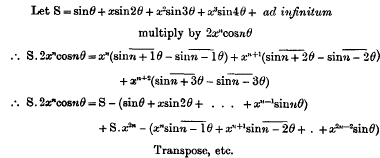
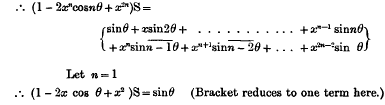
The Factorisation of l–2xncosa + x2n
-
- Journal:
- Proceedings of the Edinburgh Mathematical Society / Volume 15 / February 1896
- Published online by Cambridge University Press:
- 20 January 2009, p. 97
-
- Article
-
- You have access
- Export citation
-
On the real Common Chords of a Point Circle and Ellipse
-
- Journal:
- Proceedings of the Edinburgh Mathematical Society / Volume 13 / February 1894
- Published online by Cambridge University Press:
- 20 January 2009, pp. 105-111
-
- Article
-
- You have access
- Export citation
ASPHERICAL LABELLED ORIENTED TREES AND KNOTS
-
- Journal:
- Proceedings of the Edinburgh Mathematical Society / Volume 44 / Issue 2 / June 2001
- Published online by Cambridge University Press:
- 20 January 2009, pp. 285-294
-
- Article
-
- You have access
- Export citation
