Refine search
Actions for selected content:
26079 results in Abstract analysis
D. W. Jordan and P. Smith, Nonlinear Ordinary Differential Equations (Oxford Applied Mathematics and Computing Series), 360 pp, £12.00 (hard cover)
-
- Journal:
- Proceedings of the Edinburgh Mathematical Society / Volume 22 / Issue 1 / February 1979
- Published online by Cambridge University Press:
- 20 January 2009, p. 71
-
- Article
-
- You have access
- Export citation
Hypoelliptic differential operators with generalized constant coefficients
-
- Journal:
- Proceedings of the Edinburgh Mathematical Society / Volume 41 / Issue 1 / February 1998
- Published online by Cambridge University Press:
- 20 January 2009, pp. 47-60
-
- Article
-
- You have access
- Export citation
-
The space
 of Colombeau generalized functions is used as a frame for the study of hypoellipticity of a family of differential operators whose coefficients depend on a small parameter ε.
There are given necessary and sufficient conditions for the hypoellipticity of a family of differential operators with constant coefficients which depend on ε and behave like powers of ε as ε→0. The solutions of such family of equations should also satisfy the power order estimate with respect to ε.
 of Colombeau generalized functions is used as a frame for the study of hypoellipticity of a family of differential operators whose coefficients depend on a small parameter ε.
Three examples concerning the ore condition in Noetherian rings
-
- Journal:
- Proceedings of the Edinburgh Mathematical Society / Volume 23 / Issue 2 / June 1980
- Published online by Cambridge University Press:
- 20 January 2009, pp. 187-192
-
- Article
-
- You have access
- Export citation
Certain Expansions of xn in Hypergeometric Series
-
- Journal:
- Proceedings of the Edinburgh Mathematical Society / Volume 15 / February 1896
- Published online by Cambridge University Press:
- 20 January 2009, pp. 90-96
-
- Article
-
- You have access
- Export citation
-
In this paper the following expansion will be obtained:
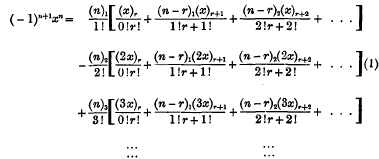
in which n and r are positive integers. The Series in the square brackets are Hypergeometric Series with a finite number of terms.
Index according to subjects
-
- Journal:
- Proceedings of the Edinburgh Mathematical Society / Volume 10 / Issue 4 / June 1957
- Published online by Cambridge University Press:
- 20 January 2009, p. 190
-
- Article
-
- You have access
- Export citation
Action at a distance, and the transmission of stress by isotropic elastio solid media
-
- Journal:
- Proceedings of the Edinburgh Mathematical Society / Volume 11 / February 1892
- Published online by Cambridge University Press:
- 20 January 2009, pp. 107-130
-
- Article
-
- You have access
- Export citation
A Construction for the Brocard Points
-
- Journal:
- Proceedings of the Edinburgh Mathematical Society / Volume 6 / February 1887
- Published online by Cambridge University Press:
- 20 January 2009, p. 88
-
- Article
-
- You have access
- Export citation
The intersection of certain quadrics
-
- Journal:
- Proceedings of the Edinburgh Mathematical Society / Volume 5 / Issue 3 / February 1938
- Published online by Cambridge University Press:
- 20 January 2009, pp. 125-150
-
- Article
-
- You have access
- Export citation
-
We investigate in this paper a certain special family of quadric varieties, that is of
 in [R]. Now among the more important properties of a quadric in [R] is that it possesses a system or systems of “ generators,” i.e., the quadric may be taken as the locus of certain families of subspaces, the behaviour of these depending on the parity of R. If R is even, a quadric V2n–1 in [2n] contains a single family of [n—l]'s, so it seems likely that in discussing special families of quadrics in [2n] an important type will be obtained by constraining the quadric to pass through a number of [n — l]'s.
 in [R]. Now among the more important properties of a quadric in [R] is that it possesses a system or systems of “ generators,” i.e., the quadric may be taken as the locus of certain families of subspaces, the behaviour of these depending on the parity of R. If R is even, a quadric V
ZT-subgroups of sharply 3-transitive groups
-
- Journal:
- Proceedings of the Edinburgh Mathematical Society / Volume 23 / Issue 1 / February 1980
- Published online by Cambridge University Press:
- 20 January 2009, pp. 9-14
-
- Article
-
- You have access
- Export citation
The distribution of irreducible polynomials in several indeterminates over a finite field
-
- Journal:
- Proceedings of the Edinburgh Mathematical Society / Volume 16 / Issue 1 / June 1968
- Published online by Cambridge University Press:
- 20 January 2009, pp. 1-17
-
- Article
-
- You have access
- Export citation
G. Springer, Introduction to Riemann Surfaces (Addison-Wesley, Reading, Mass., 1958), pp. viii + 305, 76s.
-
- Journal:
- Proceedings of the Edinburgh Mathematical Society / Volume 11 / Issue 3 / May 1959
- Published online by Cambridge University Press:
- 20 January 2009, p. 185
-
- Article
-
- You have access
- Export citation
The Condensation of Continuants
-
- Journal:
- Proceedings of the Edinburgh Mathematical Society / Volume 23 / February 1904
- Published online by Cambridge University Press:
- 20 January 2009, pp. 35-39
-
- Article
-
- You have access
- Export citation
Minimal permutation representations of the two double covers of Sn
-
- Journal:
- Proceedings of the Edinburgh Mathematical Society / Volume 39 / Issue 2 / June 1996
- Published online by Cambridge University Press:
- 20 January 2009, pp. 285-289
-
- Article
-
- You have access
- Export citation
Compact subsemigroups of (βℕ, +) containing the idempotents
-
- Journal:
- Proceedings of the Edinburgh Mathematical Society / Volume 39 / Issue 2 / June 1996
- Published online by Cambridge University Press:
- 20 January 2009, pp. 291-307
-
- Article
-
- You have access
- Export citation
On rings with quasi-injective cyclic modules
-
- Journal:
- Proceedings of the Edinburgh Mathematical Society / Volume 19 / Issue 2 / September 1974
- Published online by Cambridge University Press:
- 20 January 2009, pp. 139-145
-
- Article
-
- You have access
- Export citation
Étude sur le Triangle et sur certains points de Géométrographie
-
- Journal:
- Proceedings of the Edinburgh Mathematical Society / Volume 13 / February 1894
- Published online by Cambridge University Press:
- 20 January 2009, pp. 2-25
-
- Article
-
- You have access
- Export citation
Elements of finite order in Stone-Čech compactifications
-
- Journal:
- Proceedings of the Edinburgh Mathematical Society / Volume 36 / Issue 1 / February 1993
- Published online by Cambridge University Press:
- 20 January 2009, pp. 49-54
-
- Article
-
- You have access
- Export citation
Explicit solutions for a system of coupled Lyapunov differential matrix equations
-
- Journal:
- Proceedings of the Edinburgh Mathematical Society / Volume 30 / Issue 3 / October 1987
- Published online by Cambridge University Press:
- 20 January 2009, pp. 427-434
-
- Article
-
- You have access
- Export citation
-
This paper is concerned with the problem of obtaining explicit expressions of solutions of a system of coupled Lyapunov matrix differential equations of the type

where Fi, Ai(t), Bi(t), Ci(t) and Dij(t) are m×m complex matrices (members of ℂm×m), for 1≦i, j≦N, and t in the interval [a,b]. When the coefficient matrices of (1.1) are timeinvariant, Dij are scalar multiples of the identity matrix of the type Dij=dijI, where dij are real positive numbers, for 1≦i, j≦N Ci, is the transposed matrix of Bi and Fi = 0, for 1≦i≦N, the Cauchy problem (1.1) arises in control theory of continuous-time jump linear quadratic systems [9–11]. Algorithms for solving the above particular case can be found in [12]]. These methods yield approximations to the solution. Without knowing the explicit expression of the solutions and in order to avoid the error accumulation it is interesting to know an explicit expression for the exact solution. In Section 2, we obtain an explicit expression of the solution of the Cauchy problem (1.1) and of two-point boundary value problems related to the system arising in (1.1). Stability conditions for the solutions of the system of (1.1) are given. Because of developed techniques this paper can be regarded as a continuation of the sequence [3, 4, 5, 6].
Note II.—The Ambiguous Case
-
- Journal:
- Proceedings of the Edinburgh Mathematical Society / Volume 41 / February 1922
- Published online by Cambridge University Press:
- 20 January 2009, pp. 149-151
-
- Article
-
- You have access
- Export citation
On Integral Transforms
-
- Journal:
- Proceedings of the Edinburgh Mathematical Society / Volume 10 / Issue 3 / January 1956
- Published online by Cambridge University Press:
- 20 January 2009, pp. 125-128
-
- Article
-
- You have access
- Export citation
-
Titchmarsh and others [4] havo studied integral transform pairs of tho type
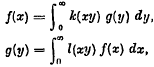
showing how such pairs may be generated as a consequence of the relation which holds between the Mellin transforms of the kernels.
