Refine search
Actions for selected content:
26079 results in Abstract analysis
Some cyclic inequalities
-
- Journal:
- Proceedings of the Edinburgh Mathematical Society / Volume 19 / Issue 2 / September 1974
- Published online by Cambridge University Press:
- 20 January 2009, pp. 115-118
-
- Article
-
- You have access
- Export citation
-
In this note we prove some cyclic inequalities which are generalisations of known results. We shall assume throughout that ai+n = ai ≧ 0 for all i, that no denominator in the statement of a result vanishes and finally that p, m and q are positive integers. We shall also use A(i, m) to denote
 with the convention that A(i, 0) = 0. The most interesting of our results is probably Theorem 2 since, in the special case p = 1, m = 2, r = 0, it gives a lower bound of ⅓n for the Shapiro sum
 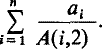 . Although it is by no means best possible, see (2), our method implicitly gives a really simple way of obtaining this lower bound which, incidentally, is an improvement on Rankin's original result (5).
 with the convention that A(i, 0) = 0. The most interesting of our results is probably Theorem 2 since, in the special case p = 1, m = 2, r = 0, it gives a lower bound of ⅓n for the Shapiro sum
  . Although it is by no means best possible, see (
A Proof of Kirkman's Hypothesis
-
- Journal:
- Proceedings of the Edinburgh Mathematical Society / Volume 13 / Issue 2 / December 1962
- Published online by Cambridge University Press:
- 20 January 2009, pp. 131-138
-
- Article
-
- You have access
- Export citation
PEM volume 27 issue 3 Cover and Fornt matter
-
- Journal:
- Proceedings of the Edinburgh Mathematical Society / Volume 27 / Issue 3 / October 1984
- Published online by Cambridge University Press:
- 20 January 2009, pp. f1-f2
-
- Article
-
- You have access
- Export citation
PEM volume 16 issue 4 Cover and Front matter
-
- Journal:
- Proceedings of the Edinburgh Mathematical Society / Volume 16 / Issue 4 / December 1969
- Published online by Cambridge University Press:
- 20 January 2009, pp. f1-f2
-
- Article
-
- You have access
- Export citation
Examples in the Geometry of Cross Ratios
-
- Journal:
- Proceedings of the Edinburgh Mathematical Society / Volume 26 / February 1907
- Published online by Cambridge University Press:
- 20 January 2009, pp. 37-45
-
- Article
-
- You have access
- Export citation
An Exercise on Logarithmic Tables
-
- Journal:
- Proceedings of the Edinburgh Mathematical Society / Volume 5 / February 1886
- Published online by Cambridge University Press:
- 20 January 2009, pp. 101-102
-
- Article
-
- You have access
- Export citation
-
In reducing some experiments, I noticed that the logarithm of 237 is about 2.37 …. Hence it occurred to me to find in what cases the figures of a number and of its common logarithm are identical:—i.e., to solve the equation

where m is any positive integer.

On the Rearrangement of Terms in a Complex Series
-
- Journal:
- Proceedings of the Edinburgh Mathematical Society / Volume 43 / February 1924
- Published online by Cambridge University Press:
- 20 January 2009, pp. 85-91
-
- Article
-
- You have access
- Export citation
The Focal Circles of Circular Cubics
-
- Journal:
- Proceedings of the Edinburgh Mathematical Society / Volume 29 / February 1910
- Published online by Cambridge University Press:
- 20 January 2009, pp. 12-16
-
- Article
-
- You have access
- Export citation
On the number of conditions determining geometrical figures
-
- Journal:
- Proceedings of the Edinburgh Mathematical Society / Volume 3 / February 1884
- Published online by Cambridge University Press:
- 20 January 2009, pp. 22-29
-
- Article
-
- You have access
- Export citation
Upper faithful d.g. near-rings
-
- Journal:
- Proceedings of the Edinburgh Mathematical Society / Volume 26 / Issue 3 / October 1983
- Published online by Cambridge University Press:
- 20 January 2009, pp. 361-370
-
- Article
-
- You have access
- Export citation
Office-Bearers
-
- Journal:
- Proceedings of the Edinburgh Mathematical Society / Volume 5 / February 1886
- Published online by Cambridge University Press:
- 20 January 2009, p. 1
-
- Article
-
- You have access
- Export citation
Note on the method of finding the particular integral of the differential Equation

-
- Journal:
- Proceedings of the Edinburgh Mathematical Society / Volume 22 / February 1903
- Published online by Cambridge University Press:
- 20 January 2009, p. 21
-
- Article
-
- You have access
- Export citation

PEM volume 11 issue 4 Cover and Back matter
-
- Journal:
- Proceedings of the Edinburgh Mathematical Society / Volume 11 / Issue 4 / November 1959
- Published online by Cambridge University Press:
- 20 January 2009, pp. b1-b7
-
- Article
-
- You have access
- Export citation
Continuous dependence results for a class of evolution inclusions
-
- Journal:
- Proceedings of the Edinburgh Mathematical Society / Volume 35 / Issue 1 / February 1992
- Published online by Cambridge University Press:
- 20 January 2009, pp. 139-158
-
- Article
-
- You have access
- Export citation
A Note on Resultants of Equations in a Cyclic Number System
-
- Journal:
- Proceedings of the Edinburgh Mathematical Society / Volume 3 / Issue 1 / March 1932
- Published online by Cambridge University Press:
- 20 January 2009, pp. 26-29
-
- Article
-
- You have access
- Export citation
-
§ 1. Introduction. Little is known concerning the theory of resultants of equations other than in the complex number system. The cyclic number systems provide a simple example which is not a division algebra. In such a system with n units er. any number y ≡ y0 + y1e1 + y2e2 + … + yn−1en−1 has coefficients yr drawn from a field, and the units satisfy the product law:

A note on orthogonal polynomials
-
- Journal:
- Proceedings of the Edinburgh Mathematical Society / Volume 17 / Issue 1 / June 1970
- Published online by Cambridge University Press:
- 20 January 2009, pp. 83-94
-
- Article
-
- You have access
- Export citation
Existentially closed locally cofinite groups
-
- Journal:
- Proceedings of the Edinburgh Mathematical Society / Volume 35 / Issue 2 / June 1992
- Published online by Cambridge University Press:
- 20 January 2009, pp. 233-253
-
- Article
-
- You have access
- Export citation
-
Let
 be a class of finite groups. Then a c-group shall be a topological group which has a fundamental system of open neighbourhoods of the identity consisting of normal subgroups with -factor groups and trivial intersection. In this note we study groups which are existentially closed (e.c.) with respect to the class Lc of all direct limits of c-groups (where satisfies certain closure properties). We show that the so-called locally closed normal subgroups of an e.c. Lc-group are totally ordered via inclusion. Moreover it turns out that every ∀2-sentence, which is true for countable e.c. L-groups, also holds for e.c. Lc-groups. This allows it to transfer many known properties from e.c. L-groups to e.c. Lc-groups.
 be a class of finite groups. Then a c
Related representation theorems for rings, semi-rings, near-rings and semi-near-rings by partial transformations and partial endomorphisms
-
- Journal:
- Proceedings of the Edinburgh Mathematical Society / Volume 20 / Issue 4 / September 1977
- Published online by Cambridge University Press:
- 20 January 2009, pp. 307-315
-
- Article
-
- You have access
- Export citation
The structure mappings on a regular semigroup
-
- Journal:
- Proceedings of the Edinburgh Mathematical Society / Volume 21 / Issue 2 / September 1978
- Published online by Cambridge University Press:
- 20 January 2009, pp. 135-142
-
- Article
-
- You have access
- Export citation
On Errors in Determinants
-
- Journal:
- Proceedings of the Edinburgh Mathematical Society / Volume 3 / Issue 2 / July 1932
- Published online by Cambridge University Press:
- 20 January 2009, pp. 107-117
-
- Article
-
- You have access
- Export citation
-
§1. Introduction. Care is needed in dealing with determinants whose elements are subject to experimental error, particularly when a determinant itself is small compared with its first minors. For, as these examples show, a relatively tiny error in one element may be responsible for a large error in the determinant

