Refine search
Actions for selected content:
26079 results in Abstract analysis
Approximation and interpolation by complex splines on the torus
-
- Journal:
- Proceedings of the Edinburgh Mathematical Society / Volume 32 / Issue 2 / June 1989
- Published online by Cambridge University Press:
- 20 January 2009, pp. 197-212
-
- Article
-
- You have access
- Export citation
-
Let T2 = {(eix1, eix2):0 ≦ xj<2π, j=1,2} be a two dimensional torus and r, s, t and k be positive integers with k>r+s+t–2. Our main object is to study the approximation and interpolation properties of a class of smooth functions whose restrictions to each triangle of a three direction mesh lie in the linear span of
 or 0≦μ≦r–1, r+s–l≦μ+ν≦r+s+t–2, or 0≦ν≦s–1, r+s–1≦μ+ν≦r+s+t–2} Where (z1, z2) ∈ T2.
 or 0≦μ≦r–1, r+s–l≦μ+ν≦r+s+t–2, or 0≦ν≦s–1, r+s–1≦μ+ν≦r+s+t–2} Where (z
Fortieth Session, 1921–22
-
- Journal:
- Proceedings of the Edinburgh Mathematical Society / Volume 40 / February 1921
- Published online by Cambridge University Press:
- 20 January 2009, pp. v-vi
-
- Article
-
- You have access
- Export citation
R. E. Machol (ED.), Information and Decision Processes (McGraw-Hill Book Company, New York, 1960), xi + 185 pp., 46s.
-
- Journal:
- Proceedings of the Edinburgh Mathematical Society / Volume 13 / Issue 3 / June 1963
- Published online by Cambridge University Press:
- 20 January 2009, p. 263
-
- Article
-
- You have access
- Export citation
PEM volume 17 issue 1 Cover and Front matter
-
- Journal:
- Proceedings of the Edinburgh Mathematical Society / Volume 17 / Issue 1 / June 1970
- Published online by Cambridge University Press:
- 20 January 2009, pp. f1-f2
-
- Article
-
- You have access
- Export citation
A Note on the Asymptotic Expansion of a Ratio of Gamma Functions
-
- Journal:
- Proceedings of the Edinburgh Mathematical Society / Volume 15 / Issue 1 / June 1966
- Published online by Cambridge University Press:
- 20 January 2009, pp. 43-45
-
- Article
-
- You have access
- Export citation
-
Many problems in mathematical analysis require a knowledge of the asymptotic behaviour of Γ(z + α)/Γ(z + β) for large values of |z|, where α and β are bounded quantities. Tricomi and Erdélyi in (1), gave the asymptotic expansion

where the
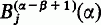 are the generalised Bernoulli polynomials, see (2), defined by
In this note, we show that if, instead of considering z to be the large variable, we consider a related large variable, (1) can be improved from a computational viewpoint.
 are the generalised Bernoulli polynomials, see
 The Irreducible Covariants belonging to the Concomitant System of Three Quadrics
-
- Journal:
- Proceedings of the Edinburgh Mathematical Society / Volume 43 / February 1924
- Published online by Cambridge University Press:
- 20 January 2009, pp. 2-16
-
- Article
-
- You have access
- Export citation
Presents to The Library
-
- Journal:
- Proceedings of the Edinburgh Mathematical Society / Volume 28 / February 1909
- Published online by Cambridge University Press:
- 20 January 2009, pp. vi-vii
-
- Article
-
- You have access
- Export citation
Margaret M. Gow, A Course in Pure Mathematics (English Universities Press, 1960), 619 pp., 40s.
-
- Journal:
- Proceedings of the Edinburgh Mathematical Society / Volume 12 / Issue 3 / June 1961
- Published online by Cambridge University Press:
- 20 January 2009, p. 166
-
- Article
-
- You have access
- Export citation
Note on a possible definition of a plane
-
- Journal:
- Proceedings of the Edinburgh Mathematical Society / Volume 10 / February 1891
- Published online by Cambridge University Press:
- 20 January 2009, p. 95
-
- Article
-
- You have access
- Export citation
R. Seydel Practical bifurcation and stability analysis: from equilibrium to chaos (2nd edition) (Interdisciplinary Applied Mathematics, Vol. 5, Springer-Verlag, Berlin-Heidelberg-New York-London-Paris-Tokyo-Hong Kong 1994), xv + 407 pp., 3 540 94316 1, £34.50.
-
- Journal:
- Proceedings of the Edinburgh Mathematical Society / Volume 39 / Issue 2 / June 1996
- Published online by Cambridge University Press:
- 20 January 2009, pp. 405-406
-
- Article
-
- You have access
- Export citation
A Pair of Dual Integral Equations Occurring in Diffraction Theory
-
- Journal:
- Proceedings of the Edinburgh Mathematical Society / Volume 13 / Issue 2 / December 1962
- Published online by Cambridge University Press:
- 20 January 2009, pp. 179-187
-
- Article
-
- You have access
- Export citation
-
Dual integral equations of the form


where f(x) and g(x) are given functions, ψ(x) is unknown, k≧0, μ, v and α are real constants, have applications to diffraction theory and also to dynamical problems in elasticity. The special cases v = −μ, α = 0 and v = μ = 0, 0<α2<1 were treated by Ahiezer (1). More recently, equations equivalent to the above were solved by Peters (2) who adapted a method used earlier by Gordon (3) for treating the (extensively studied) case μ = v, k = 0.

H. Lamb, Statics (Cambridge University Press, 1960), pp. 357 + xii, 18s. 6d.
-
- Journal:
- Proceedings of the Edinburgh Mathematical Society / Volume 12 / Issue 3 / June 1961
- Published online by Cambridge University Press:
- 20 January 2009, p. 169
-
- Article
-
- You have access
- Export citation
§7. Relations among radii
-
- Journal:
- Proceedings of the Edinburgh Mathematical Society / Volume 1 / February 1883
- Published online by Cambridge University Press:
- 20 January 2009, pp. 104-116
-
- Article
-
- You have access
- Export citation
An injective far-field pattern operator and inverse scattering problem in a finite depth ocean
-
- Journal:
- Proceedings of the Edinburgh Mathematical Society / Volume 34 / Issue 2 / June 1991
- Published online by Cambridge University Press:
- 20 January 2009, pp. 295-311
-
- Article
-
- You have access
- Export citation
PEM volume 6 Back matter and figures
-
- Journal:
- Proceedings of the Edinburgh Mathematical Society / Volume 6 / February 1887
- Published online by Cambridge University Press:
- 20 January 2009, pp. b1-b18
-
- Article
-
- You have access
- Export citation
The Effect of a Rise in Prices upon the Amount of Small Money used
-
- Journal:
- Proceedings of the Edinburgh Mathematical Society / Volume 35 / February 1916
- Published online by Cambridge University Press:
- 20 January 2009, pp. 66-73
-
- Article
-
- You have access
- Export citation
The Linear j-Differential Equation
-
- Journal:
- Proceedings of the Edinburgh Mathematical Society / Volume 14 / Issue 3 / June 1965
- Published online by Cambridge University Press:
- 20 January 2009, pp. 211-219
-
- Article
-
- You have access
- Export citation
-
The basic reciprocity of j-differential and LM-integral

for bounded functions f(x) with simple discontinuities but continuous on the left at each point and for g(x) in the somewhat restricted class B of functions of bounded variation and also left-continuous, was established in (2) and (3); the dot here indicates the lower product of
 and (jg, g+ (x+)dx), with
  , and the integral indicated is the RJDS-integral, equivalent to (LM)
  .
.
 and (jg, g
 , and the integral indicated is the RJDS-integral, equivalent to (LM)
  .
.Edward Lindsay Ince, M.A., D.Sc., F.R.S.E.
-
- Journal:
- Proceedings of the Edinburgh Mathematical Society / Volume 6 / Issue 4 / October 1941
- Published online by Cambridge University Press:
- 20 January 2009, pp. 263-264
-
- Article
-
- You have access
- Export citation
Parseval Relations for Kontorovich-Lebedev Transforms
-
- Journal:
- Proceedings of the Edinburgh Mathematical Society / Volume 13 / Issue 1 / June 1962
- Published online by Cambridge University Press:
- 20 January 2009, pp. 5-11
-
- Article
-
- You have access
- Export citation
-
The Kontorovich-Lebedev Transform of a function f(r), 0<r<∞, may be written in a general form as fg(μ) where,

A quasi-equivalence between Borel summability and convergence for Fourier-Laguerre series at the end-point
-
- Journal:
- Proceedings of the Edinburgh Mathematical Society / Volume 22 / Issue 3 / October 1979
- Published online by Cambridge University Press:
- 20 January 2009, pp. 217-226
-
- Article
-
- You have access
- Export citation
-
A suitable function f(x) 0 ≤ x < ∞, can be expanded into a Fourier series of Laguerre polynomials
 , whose interval of orthogonality is 0 ≤ x < ∞. The usual problems as to convergence and, lacking convergence, summability, and also the asymptotic behaviour of Lebesgue constants, arise for such developments. A summary of work on these convergence and summability problems, together with extensive references to the literature, can be found in the standard treatise by G. Szegö (5, especially Chapter IX) to whom many of these results are due.
 , whose interval of orthogonality is 0 ≤ x < ∞. The usual problems as to convergence and, lacking convergence, summability, and also the asymptotic behaviour of Lebesgue constants, arise for such developments. A summary of work on these convergence and summability problems, together with extensive references to the literature, can be found in the standard treatise by G. Szegö (5, especially Chapter IX) to whom many of these results are due.