Refine search
Actions for selected content:
26079 results in Abstract analysis
P. G. Baines Topographic effects in stratified flows (Cambridge University Press, 1995), xvi + 482pp., 0 521 43501 3 (hardback), £50.
-
- Journal:
- Proceedings of the Edinburgh Mathematical Society / Volume 39 / Issue 3 / October 1996
- Published online by Cambridge University Press:
- 20 January 2009, p. 593
-
- Article
-
- You have access
- Export citation
Green's functions and Riemann's method
-
- Journal:
- Proceedings of the Edinburgh Mathematical Society / Volume 14 / Issue 4 / December 1965
- Published online by Cambridge University Press:
- 20 January 2009, pp. 293-302
-
- Article
-
- You have access
- Export citation
R. L. E. Schwarzenberger N-dimensional crystallography (Pitman, Research Notes in Mathematics No. 41, 1980), £6.50.
-
- Journal:
- Proceedings of the Edinburgh Mathematical Society / Volume 25 / Issue 1 / February 1982
- Published online by Cambridge University Press:
- 20 January 2009, pp. 106-107
-
- Article
-
- You have access
- Export citation
On the Cardinal Function of Interpolation Theory
-
- Journal:
- Proceedings of the Edinburgh Mathematical Society / Volume 1 / Issue 1 / May 1927
- Published online by Cambridge University Press:
- 20 January 2009, pp. 41-46
-
- Article
-
- You have access
- Export citation
-
1. The cardinal function is the interpolation function
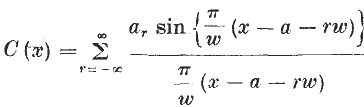
which takes the values αr at the points α + rw. Its principal properties were discovered by Professor Whittaker, amongst others that
(A) When C (x) is analysed into periodic constituents by Fourier's integral-theorem, all constituents of period less than 2w are absent.
On quotients of tensor algebras and their C*-envelopes
-
- Journal:
- Proceedings of the Edinburgh Mathematical Society / Volume 43 / Issue 2 / June 2000
- Published online by Cambridge University Press:
- 20 January 2009, pp. 361-377
-
- Article
-
- You have access
- Export citation
Semigroups of left quotients—the uniqueness problem
-
- Journal:
- Proceedings of the Edinburgh Mathematical Society / Volume 35 / Issue 2 / June 1992
- Published online by Cambridge University Press:
- 20 January 2009, pp. 213-226
-
- Article
-
- You have access
- Export citation
-
Let S be a subsemigroup of a semigroup Q. Then Q is a semigroup of left quotients of S if every element of Q can be written as a*b, where a lies in a group
 -class of Q and a* is the inverse of a in this group; in addition, we insist that every element of S satisfying a weak cancellation condition named square-cancellable lie in a subgroup of Q.
J. B. Fountain and M. Petrich gave an example of a semigroup having two non-isomorphic semigroups of left quotients. More positive results are available if we restrict the classes of semigroups from which the semigroups of left quotients may come. For example, a semigroup has at most one bisimple inverse ω-semigroup of left quotients. The crux of the matter is the restrictions to a semigroup S of Green's relations ℛ and ℒ in a semigroup of quotients of S. With this in mind we give necessary and sufficient conditions for two semigroups of left quotients of S to be isomorphic under an isomorphism fixing S pointwise.
The above result is then used to show that if R is a subring of rings Q1 and Q2 and the multiplicative subsemigroups of Q1 and Q2 are semigroups of left quotients of the multiplicative semigroup of R, then Ql and Q2 are isomorphic rings.
 -class of Q and a* is the inverse of a in this group; in addition, we insist that every element of S satisfying a weak cancellation condition named square-cancellable lie in a subgroup of Q.
Address on Celestial Photography
-
- Journal:
- Proceedings of the Edinburgh Mathematical Society / Volume 14 / February 1895
- Published online by Cambridge University Press:
- 20 January 2009, p. 26
-
- Article
-
- You have access
- Export citation
Tesselations of S2 and equations over torsion-free groups
-
- Journal:
- Proceedings of the Edinburgh Mathematical Society / Volume 38 / Issue 3 / October 1995
- Published online by Cambridge University Press:
- 20 January 2009, pp. 485-493
-
- Article
-
- You have access
- Export citation
Summation of certain Series
-
- Journal:
- Proceedings of the Edinburgh Mathematical Society / Volume 3 / February 1884
- Published online by Cambridge University Press:
- 20 January 2009, pp. 107-108
-
- Article
-
- You have access
- Export citation
Hiram Paley, AND Paul M. Weichsel, A First Course in Abstract Algebra (Holt, Rinehart and Winston, 1966), xiii+334 pp., $8.95.
-
- Journal:
- Proceedings of the Edinburgh Mathematical Society / Volume 16 / Issue 2 / December 1968
- Published online by Cambridge University Press:
- 20 January 2009, p. 181
-
- Article
-
- You have access
- Export citation
Solution of the Cubic Equation
-
- Journal:
- Proceedings of the Edinburgh Mathematical Society / Volume 24 / February 1905
- Published online by Cambridge University Press:
- 20 January 2009, pp. 20-30
-
- Article
-
- You have access
- Export citation
-
§ 1. The roots of the cubic equation

are given by the formula

This solution is of little practical use when the roots of the cubic are all real and unequal, that is, when
 is negative (the-Irreducible Case of Cardan's Solution).

 is negative (the-Irreducible Case of Cardan's Solution).
On the moduli of continuity of Hp functions with 0<p<1
-
- Journal:
- Proceedings of the Edinburgh Mathematical Society / Volume 35 / Issue 1 / February 1992
- Published online by Cambridge University Press:
- 20 January 2009, pp. 89-100
-
- Article
-
- You have access
- Export citation
Some applications of double-negation sheafification
-
- Journal:
- Proceedings of the Edinburgh Mathematical Society / Volume 20 / Issue 4 / September 1977
- Published online by Cambridge University Press:
- 20 January 2009, pp. 279-285
-
- Article
-
- You have access
- Export citation
PSL(2, q) as an image of the extended modular group with applications to group actions on surfaces
-
- Journal:
- Proceedings of the Edinburgh Mathematical Society / Volume 30 / Issue 1 / February 1987
- Published online by Cambridge University Press:
- 20 January 2009, pp. 143-151
-
- Article
-
- You have access
- Export citation
-
The modular group PSL(2, ℤ), which is isomorphic to a free product of a cyclicgroupof order 2 and a cyclic group of order 3, has many important homomorphic images. Inparticular, Macbeath [7] showed that PSL(2, q) is an image of the modular group if q ≠ 9. (Here, as usual, q is a prime power.) The extended modular group PGL(2, ℤ) contains PSL{2, ℤ) with index 2. It has a presentation

the subgroup PSL(2, ℤ) being generated by UV and VW.
On the number of elements in space
-
- Journal:
- Proceedings of the Edinburgh Mathematical Society / Volume 7 / February 1888
- Published online by Cambridge University Press:
- 20 January 2009, p. 10
-
- Article
-
- You have access
- Export citation
Yau-Chuen Wong and Kung-Fu Ng, Partially Ordered Topological Vector Spaces (Clarendon Press, Oxford, 1973), ix+217 pp.
-
- Journal:
- Proceedings of the Edinburgh Mathematical Society / Volume 19 / Issue 2 / September 1974
- Published online by Cambridge University Press:
- 20 January 2009, p. 212
-
- Article
-
- You have access
- Export citation
Maximum and Minimum
-
- Journal:
- Proceedings of the Edinburgh Mathematical Society / Volume 15 / February 1896
- Published online by Cambridge University Press:
- 20 January 2009, pp. 83-85
-
- Article
-
- You have access
- Export citation
Integral Equation Formulation of some Three Part Boundary Value Problems
-
- Journal:
- Proceedings of the Edinburgh Mathematical Society / Volume 13 / Issue 4 / December 1963
- Published online by Cambridge University Press:
- 20 January 2009, pp. 317-323
-
- Article
-
- You have access
- Export citation
PEM volume 31 issue 2 Cover and Back matter
-
- Journal:
- Proceedings of the Edinburgh Mathematical Society / Volume 31 / Issue 2 / June 1988
- Published online by Cambridge University Press:
- 20 January 2009, p. b1
-
- Article
-
- You have access
- Export citation
A. Csaszar, General topology (Adam Hilger, 1978), 488 pp., £20–50
-
- Journal:
- Proceedings of the Edinburgh Mathematical Society / Volume 22 / Issue 1 / February 1979
- Published online by Cambridge University Press:
- 20 January 2009, p. 69
-
- Article
-
- You have access
- Export citation
