Refine search
Actions for selected content:
26079 results in Abstract analysis
Analytical Note on Lines Forming a Harmonic Pencil
-
- Journal:
- Proceedings of the Edinburgh Mathematical Society / Volume 39 / February 1920
- Published online by Cambridge University Press:
- 20 January 2009, pp. 71-72
-
- Article
-
- You have access
- Export citation
End-to-end Focal Chords in an Ellipse
-
- Journal:
- Proceedings of the Edinburgh Mathematical Society / Volume 29 / February 1910
- Published online by Cambridge University Press:
- 20 January 2009, pp. 83-89
-
- Article
-
- You have access
- Export citation
-
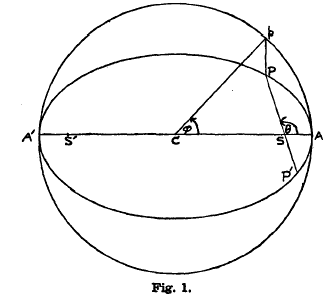
The relation between the eccentric and focal angles of P (Fig. 1) is

or, more compactly,

where



Logarithms in multiplier algebras
-
- Journal:
- Proceedings of the Edinburgh Mathematical Society / Volume 22 / Issue 3 / October 1979
- Published online by Cambridge University Press:
- 20 January 2009, pp. 187-190
-
- Article
-
- You have access
- Export citation
Note on the Researches of Maclaurin on Circular Cubics
-
- Journal:
- Proceedings of the Edinburgh Mathematical Society / Volume 30 / February 1911
- Published online by Cambridge University Press:
- 20 January 2009, pp. 89-96
-
- Article
-
- You have access
- Export citation
Problem in Plane Geometry
-
- Journal:
- Proceedings of the Edinburgh Mathematical Society / Volume 27 / February 1909
- Published online by Cambridge University Press:
- 20 January 2009, pp. 76-88
-
- Article
-
- You have access
- Export citation
Two triplets of circum-hyperbolas
-
- Journal:
- Proceedings of the Edinburgh Mathematical Society / Volume 12 / February 1893
- Published online by Cambridge University Press:
- 20 January 2009, pp. 69-75
-
- Article
-
- You have access
- Export citation
-
1. Let one of the series of circles, which can be drawn so as to touch the sides AB, AC of a triangle, touch those sides in K, L; and let AK = AL = δ.
Then the points K, L are

and the lines BL, CK are givn by

Hence eliminating δ we get for the locus of P the hyperbola

The allied hyperbolas are

Gordan's Theorem for Double Binary Forms
-
- Journal:
- Proceedings of the Edinburgh Mathematical Society / Volume 41 / February 1922
- Published online by Cambridge University Press:
- 20 January 2009, pp. 116-127
-
- Article
-
- You have access
- Export citation
Note on the Formula for tan (A+B)
-
- Journal:
- Proceedings of the Edinburgh Mathematical Society / Volume 14 / February 1895
- Published online by Cambridge University Press:
- 20 January 2009, p. 122
-
- Article
-
- You have access
- Export citation
-
From the figure we have at once
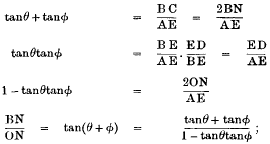
similarly

PEM volume 7 figures
-
- Journal:
- Proceedings of the Edinburgh Mathematical Society / Volume 7 / February 1888
- Published online by Cambridge University Press:
- 20 January 2009, pp. b1-b3
-
- Article
-
- You have access
- Export citation
PEM volume 1 issue 3 Cover and Front matter
-
- Journal:
- Proceedings of the Edinburgh Mathematical Society / Volume 1 / Issue 3 / July 1928
- Published online by Cambridge University Press:
- 20 January 2009, pp. f1-f2
-
- Article
-
- You have access
- Export citation
L. Fox (Editor), Numerical Solution of Ordinary and Partial Differential Equations (Pergamon Press, 1962), x+509 pp., 70s.
-
- Journal:
- Proceedings of the Edinburgh Mathematical Society / Volume 13 / Issue 2 / December 1962
- Published online by Cambridge University Press:
- 20 January 2009, p. 200
-
- Article
-
- You have access
- Export citation
Local invariance of free topological groups
-
- Journal:
- Proceedings of the Edinburgh Mathematical Society / Volume 29 / Issue 1 / February 1986
- Published online by Cambridge University Press:
- 20 January 2009, pp. 1-5
-
- Article
-
- You have access
- Export citation
Modular correspondences on X(11)
-
- Journal:
- Proceedings of the Edinburgh Mathematical Society / Volume 35 / Issue 3 / October 1992
- Published online by Cambridge University Press:
- 20 January 2009, pp. 427-435
-
- Article
-
- You have access
- Export citation
Invariants and examples of group actions on trees and length functions
-
- Journal:
- Proceedings of the Edinburgh Mathematical Society / Volume 34 / Issue 2 / June 1991
- Published online by Cambridge University Press:
- 20 January 2009, pp. 313-320
-
- Article
-
- You have access
- Export citation
Allan M. Sinclair, Automatic Continuity of Linear Operators (Cambridge University Press, 1976), 92 pp., £2·90.
-
- Journal:
- Proceedings of the Edinburgh Mathematical Society / Volume 20 / Issue 4 / September 1977
- Published online by Cambridge University Press:
- 20 January 2009, p. 364
-
- Article
-
- You have access
- Export citation
M. N. Huxley Area, lattice points and exponential sums (London Mathematical Society Monographs New Series No. 13, Clarendon Press, Oxford, 1996), xii + 494 pp., 0 19 853466 3, (hardback) £85.
-
- Journal:
- Proceedings of the Edinburgh Mathematical Society / Volume 41 / Issue 2 / June 1998
- Published online by Cambridge University Press:
- 20 January 2009, pp. 429-430
-
- Article
-
- You have access
- Export citation
J. D. Pryce Basic Methods of Linear Functional Analysis (Hutchinson, 1973), 320 pp., £4·00 cased, £2·25 paper.
-
- Journal:
- Proceedings of the Edinburgh Mathematical Society / Volume 19 / Issue 2 / September 1974
- Published online by Cambridge University Press:
- 20 January 2009, pp. 214-215
-
- Article
-
- You have access
- Export citation
PEM volume 15 Back matter and figures
-
- Journal:
- Proceedings of the Edinburgh Mathematical Society / Volume 15 / February 1896
- Published online by Cambridge University Press:
- 20 January 2009, pp. b1-b20
-
- Article
-
- You have access
- Export citation
Certain two-dimensional mixed boundary-value problems for wedge-shaped regions and dual integral equations
-
- Journal:
- Proceedings of the Edinburgh Mathematical Society / Volume 14 / Issue 4 / December 1965
- Published online by Cambridge University Press:
- 20 January 2009, pp. 321-332
-
- Article
-
- You have access
- Export citation
-
Finding the distribution of stress in earth dams containing cracks is an outstanding problem of soil mechanics. Even the simplest mathematical model, viz., that of a wedge containing a plane crack which is symmetrically situated along the bisector plane of the angle of the wedge, with the plane strain assumption of the infinitesimal theory of elasticity, presents a difficult problem of solving the bi-harmonic equation subject to mixed boundary conditions. While elasticity problems related to wedge-shaped bodies have been investigated, it appears little attention has been paid to the mixed boundary-value problems.As a first step towards the solution of the mixed boundary value problem for the biharmonic equation, we discuss in this paper the solution of Laplace's equation

for wedge-shaped regions subject to mixed type of conditions on the boundary. If we assume that φ does not depend on z, the equation (1.1) is reduced to the equation

PEM volume 25 issue 3 Cover and Front matter
-
- Journal:
- Proceedings of the Edinburgh Mathematical Society / Volume 25 / Issue 3 / October 1982
- Published online by Cambridge University Press:
- 20 January 2009, pp. f1-f2
-
- Article
-
- You have access
- Export citation
