Refine search
Actions for selected content:
26079 results in Abstract analysis
P. R. Halmos and V. S. Sunder, Bounded Integral Operators on L2 Spaces (Ergebnisse der Mathematik und ihrer Grenzgebiete, Springer-Verlag, 1978), 132 pp., Cloth DM 33, U.S. $18.20.
-
- Journal:
- Proceedings of the Edinburgh Mathematical Society / Volume 23 / Issue 1 / February 1980
- Published online by Cambridge University Press:
- 20 January 2009, p. 143
-
- Article
-
- You have access
- Export citation
Note on Napier's Rules
-
- Journal:
- Proceedings of the Edinburgh Mathematical Society / Volume 16 / February 1897
- Published online by Cambridge University Press:
- 20 January 2009, pp. 40-41
-
- Article
-
- You have access
- Export citation
-
Now a third Δ can similarly be derived from this second, a fourth from the third, and a fifth from the fourth. But when the process is applied to the fifth, the first Δ is obtained. Hence only 5 Δs can be obtained, which are the following:-
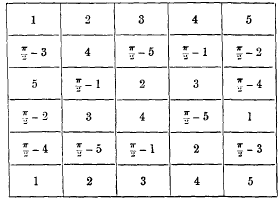
where the mid-column contains the hypotenuse, the two next to it contain the angles, and the extreme columns the sides of the several right-angled triangles.
ASYMPTOTIC STABILITY OF AttRTor1R((R/$Afr$n),A)
-
- Journal:
- Proceedings of the Edinburgh Mathematical Society / Volume 44 / Issue 3 / October 2001
- Published online by Cambridge University Press:
- 20 January 2009, pp. 479-483
-
- Article
-
- You have access
- Export citation
Hypercentral injectors in infinite soluble groups
-
- Journal:
- Proceedings of the Edinburgh Mathematical Society / Volume 22 / Issue 3 / October 1979
- Published online by Cambridge University Press:
- 20 January 2009, pp. 191-194
-
- Article
-
- You have access
- Export citation
-
The Carter subgroups of a finite soluble group may be characterised either as theself-normalising nilpotent subgroups or as the nilpotent projectors. Subgroups with properties analogous to both of these have been considered by Newell (2, 3) in the class of
 -groups. The results obtained are necessarily less satisfactory than in the finite case, the subgroups either being almost self-normalising (i.e. having finite index in their normaliser) or having an almost-covering property. Also the subgroups are not necessarily conjugate but lie in finitely many conjugacy classes.
 -groups. The results obtained are necessarily less satisfactory than in the finite case, the subgroups either being almost self-normalising (i.e. having finite index in their normaliser) or having an almost-covering property. Also the subgroups are not necessarily conjugate but lie in finitely many conjugacy classes.
PEM volume 23 Cover and Front matter
-
- Journal:
- Proceedings of the Edinburgh Mathematical Society / Volume 23 / February 1904
- Published online by Cambridge University Press:
- 20 January 2009, pp. f1-f5
-
- Article
-
- You have access
- Export citation
Michael Atiyah Collected works, Vol. 1: Early papers, general papers (Clarendon Press, Oxford, 1988), 386 pp., 0 19 853275 X, £30.
-
- Journal:
- Proceedings of the Edinburgh Mathematical Society / Volume 33 / Issue 2 / June 1990
- Published online by Cambridge University Press:
- 20 January 2009, pp. 334-335
-
- Article
-
- You have access
- Export citation
FINITE CONJUGACY IN ALGEBRAS AND ORDERS
-
- Journal:
- Proceedings of the Edinburgh Mathematical Society / Volume 44 / Issue 1 / February 2001
- Published online by Cambridge University Press:
- 20 January 2009, pp. 201-213
-
- Article
-
- You have access
- Export citation
Corrections to a paper, “Coaxal Circles and Conics,’ by Wm. Finlayson, in Vol. XXV. of Proceedings
-
- Journal:
- Proceedings of the Edinburgh Mathematical Society / Volume 26 / February 1907
- Published online by Cambridge University Press:
- 20 January 2009, p. vii
-
- Article
-
- You have access
- Export citation
Stability in pro-homotopy theory
-
- Journal:
- Proceedings of the Edinburgh Mathematical Society / Volume 33 / Issue 3 / October 1990
- Published online by Cambridge University Press:
- 20 January 2009, pp. 419-441
-
- Article
-
- You have access
- Export citation
-
If
 is a category, an object of pro- is stable if it is isomorphic in pro- to an object of . A local condition on such a pro-object, called strong-movability, is defined, and it is shown in various contexts that this condition is equivalent to stability. Also considered, in the case is a suitable model category, is the stability problem in the homotopy category Ho(pro-), where pro- has the induced closed model category structure defined by Edwards and Hastings [6].
 is a category, an object of pro-
M. Rosenblum and J. Rovnyak, Hardy classes and operator theory (Oxford University Press, USA, 1985), xii + 161 pp., £37.50.
-
- Journal:
- Proceedings of the Edinburgh Mathematical Society / Volume 30 / Issue 2 / June 1987
- Published online by Cambridge University Press:
- 20 January 2009, pp. 326-327
-
- Article
-
- You have access
- Export citation
PEM volume 21 Back matter and figures
-
- Journal:
- Proceedings of the Edinburgh Mathematical Society / Volume 21 / February 1902
- Published online by Cambridge University Press:
- 20 January 2009, pp. b1-b22
-
- Article
-
- You have access
- Export citation
Groups which satisfy a weak form of Poincaré duality
-
- Journal:
- Proceedings of the Edinburgh Mathematical Society / Volume 34 / Issue 3 / October 1991
- Published online by Cambridge University Press:
- 20 January 2009, pp. 463-486
-
- Article
-
- You have access
- Export citation
On the generalised Todd genus of flag bundles
-
- Journal:
- Proceedings of the Edinburgh Mathematical Society / Volume 19 / Issue 1 / March 1974
- Published online by Cambridge University Press:
- 20 January 2009, pp. 35-38
-
- Article
-
- You have access
- Export citation
-
Let V be a complex algebraic variety. Given integers a1, …, am such that

one defines a (a1, …, am)-flag as a nested system

of subspaces of Sn, the n-dimensional complex projective space. The set of all such flags is called an incomplete flag-manifold in Sn, and is denoted by W(al, …, am). Also let E be a complex n-dimensional vector bundle over V. Then we denote by E(a1, …, am−1, n; V) an associated fibre bundle of E with fibre W(a1 − 1, …, am−1 − 1, n − 1). E(a1, …, am−1 − 1, n; V) is called an incomplete flag bundle of E over V (cf. (2), (3)). In Section 10.3 and Section 14.4 of (1), the generalised Todd genus Ty(W(0, n)) and Ty(W(0, 1, …, n)) of the n-dimensional projective space W(0, n) and the flag manifold W(0, 1, …, n) (or F(n+l)) were calculated. Here we compute Ty(W(a1, …, am)) and also Ty(E(a1, …, am−1, n; V)).


On the smallest number of entries necessary in a table of logarithms to seven decimal places
-
- Journal:
- Proceedings of the Edinburgh Mathematical Society / Volume 10 / February 1891
- Published online by Cambridge University Press:
- 20 January 2009, pp. 35-37
-
- Article
-
- You have access
- Export citation
-
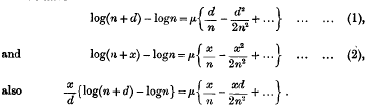
Taking seven figure logarithms it is required to find at what interval from n, a number of five figures, the next entry need be made, in order that any intermediate logarithm may be calculated by the method of proportional parts.
We have
Sur les cubiques gauches équilatères
-
- Journal:
- Proceedings of the Edinburgh Mathematical Society / Volume 13 / February 1894
- Published online by Cambridge University Press:
- 20 January 2009, pp. 146-149
-
- Article
-
- You have access
- Export citation
A Note on Certain Integral Equations of Abel-Type
-
- Journal:
- Proceedings of the Edinburgh Mathematical Society / Volume 13 / Issue 3 / June 1963
- Published online by Cambridge University Press:
- 20 January 2009, pp. 271-272
-
- Article
-
- You have access
- Export citation
Index of Papers Published in this Volume Arranged According to Names of Authors
-
- Journal:
- Proceedings of the Edinburgh Mathematical Society / Volume 9 / Issue 4 / May 1958
- Published online by Cambridge University Press:
- 20 January 2009, p. 207
-
- Article
-
- You have access
- Export citation
On large deviations in Hilbert space
-
- Journal:
- Proceedings of the Edinburgh Mathematical Society / Volume 34 / Issue 3 / October 1991
- Published online by Cambridge University Press:
- 20 January 2009, pp. 487-495
-
- Article
-
- You have access
- Export citation
Convergence in Sequence Spaces
-
- Journal:
- Proceedings of the Edinburgh Mathematical Society / Volume 11 / Issue 2 / November 1958
- Published online by Cambridge University Press:
- 20 January 2009, pp. 83-85
-
- Article
-
- You have access
- Export citation
Note on the evaluation of functions of the form 0°
-
- Journal:
- Proceedings of the Edinburgh Mathematical Society / Volume 3 / February 1884
- Published online by Cambridge University Press:
- 20 January 2009, pp. 70-77
-
- Article
-
- You have access
- Export citation
-
Let f(t), ø(t), be two functions of t, such that they both vanish with t, that is, f(0) = 0, ø(0) = 0; and put


