Refine search
Actions for selected content:
26079 results in Abstract analysis
PEM volume 38 Cover and Front matter
-
- Journal:
- Proceedings of the Edinburgh Mathematical Society / Volume 38 / February 1919
- Published online by Cambridge University Press:
- 20 January 2009, pp. f1-f5
-
- Article
-
- You have access
- Export citation
Commutative non-associative number theory
-
- Journal:
- Proceedings of the Edinburgh Mathematical Society / Volume 20 / Issue 2 / September 1976
- Published online by Cambridge University Press:
- 20 January 2009, pp. 133-136
-
- Article
-
- You have access
- Export citation
-
Trevor Evans in (8) introduced postulates for a non-associative number theory similar to, but less general than, those of A. Robinson (9). Evans' number theory is also non-commutative under addition and multiplication, but an alternative equality axiom also suggested by Robinson leads to a number theory which is commutative under addition and still non-associative except in the special case:

Non-simplicity of locally finite barely transitive groups
-
- Journal:
- Proceedings of the Edinburgh Mathematical Society / Volume 40 / Issue 3 / October 1997
- Published online by Cambridge University Press:
- 20 January 2009, pp. 483-490
-
- Article
-
- You have access
- Export citation
Asymptotic Expressions for the Bessel Functions and the Fourier-Bessel Expansions
-
- Journal:
- Proceedings of the Edinburgh Mathematical Society / Volume 39 / February 1920
- Published online by Cambridge University Press:
- 20 January 2009, pp. 13-20
-
- Article
-
- You have access
- Export citation
-
Asymptotic Expressions for the Bessel Functions.
From the asymptotic expansion for Ku(z) it follows that, if − π < amp z < π,

This theorem is also true if amp z = ± π; to prove this consider the formula

Failing Cases of Fourier's Double-Integral Theorem
-
- Journal:
- Proceedings of the Edinburgh Mathematical Society / Volume 3 / February 1884
- Published online by Cambridge University Press:
- 20 January 2009, pp. 12-18
-
- Article
-
- You have access
- Export citation
-
Fourier's Theorem, as usually stated, is

Most writers give this without limitation, but De Morgan (Diff. and Int. Calc. pp. 618 &c.) directs attention to what he calls the apparent neglect by previous writers of the limitation of the theorem to functions which satisfy the condition

Nonlinear density-dependent diffusion for competing species interactions: Large-time asymptotic behaviour
-
- Journal:
- Proceedings of the Edinburgh Mathematical Society / Volume 27 / Issue 2 / June 1984
- Published online by Cambridge University Press:
- 20 January 2009, pp. 131-144
-
- Article
-
- You have access
- Export citation
The dynamics of linearized polynomials
-
- Journal:
- Proceedings of the Edinburgh Mathematical Society / Volume 43 / Issue 1 / February 2000
- Published online by Cambridge University Press:
- 20 January 2009, pp. 113-128
-
- Article
-
- You have access
- Export citation
-
Let F = GF(q). To any polynomial G ∈ F[x] there is associated a mapping Ĝ on the set IF of monic irreducible polynomials over F. We present a natural and effective theory of the dynamics of Ĝ for the case in which G is a monic q-linearized polynomial. The main outcome is the following theorem.
Assume that G is not of the form
 , where l ≥ 0 (in which event the dynamics is trivial). Then, for every integer n ≥ 1 and for every integer k ≥ 0, there exist infinitely many μ ∈ IF. having preperiod k and primitive period n with respect to Ĝ.
Previously, Morton, by somewhat different means, had studied the primitive periods of Ĝ when G = xq – ax, α a non-zero element of F. Our theorem extends and generalizes Morton's result. Moreover, it establishes a conjecture of Morton for the class of q-linearized polynomials.
 , where l ≥ 0 (in which event the dynamics is trivial). Then, for every integer n ≥ 1 and for every integer k ≥ 0, there exist infinitely many μ ∈ I
Nilpotent subsets of near-rings with minimal condition
-
- Journal:
- Proceedings of the Edinburgh Mathematical Society / Volume 23 / Issue 3 / October 1980
- Published online by Cambridge University Press:
- 20 January 2009, pp. 297-299
-
- Article
-
- You have access
- Export citation
-
Throughout this paper all near-rings will be zero-symmetric and left distributive. A near-ring with minimal condition on right N-subgroups will be called an
 near-ring. It is well known (see (1), 3.40, p. 90)) that a nil right N-subgroup of an near-ring is nilpotent. However, in a deeper study of near-rings a stronger result than this is sometimes required (2, p. 77).
 near-ring. It is well known (see (
Local structure of some Out(Fn)-complexes
-
- Journal:
- Proceedings of the Edinburgh Mathematical Society / Volume 33 / Issue 3 / October 1990
- Published online by Cambridge University Press:
- 20 January 2009, pp. 367-379
-
- Article
-
- You have access
- Export citation
An Account of Newton's “Opticks”
-
- Journal:
- Proceedings of the Edinburgh Mathematical Society / Volume 1 / February 1883
- Published online by Cambridge University Press:
- 20 January 2009, p. 129
-
- Article
-
- You have access
- Export citation
Theorems connected with the Differentiation of a Circulant
-
- Journal:
- Proceedings of the Edinburgh Mathematical Society / Volume 37 / February 1918
- Published online by Cambridge University Press:
- 20 January 2009, pp. 85-96
-
- Article
-
- You have access
- Export citation
Pseudo-umbilical surfaces with constant Gauss curvature
-
- Journal:
- Proceedings of the Edinburgh Mathematical Society / Volume 18 / Issue 2 / December 1972
- Published online by Cambridge University Press:
- 20 January 2009, pp. 143-148
-
- Article
-
- You have access
- Export citation
-
Let M be a surface immersed in an m-dimensional space form Rm(c) of curvature c = 1, 0 or −1. Let h be the second fundamental form of this immersion; it is a certain symmetric bilinear mapping
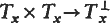 for x ∈ M, where Tx is the tangent space and
  the normal space of M at x. Let H be the mean curvature vector of M in Rm(c) and 〈, 〉 the scalar product on Rm(c). If there exists a function λ on M such that 〈h(X, Y), H〉 = λ〈X, Y〉 for all tangent vectors X, Y, then M is called a pseudo-umbilical surface of Rm(c). Let D denote the covariant differentiation of Rm(c) and η be a normal vector field. If we denote by D*η the normal component of Dη, then D* defines a connection in the normal bundle. A normal vector field η is said to be parallel in the normal bundle if Dη = 0. The length of mean curvature vector is called the mean curvature.
 for x ∈ M, where T
 the normal space of M at x. Let H be the mean curvature vector of M in R
Distinguishedness of weighted Fréchet spaces of continuous functions
-
- Journal:
- Proceedings of the Edinburgh Mathematical Society / Volume 35 / Issue 2 / June 1992
- Published online by Cambridge University Press:
- 20 January 2009, pp. 271-283
-
- Article
-
- You have access
- Export citation
-
In this paper, we prove that if
 is an increasing sequence of strictly positive and continuous functions on a locally compact Hausdorff space X such that
  then the Fréchet space C(X) is distinguished if and only if it satisfies Heinrich's density condition, or equivalently, if and only if the sequence satisfies condition (H) (cf. e.g.‵[1] for the introduction of (H)). As a consequence, the bidual λ∞(A) of the distinguished Köthe echelon space λ0(A) is distinguished if and only if the space λ1(A) is distinguished. This gives counterexamples to a problem of Grothendieck in the context of Köthe echelon spaces.
 is an increasing sequence of strictly positive and continuous functions on a locally compact Hausdorff space X such that
  then the Fréchet space C
Reflexive ideals and injective modules over Noetherian v-H orders
-
- Journal:
- Proceedings of the Edinburgh Mathematical Society / Volume 34 / Issue 1 / February 1991
- Published online by Cambridge University Press:
- 20 January 2009, pp. 31-43
-
- Article
-
- You have access
- Export citation
Conditions on Banach algebras which imply finite dimensionality
-
- Journal:
- Proceedings of the Edinburgh Mathematical Society / Volume 20 / Issue 1 / March 1976
- Published online by Cambridge University Press:
- 20 January 2009, pp. 1-5
-
- Article
-
- You have access
- Export citation
W. Ledermann, Introduction to the Theory of Finite Groups (University Mathematical Texts, Oliver and Boyd, 5th edition, Edinburgh, 1964), x + 174 pp., 10s. 6d.
-
- Journal:
- Proceedings of the Edinburgh Mathematical Society / Volume 15 / Issue 1 / June 1966
- Published online by Cambridge University Press:
- 20 January 2009, p. 75
-
- Article
-
- You have access
- Export citation
On the fundamental group of an almost-acyclic 2-complex
-
- Journal:
- Proceedings of the Edinburgh Mathematical Society / Volume 24 / Issue 2 / June 1981
- Published online by Cambridge University Press:
- 20 January 2009, pp. 119-122
-
- Article
-
- You have access
- Export citation
The Vibrations of a Particle about a Position of Equilibrium—Part III: The Significance of the Divergence of the Series Solution
-
- Journal:
- Proceedings of the Edinburgh Mathematical Society / Volume 41 / February 1922
- Published online by Cambridge University Press:
- 20 January 2009, pp. 128-140
-
- Article
-
- You have access
- Export citation
-
In the two parts of this investigation previously published it has been shown that the solution in terms of elliptic functions represents the motion of the particular dynamical system under consideration throughout the whole range of values of s and g for which a real solution exists, except for those values for which s = 2g and k = 1, but that, on the other hand, the series solution is convergent and represents the motion only so long as
for values of s and g for which the sign of this inequality is reversed the trigonometric series representing the solution are divergent. It is of importance to investigate what discontinuities, if any, of the system correspond to values of s and g which lie on the boundary of the region of convergence; the present part is concerned primarily with showing that under such circumstances no discontinuity of the system exists, thus confirming the suggestions made in Part I., § 12.
The Jacobian Curve of a Net of Quadrics
-
- Journal:
- Proceedings of the Edinburgh Mathematical Society / Volume 3 / Issue 4 / August 1933
- Published online by Cambridge University Press:
- 20 January 2009, pp. 259-268
-
- Article
-
- You have access
- Export citation
Linear diophantine equations with cyclic coefficient matrices and its applications to Riemann surfaces
-
- Journal:
- Proceedings of the Edinburgh Mathematical Society / Volume 28 / Issue 3 / October 1985
- Published online by Cambridge University Press:
- 20 January 2009, pp. 369-380
-
- Article
-
- You have access
- Export citation
-
Let co, c1, …, cn-1 be the nonzero complex numbers and let C = (cu+1,v+1) = (cn+u-v), O≦u,v≦n — 1, be a cyclic matrix, where n + u — v is taken modulo n. In this paper we shall give the solution of the linear equations

where Lu (0≦u≦n —1) is a fixed complex number. In Theorem 1 weshall give a necessary and sufficient condition for (1) to have an integral solution.
