Refine search
Actions for selected content:
26079 results in Abstract analysis
On functions with derivative of bounded variation: An analogue of Banach's indicatrix theorem
-
- Journal:
- Proceedings of the Edinburgh Mathematical Society / Volume 29 / Issue 1 / February 1986
- Published online by Cambridge University Press:
- 20 January 2009, pp. 61-68
-
- Article
-
- You have access
- Export citation
-
A simple, but nice theorem of Banach states that the variation of a continuous function F:[a, b]→ ℝ is given by
 where t(y) is defined as the number of x ∈ [a, b[ for which F(x)= y (see, e.g., [1], VIII.5, Th. 3). In this paper we essentially derive a similar representation for the variation of F′ which also yields a criterion for a function to be an integral of a function of bounded variation. The proof given here is quite elementary, though long and somewhat intriciate.
 where t(y) is defined as the number of x ∈ [a, b[ for which F(x)= y (see, e.g., [1], VIII.5, Th. 3). In this paper we essentially derive a similar representation for the variation of F′ which also yields a criterion for a function to be an integral of a function of bounded variation. The proof given here is quite elementary, though long and somewhat intriciate.
List of Members
-
- Journal:
- Proceedings of the Edinburgh Mathematical Society / Volume 32 / February 1913
- Published online by Cambridge University Press:
- 20 January 2009, pp. 160-168
-
- Article
-
- You have access
- Export citation
Office-Bearers
-
- Journal:
- Proceedings of the Edinburgh Mathematical Society / Volume 23 / February 1904
- Published online by Cambridge University Press:
- 20 January 2009, p. 1
-
- Article
-
- You have access
- Export citation
Two remarkable Cubics associated with a Triangle
-
- Journal:
- Proceedings of the Edinburgh Mathematical Society / Volume 33 / February 1914
- Published online by Cambridge University Press:
- 20 January 2009, pp. 69-84
-
- Article
-
- You have access
- Export citation
Nörlund Methods of Summability Associated with Polynomials
-
- Journal:
- Proceedings of the Edinburgh Mathematical Society / Volume 12 / Issue 1 / June 1960
- Published online by Cambridge University Press:
- 20 January 2009, pp. 7-15
-
- Article
-
- You have access
- Export citation
-
Let s, sn(n = 0, 1, …) be arbitrary complex numbers, and let

be a polynomial, with complex coefficients, which satisfies the normalizing condition

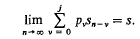
Associated with such a polynomial is a Nörlund method of summability Np: the sequence {sn} is said to be Np-convergent to s, and we write sn →s (Np), if

PEM volume 37 issue 2 Cover and Front matter
-
- Journal:
- Proceedings of the Edinburgh Mathematical Society / Volume 37 / Issue 2 / June 1994
- Published online by Cambridge University Press:
- 20 January 2009, pp. f1-f3
-
- Article
-
- You have access
- Export citation
Length of the Perpendicular from a given Point to a given Straight Line
-
- Journal:
- Proceedings of the Edinburgh Mathematical Society / Volume 39 / February 1920
- Published online by Cambridge University Press:
- 20 January 2009, pp. 75-76
-
- Article
-
- You have access
- Export citation
On the projective tensor product of Fréchet spaces
-
- Journal:
- Proceedings of the Edinburgh Mathematical Society / Volume 34 / Issue 2 / June 1991
- Published online by Cambridge University Press:
- 20 January 2009, pp. 169-178
-
- Article
-
- You have access
- Export citation
-
We are concerned with the following problem. Let F be a Fréchet Montel space and let E be a Fréchet space with a certain property (P). When does it follow that the complete projective tensor product
 has the property (P)? (We consider the following properties: being Montel, reflexive, satisfying the density condition.) In this paper we provide a positive answer if F is a Montel generalized Dubinsky sequence space with decreasing steps.
 has the property (P)? (We consider the following properties: being Montel, reflexive, satisfying the density condition.) In this paper we provide a positive answer if F is a Montel generalized Dubinsky sequence space with decreasing steps.
Multipliers of invariant subspaces in the bidisc
-
- Journal:
- Proceedings of the Edinburgh Mathematical Society / Volume 37 / Issue 2 / June 1994
- Published online by Cambridge University Press:
- 20 January 2009, pp. 193-199
-
- Article
-
- You have access
- Export citation
-
For any nonzero invariant subspace M in H2(T2), set
 . Then Mx is also an invariant subspace of H2(T2) that contains M. If M is of finite codimension in H2(T2) then Mx = H2(T2) and if M = qH2(T2) for some inner function q then Mx = M. In this paper invariant subspaces with Mx = M are studied. If M = q1H2(T2) ∩ q2H2(T2) and q1, q2 are inner functions then Mx = M. However in general this invariant subspace may not be of the form: qH2(T2) for some inner function q. Put
  (M) = {ø ∈ L ∞: ø M ⊆ H2(T2)}; then (M) is described and (M) = (Mx) is shown. This is the set of all multipliers of M in the title. A necessary and sufficient condition for (M) = H∞(T2) is given. It is noted that the kernel of a Hankel operator is an invariant subspace M with Mx = M. The argument applies to the polydisc case.
 . Then M
 (M) = {ø ∈ L ∞: ø M ⊆ H
Generators for locally compact groups
-
- Journal:
- Proceedings of the Edinburgh Mathematical Society / Volume 36 / Issue 3 / October 1993
- Published online by Cambridge University Press:
- 20 January 2009, pp. 463-467
-
- Article
-
- You have access
- Export citation
On Professor Whittaker's solution of differential equations by definite integrals: Part I
-
- Journal:
- Proceedings of the Edinburgh Mathematical Society / Volume 2 / Issue 4 / June 1931
- Published online by Cambridge University Press:
- 20 January 2009, pp. 205-219
-
- Article
-
- You have access
- Export citation
The Nine-point Circle
-
- Journal:
- Proceedings of the Edinburgh Mathematical Society / Volume 13 / February 1894
- Published online by Cambridge University Press:
- 20 January 2009, pp. 26-27
-
- Article
-
- You have access
- Export citation
A Theorem on the Complete Integral
-
- Journal:
- Proceedings of the Edinburgh Mathematical Society / Volume 3 / Issue 2 / July 1932
- Published online by Cambridge University Press:
- 20 January 2009, pp. 144-146
-
- Article
-
- You have access
- Export citation
A mixed dirichlet-neumann problem for a nonlinear reynolds equation in elastohydrodynamic piezoviscous lubrication
-
- Journal:
- Proceedings of the Edinburgh Mathematical Society / Volume 39 / Issue 1 / February 1996
- Published online by Cambridge University Press:
- 20 January 2009, pp. 151-162
-
- Article
-
- You have access
- Export citation
An extended Hamburger moment problem
-
- Journal:
- Proceedings of the Edinburgh Mathematical Society / Volume 28 / Issue 2 / June 1985
- Published online by Cambridge University Press:
- 20 January 2009, pp. 167-183
-
- Article
-
- You have access
- Export citation
-
The classical Hamburger moment problem can be formulated as follows: Given a sequence {cn:n=0,1,2,…} of real numbers, find necessary and sufficient conditions for the existence of a distribution function ψ (i.e. a bounded, real-valued, non-decreasing function) on (– ∞,∞) with infinitely many points of increase, such that
 , n = 0,1,2, … This problem was posed and solved by Hamburger [5] in 1921. The corresponding problem for functions ψ on the interval [0,∞) had already been treated by Stieltjes [15] in 1894. The characterizations were in terms of positivity of Hankel determinants associated with the sequence {cn}, and the original proofs rested on the theory of continued fractions. Much work has since been done on questions connected with these problems, using orthogonal functions and extension of positive definite functionals associated with the sequence. Accounts of the classical moment problems with later developments can be found in [1,4,14]. Good modern accounts of the theory of orthogonal polynomials can be found in [2,3].
 , n = 0,1,2, … This problem was posed and solved by Hamburger [
Positive p-summing operators, vector measures and tensor products
-
- Journal:
- Proceedings of the Edinburgh Mathematical Society / Volume 31 / Issue 2 / June 1988
- Published online by Cambridge University Press:
- 20 January 2009, pp. 179-184
-
- Article
-
- You have access
- Export citation
-
In this paper we shall introduce a certain class of operators from a Banach lattice X into a Banach space B (see Definition 1) which is closely related to p-absolutely summing operators defined by Pietsch [8].
These operators, called positive p-summing, have already been considered in [9] in the case p = 1 (there they are called cone absolutely summing, c.a.s.) and in [1] by the author who found this space to be the space of boundary values of harmonic B-valued functions in
 .
.Here we shall use these spaces and the space of majorizing operators to characterize the space of bounded p-variation measures
 and to endow the tensor product
  with a norm in order to get
  as its completion in this norm.
 .
. and to endow the tensor product
  with a norm in order to get
  as its completion in this norm.
On the endomorphism near-ring of a free group
-
- Journal:
- Proceedings of the Edinburgh Mathematical Society / Volume 23 / Issue 1 / February 1980
- Published online by Cambridge University Press:
- 20 January 2009, pp. 103-121
-
- Article
-
- You have access
- Export citation
The weak-star closure of the unit ball in a hyperplane
-
- Journal:
- Proceedings of the Edinburgh Mathematical Society / Volume 18 / Issue 1 / June 1972
- Published online by Cambridge University Press:
- 20 January 2009, pp. 7-11
-
- Article
-
- You have access
- Export citation
On Physical Science in Schools
-
- Journal:
- Proceedings of the Edinburgh Mathematical Society / Volume 4 / February 1885
- Published online by Cambridge University Press:
- 20 January 2009, pp. 21-22
-
- Article
-
- You have access
- Export citation
H. Minc, Permanents (Encyclopedia of Mathematics and its Applications, vol. 6, Addison-Wesley Advanced Book Programme, 1978), xviii + 205 pp., $21.50.
-
- Journal:
- Proceedings of the Edinburgh Mathematical Society / Volume 25 / Issue 1 / February 1982
- Published online by Cambridge University Press:
- 20 January 2009, p. 110
-
- Article
-
- You have access
- Export citation
