Refine search
Actions for selected content:
26079 results in Abstract analysis
Günter Meinardus, Approximation von Funktionen und ihre numerische Behandlung(Berlin, Springer-Verlag, 1964), 180 pp.
-
- Journal:
- Proceedings of the Edinburgh Mathematical Society / Volume 15 / Issue 3 / June 1967
- Published online by Cambridge University Press:
- 20 January 2009, pp. 247-248
-
- Article
-
- You have access
- Export citation
H. Neill and A. J. Moakes, Vectors, Matrices and Linear Equations (Oliver and Boyd, 1967), 216 pp.
-
- Journal:
- Proceedings of the Edinburgh Mathematical Society / Volume 17 / Issue 1 / June 1970
- Published online by Cambridge University Press:
- 20 January 2009, pp. 109-110
-
- Article
-
- You have access
- Export citation
Counting balanced signed graphs using marked graphs
-
- Journal:
- Proceedings of the Edinburgh Mathematical Society / Volume 24 / Issue 2 / June 1981
- Published online by Cambridge University Press:
- 20 January 2009, pp. 99-104
-
- Article
-
- You have access
- Export citation
On bounded skew-symmetric forms
-
- Journal:
- Proceedings of the Edinburgh Mathematical Society / Volume 5 / Issue 2 / June 1937
- Published online by Cambridge University Press:
- 20 January 2009, pp. 90-92
-
- Article
-
- You have access
- Export citation
Multiparameter root vectors
-
- Journal:
- Proceedings of the Edinburgh Mathematical Society / Volume 32 / Issue 1 / February 1989
- Published online by Cambridge University Press:
- 20 January 2009, pp. 19-29
-
- Article
-
- You have access
- Export citation
-
The concept of “root vectors” is investigated for a class of multiparameter eigenvalue problems

where
 operate in Hilbert spaces Hm and
  . Previous work on this “uniformly elliptic” class has demonstrated completeness of the decomposable tensors x1 ⊗…⊗ xk in a subspace G of finite codimension in H=H1 ⊗…⊗ Hk, but questions remain about extending this to a basis of H. In this work, bases of elements ym, in general nondecomposable but satisfying recursive equations of the type
  are constructed for the “root subspaces” corresponding to λ∈ℝk.
 operate in Hilbert spaces H
 . Previous work on this “uniformly elliptic” class has demonstrated completeness of the decomposable tensors x
 are constructed for the “root subspaces” corresponding to λ∈ℝ
Francis B. Hildebrand, Finite Difference Equations and Simulations (Prentice Hall, 1968), ix+338 pp., 119s. 6d.
-
- Journal:
- Proceedings of the Edinburgh Mathematical Society / Volume 16 / Issue 3 / June 1969
- Published online by Cambridge University Press:
- 20 January 2009, p. 268
-
- Article
-
- You have access
- Export citation
PEM volume 34 issue 2 Cover and Front matter
-
- Journal:
- Proceedings of the Edinburgh Mathematical Society / Volume 34 / Issue 2 / June 1991
- Published online by Cambridge University Press:
- 20 January 2009, pp. f1-f3
-
- Article
-
- You have access
- Export citation
Invariants for automorphisms of certain iterated skew polynomial rings
-
- Journal:
- Proceedings of the Edinburgh Mathematical Society / Volume 39 / Issue 3 / October 1996
- Published online by Cambridge University Press:
- 20 January 2009, pp. 461-472
-
- Article
-
- You have access
- Export citation
L-ideals of M(G) determined by continuity of translation
-
- Journal:
- Proceedings of the Edinburgh Mathematical Society / Volume 18 / Issue 4 / December 1973
- Published online by Cambridge University Press:
- 20 January 2009, pp. 307-316
-
- Article
-
- You have access
- Export citation
-
G denotes a locally compact abelian group and M(G) the convolution algebra of regular bounded Borel measures on G. An ideal I of M(G) closed in the usual (total variation) norm topology is called an L-ideal if μ ∈ I, ν≪ μ (ν absolutely continuous with respect to μ) implies that ν ∈ I. Here we are concerned with the L-idealsL1(G),
 , and M0(G) where, as usual, L1(G) denotes the set of measures absolutely continuous with respect to Haar measure, denotes the radical of L1(G) in M(G) and M0(G) denotes the set of measures whose Fourier-Stieltjes transforms vanish at infinity.
 , and M
On elemental annihilator rings
-
- Journal:
- Proceedings of the Edinburgh Mathematical Society / Volume 17 / Issue 2 / December 1970
- Published online by Cambridge University Press:
- 20 January 2009, pp. 187-188
-
- Article
-
- You have access
- Export citation
Integral equations for Lamé functions
-
- Journal:
- Proceedings of the Edinburgh Mathematical Society / Volume 7 / Issue 1 / October 1942
- Published online by Cambridge University Press:
- 20 January 2009, pp. 3-15
-
- Article
-
- You have access
- Export citation
R. P. Gilbert and R. J. Weinacht (editors), Function Theoretic Methods in Differential Equations (Research Notes in Mathematics, Vol. 8, Pitman Publishing, 1976), iix + 309 pp.,£9·50.
-
- Journal:
- Proceedings of the Edinburgh Mathematical Society / Volume 20 / Issue 4 / September 1977
- Published online by Cambridge University Press:
- 20 January 2009, pp. 366-367
-
- Article
-
- You have access
- Export citation
On a Set of Conform-Invariant Equations of the Gravitational Field
-
- Journal:
- Proceedings of the Edinburgh Mathematical Society / Volume 10 / Issue 1 / January 1953
- Published online by Cambridge University Press:
- 20 January 2009, pp. 16-20
-
- Article
-
- You have access
- Export citation
-
Eddington has considered equations of the gravitational field in empty space which are of the fourth differential order, viz. the sets of equations which express the vanishing of the Hamiltonian derivatives of certain fundamental invariants. The author has shown that a wide class of such equations are satisfied by any solution of the equations

where Gμν and gμν are the components of the Ricci tensor and the metrical tensor respectively, whilst λ is an arbitrary constant. For a V4 this applies in particular when the invariant referred to above is chosen from the set
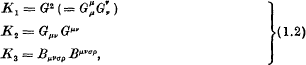
where Bμνσρ is the covariant curvature tensor. K3 has been included since, according to a result due to Lanczos3, its Hamiltonian derivative
 is a linear combination of
  and
and  , i.e. of the Hamiltonian derivatives of K1 and K2. In fact
 is a linear combination of
  and
and  , i.e. of the Hamiltonian derivatives of K
On uniqueness of flows of a dipolar fluid
-
- Journal:
- Proceedings of the Edinburgh Mathematical Society / Volume 17 / Issue 3 / June 1971
- Published online by Cambridge University Press:
- 20 January 2009, pp. 263-269
-
- Article
-
- You have access
- Export citation
The Definition of Lie Derivative
-
- Journal:
- Proceedings of the Edinburgh Mathematical Society / Volume 12 / Issue 1 / June 1960
- Published online by Cambridge University Press:
- 20 January 2009, pp. 27-29
-
- Article
-
- You have access
- Export citation
M. Aschbacher 3-Transposition Groups (Cambridge Tracts in Mathematics Vol. 124, Cambridge, 1997), vii + 260pp., 0 521 57196 0 (hardback), £35.00 (US$49.95).
-
- Journal:
- Proceedings of the Edinburgh Mathematical Society / Volume 42 / Issue 1 / February 1999
- Published online by Cambridge University Press:
- 20 January 2009, pp. 212-213
-
- Article
-
- You have access
- Export citation
Sur les cordes communes à une conique et à un cercle de rayon nul: Application à la théorie géométrique des foyers dans les coniques
-
- Journal:
- Proceedings of the Edinburgh Mathematical Society / Volume 5 / February 1886
- Published online by Cambridge University Press:
- 20 January 2009, pp. 84-92
-
- Article
-
- You have access
- Export citation
-
Etant donnés une conique K, dont l'équation est K = 0, et un point P (α, β), l'équation générale des coniques qui passant par les points d'intersection de la conique K et du cercle P de rayon nul, qui a le point (α, β) pour centre, est

Comme les quatre points d'intersection du cercle P et de la conique K sont imaginaires, le système (1) comprend un seul couple de droites réelles Δ et Δ. Ces droites seront dites, par analogie avec une expression proposée par Chasles, les conjointes du point P et de la conique K.
A question of C. R. Hobby on regular p-groups
-
- Journal:
- Proceedings of the Edinburgh Mathematical Society / Volume 18 / Issue 3 / June 1973
- Published online by Cambridge University Press:
- 20 January 2009, pp. 207-208
-
- Article
-
- You have access
- Export citation
On (J, pn)-summability of Fourier series
-
- Journal:
- Proceedings of the Edinburgh Mathematical Society / Volume 18 / Issue 1 / June 1972
- Published online by Cambridge University Press:
- 20 January 2009, pp. 13-17
-
- Article
-
- You have access
- Export citation
-
Let pn>0 be such that
 pn diverges, and the radius of convergence of the power series
is 1. Given any series σan with partial sums sn, we shall use the notation

and

 p
p
On a Splitting Theorem of Gaschütz
-
- Journal:
- Proceedings of the Edinburgh Mathematical Society / Volume 15 / Issue 1 / June 1966
- Published online by Cambridge University Press:
- 20 January 2009, pp. 57-60
-
- Article
-
- You have access
- Export citation
