Refine search
Actions for selected content:
26079 results in Abstract analysis
A Determinantal Expansion for a Glass of Definite Integral1. Part 1
-
- Journal:
- Proceedings of the Edinburgh Mathematical Society / Volume 9 / Issue 1 / October 1953
- Published online by Cambridge University Press:
- 20 January 2009, pp. 44-52
-
- Article
-
- You have access
- Export citation
-
1. Let w(x) be a non-negative weight function for the finite interval (a, b) such that
 exists and is positive, and let Tr(x), r = 0, 1, 2,…be the corresponding orthonormal system of polynomials. Then if F(x) is continuous on (a, b) and has “Fourier” coefficients
Parseval's formula gives

 exists and is positive, and let T
Sets of idempotents that generate the semigroup of singular endomorphisms of a finite-dimensional vector space
-
- Journal:
- Proceedings of the Edinburgh Mathematical Society / Volume 25 / Issue 2 / June 1982
- Published online by Cambridge University Press:
- 20 January 2009, pp. 133-139
-
- Article
-
- You have access
- Export citation
Isomorphisms between radical weighted convolution algebras
-
- Journal:
- Proceedings of the Edinburgh Mathematical Society / Volume 26 / Issue 3 / October 1983
- Published online by Cambridge University Press:
- 20 January 2009, pp. 343-351
-
- Article
-
- You have access
- Export citation
On a Class of Arrangements
-
- Journal:
- Proceedings of the Edinburgh Mathematical Society / Volume 8 / Issue 3 / December 1949
- Published online by Cambridge University Press:
- 20 January 2009, pp. 119-125
-
- Article
-
- You have access
- Export citation
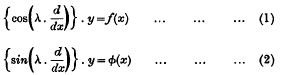
The solutions of the differential equations
-
- Journal:
- Proceedings of the Edinburgh Mathematical Society / Volume 12 / February 1893
- Published online by Cambridge University Press:
- 20 January 2009, pp. 109-111
-
- Article
-
- You have access
- Export citation
On the limits of oscillation of a function and its Cesàro means
-
- Journal:
- Proceedings of the Edinburgh Mathematical Society / Volume 7 / Issue 3 / February 1946
- Published online by Cambridge University Press:
- 20 January 2009, pp. 162-167
-
- Article
-
- You have access
- Export citation
The number of partitions of a set of N points in k dimensions induced by hyperplanes
-
- Journal:
- Proceedings of the Edinburgh Mathematical Society / Volume 15 / Issue 4 / December 1967
- Published online by Cambridge University Press:
- 20 January 2009, pp. 285-289
-
- Article
-
- You have access
- Export citation
On some fractional integrals and their applications
-
- Journal:
- Proceedings of the Edinburgh Mathematical Society / Volume 28 / Issue 1 / February 1985
- Published online by Cambridge University Press:
- 20 January 2009, pp. 97-105
-
- Article
-
- You have access
- Export citation
-
In previous papers [3, 4] the author has discussed the symmetric generalised Erdélyi–Kober operators of fractional integration defined by

where α>0, γ≧0 and the operators ℑiγ(η,α) and
 defined as in equations (1) and (2) respectively but with Jα−1, the Bessel function of the first kind replaced by Iα−1, the modified Bessel function of the first kind.
 defined as in equations (1) and (2) respectively but with J
Office-Bearers
-
- Journal:
- Proceedings of the Edinburgh Mathematical Society / Volume 3 / February 1884
- Published online by Cambridge University Press:
- 20 January 2009, p. 1
-
- Article
-
- You have access
- Export citation
Minimal generating systems of a subgroup of SL(2, ℂ)
-
- Journal:
- Proceedings of the Edinburgh Mathematical Society / Volume 31 / Issue 2 / June 1988
- Published online by Cambridge University Press:
- 20 January 2009, pp. 261-265
-
- Article
-
- You have access
- Export citation
AN EQUIVARIANT WHITEHEAD ALGORITHM AND CONJUGACY FOR ROOTS OF DEHN TWIST AUTOMORPHISMS
-
- Journal:
- Proceedings of the Edinburgh Mathematical Society / Volume 44 / Issue 1 / February 2001
- Published online by Cambridge University Press:
- 20 January 2009, pp. 117-141
-
- Article
-
- You have access
- Export citation
Recherches sur l'Enveloppe des Pédales des divers points d'une Circonférence par rapport à un triangle inscrit
-
- Journal:
- Proceedings of the Edinburgh Mathematical Society / Volume 23 / February 1904
- Published online by Cambridge University Press:
- 20 January 2009, pp. 2-34
-
- Article
-
- You have access
- Export citation
Diffusive waves in inhomogeneous media
-
- Journal:
- Proceedings of the Edinburgh Mathematical Society / Volume 32 / Issue 2 / June 1989
- Published online by Cambridge University Press:
- 20 January 2009, pp. 291-315
-
- Article
-
- You have access
- Export citation
-
When the function f(u) is of “bistable type’, i.e. has two zeros h̲ and h+ at which f' is negative and (for simplicity) has only one other zero between them, then the constant functions u = h± are L∞-stable solutions of the nonlinear diffusion equation

In addition, there are travelling wave solutions u+(x, t) and u̲(x, t) which, if

connect h+ to h̲ in the sense that

the convergence being uniform on bounded x-intervals. These solutions are of the form

where U(z) is a monotone function (the wave's profile), U(±∞) = h±, and the velocity c is a specific positive number depending on the function f.
On the structure of certain basic sequences associated with an arithmetic function
-
- Journal:
- Proceedings of the Edinburgh Mathematical Society / Volume 17 / Issue 4 / December 1971
- Published online by Cambridge University Press:
- 20 January 2009, pp. 305-310
-
- Article
-
- You have access
- Export citation
-
We have previously studied in some detail the multiplicative properties of a given arithmetic function f with respect to a fixed basic sequence
 (see, for example, (1), (2)). We investigate here the structure of M(f), the collection of all basic sequences such that f is multiplicative with respect to , and in particular we focus our attention on the maximal members of M(f). Our principal result will be a proof that each maximal member of M(f) contains the same set of type II primitive pairs. Moreover, we will give a simple criterion for determining, in terms of the behaviour of f, whether or not a particular primitive pair (p, p) is in any (and therefore every) maximal member of M(f).
 (see, for example, (
PEM volume 10 issue 2 Cover and Back matter
-
- Journal:
- Proceedings of the Edinburgh Mathematical Society / Volume 10 / Issue 2 / December 1954
- Published online by Cambridge University Press:
- 20 January 2009, pp. b1-b2
-
- Article
-
- You have access
- Export citation
A criterion for absolute Cesàro summability of negative order of a Fourier series
-
- Journal:
- Proceedings of the Edinburgh Mathematical Society / Volume 14 / Issue 4 / December 1965
- Published online by Cambridge University Press:
- 20 January 2009, pp. 311-319
-
- Article
-
- You have access
- Export citation
-
Let f(x) be integrable L(0, 2π) and periodic with period 2π, and let ψ(t) be the conjugate function of
 with respect to the variable t, where x is onsidered as an arbitrary constant. The following theorems are due to K. K. Chen (1), (2), pp. 111–124.
 with respect to the variable t, where x is onsidered as an arbitrary constant. The following theorems are due to K. K. Chen (
List of Members—July 1933
-
- Journal:
- Proceedings of the Edinburgh Mathematical Society / Volume 3 / Issue 4 / August 1933
- Published online by Cambridge University Press:
- 20 January 2009, pp. 305-311
-
- Article
-
- You have access
- Export citation
P. R. Baxandall and H. Liebeck Differential Vector Calculus (Longman Mathematical Texts, Longman, London, 1981) 240 pp. £7.95.
-
- Journal:
- Proceedings of the Edinburgh Mathematical Society / Volume 26 / Issue 1 / February 1983
- Published online by Cambridge University Press:
- 20 January 2009, p. 117
-
- Article
-
- You have access
- Export citation
On the history and degree of certain geometrical approximations
-
- Journal:
- Proceedings of the Edinburgh Mathematical Society / Volume 10 / February 1891
- Published online by Cambridge University Press:
- 20 January 2009, pp. 23-30
-
- Article
-
- You have access
- Export citation
On Electrolysis
-
- Journal:
- Proceedings of the Edinburgh Mathematical Society / Volume 10 / February 1891
- Published online by Cambridge University Press:
- 20 January 2009, p. 34
-
- Article
-
- You have access
- Export citation
