Refine search
Actions for selected content:
26079 results in Abstract analysis
J. Hammer, Unsolved Problems concerning Lattice Points (Pitman Research Notes in Mathematics; no. 15, Pitman Publishing Ltd., 1977), 101 pp.
-
- Journal:
- Proceedings of the Edinburgh Mathematical Society / Volume 23 / Issue 1 / February 1980
- Published online by Cambridge University Press:
- 20 January 2009, p. 141
-
- Article
-
- You have access
- Export citation
A note on free inverse semigroups
-
- Journal:
- Proceedings of the Edinburgh Mathematical Society / Volume 19 / Issue 1 / March 1974
- Published online by Cambridge University Press:
- 20 January 2009, pp. 17-23
-
- Article
-
- You have access
- Export citation
List of Members
-
- Journal:
- Proceedings of the Edinburgh Mathematical Society / Volume 42 / February 1923
- Published online by Cambridge University Press:
- 20 January 2009, pp. 105-112
-
- Article
-
- You have access
- Export citation
Elliptic multiparameter eigenvalue problems
-
- Journal:
- Proceedings of the Edinburgh Mathematical Society / Volume 30 / Issue 2 / June 1987
- Published online by Cambridge University Press:
- 20 January 2009, pp. 215-228
-
- Article
-
- You have access
- Export citation
-
We study the eigenproblem

where
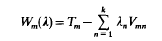
and Tm, Vmn are self-adjoint operators on separable Hilbert spaces Hm. We assume the Tm to be bounded below with compact resolvents, and the Vmn to be bounded and to satisfy an “ellipticity” condition. If k = 1 then ellipticity is automatic, and if each Tm is positive definite then the problem is “left definite”.
PEM volume 13 issue 4 Cover and Front matter
-
- Journal:
- Proceedings of the Edinburgh Mathematical Society / Volume 13 / Issue 4 / December 1963
- Published online by Cambridge University Press:
- 20 January 2009, pp. f1-f7
-
- Article
-
- You have access
- Export citation
PEM volume 6 issue 1 Cover and Front matter
-
- Journal:
- Proceedings of the Edinburgh Mathematical Society / Volume 6 / Issue 1 / May 1939
- Published online by Cambridge University Press:
- 20 January 2009, pp. f1-f2
-
- Article
-
- You have access
- Export citation
D. E. Rutherford, Introduction to Lattice Theory (Oliver and Boyd, 1965), 117 pp.,35s.
-
- Journal:
- Proceedings of the Edinburgh Mathematical Society / Volume 15 / Issue 2 / December 1966
- Published online by Cambridge University Press:
- 20 January 2009, p. 155
-
- Article
-
- You have access
- Export citation
On Keller's conjecture for certain cyclic groups
-
- Journal:
- Proceedings of the Edinburgh Mathematical Society / Volume 22 / Issue 1 / February 1979
- Published online by Cambridge University Press:
- 20 January 2009, pp. 17-21
-
- Article
-
- You have access
- Export citation
James Gregory: A Study in the Early History of Interpolation
-
- Journal:
- Proceedings of the Edinburgh Mathematical Society / Volume 3 / Issue 3 / February 1933
- Published online by Cambridge University Press:
- 20 January 2009, pp. 151-172
-
- Article
-
- You have access
- Export citation
-
In a highly interesting critical account of the mathematical work of James Gregory (1638–1675), written for the Proceedings of the Edinburgh Mathematical Society, (1) 41 (1923), 2–25, by the late Professor G. A. Gibson, there occurs at p. 8 something of a mathematical puzzle. On that page a pair of formulae are quoted, which certainly are striking examples of the analytical power of Gregory, and which run as follows:—
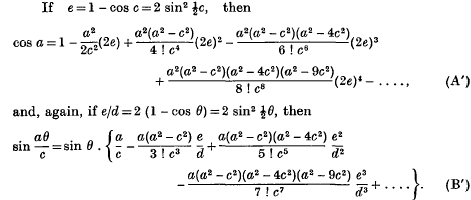
Gibson adds that “there is another formula (Rigaud, p. 207), but it is of a very complicated character and I do not reproduce it.” It will be convenient to refer to the above pair as formulae A′ and B′, and to the more complicated but analogous series as formula C, and to the original series, from which the above were transcribed, as formulse A and B. I am indebted to Mr A. Inglis for drawing my attention to the problem.
A triple in CAT
-
- Journal:
- Proceedings of the Edinburgh Mathematical Society / Volume 23 / Issue 3 / October 1980
- Published online by Cambridge University Press:
- 20 January 2009, pp. 261-268
-
- Article
-
- You have access
- Export citation
-
A triple (or monad) in a category K is a triple
 = (T, μ, η) where, T: K → K is a functor and μ: TT →, T, η: 1k → T are natural transformations for which (1.1) and (1.2) commute: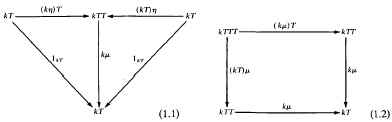
In these diagrams the component of a natural transformation α at an object x is denoted xα. Thus for example (kη)T is the value of the functor T applied to the component of η at k, whereas (kT)η is the component of η at the object kT. I write functions and functors on the right and composition from left to right.
 = (T, μ, η) where, T:
Primary and coprimary decompositions
-
- Journal:
- Proceedings of the Edinburgh Mathematical Society / Volume 18 / Issue 4 / December 1973
- Published online by Cambridge University Press:
- 20 January 2009, pp. 251-264
-
- Article
-
- You have access
- Export citation
G. B. Keene, Abstract Sets and Finite Ordinals (Pergamon Press, 1961), 106 pp., 21s.
-
- Journal:
- Proceedings of the Edinburgh Mathematical Society / Volume 13 / Issue 3 / June 1963
- Published online by Cambridge University Press:
- 20 January 2009, p. 259
-
- Article
-
- You have access
- Export citation
M. G. Smith , Laplace Transform Theory. New University Mathematics Series (Van Nostrand, 1966), 116 pp., 35s. (cloth bound), 18s. (paperback).
-
- Journal:
- Proceedings of the Edinburgh Mathematical Society / Volume 16 / Issue 2 / December 1968
- Published online by Cambridge University Press:
- 20 January 2009, p. 180
-
- Article
-
- You have access
- Export citation
PEM volume 4 figures
-
- Journal:
- Proceedings of the Edinburgh Mathematical Society / Volume 4 / February 1885
- Published online by Cambridge University Press:
- 20 January 2009, pp. b1-b14
-
- Article
-
- You have access
- Export citation
R. E. Showalter, Hilbert Space Methods for Partial Differential Equations (Pitman, 1977), xii+196 pp., £1400.
-
- Journal:
- Proceedings of the Edinburgh Mathematical Society / Volume 22 / Issue 1 / February 1979
- Published online by Cambridge University Press:
- 20 January 2009, p. 66
-
- Article
-
- You have access
- Export citation
A Device for the Analysis of Intervals and Chords in Music
-
- Journal:
- Proceedings of the Edinburgh Mathematical Society / Volume 6 / February 1887
- Published online by Cambridge University Press:
- 20 January 2009, pp. 24-28
-
- Article
-
- You have access
- Export citation
K. Knopp, Theorie und Anwendung der unendlichen Reihen (Springer, 5th edition, 1964), 582 pp., DM. 48.
-
- Journal:
- Proceedings of the Edinburgh Mathematical Society / Volume 15 / Issue 1 / June 1966
- Published online by Cambridge University Press:
- 20 January 2009, p. 84
-
- Article
-
- You have access
- Export citation
The solution via monotonicity methods of some nonscalar reaction-diffusion problems
-
- Journal:
- Proceedings of the Edinburgh Mathematical Society / Volume 39 / Issue 2 / June 1996
- Published online by Cambridge University Press:
- 20 January 2009, pp. 271-284
-
- Article
-
- You have access
- Export citation
Formulae for the Construction of Right-Angled Triangles
-
- Journal:
- Proceedings of the Edinburgh Mathematical Society / Volume 39 / February 1920
- Published online by Cambridge University Press:
- 20 January 2009, pp. 76-77
-
- Article
-
- You have access
- Export citation
M. Rosenblum and J. Rovnyak Topics in Hardy classes and univalent functions (Birkhäuser Advanced Texts, Birkhäuser, Basel, Berlin, Boston1994) 264 pp, 3 7643 5111 X, £36.
-
- Journal:
- Proceedings of the Edinburgh Mathematical Society / Volume 38 / Issue 2 / June 1995
- Published online by Cambridge University Press:
- 20 January 2009, pp. 358-359
-
- Article
-
- You have access
- Export citation
