Refine search
Actions for selected content:
26080 results in Abstract analysis
EXISTENCE OF SOLUTIONS FOR A SYSTEM INVOLVING SCHRÖDINGER OPERATORS WITH WEIGHTS
-
- Journal:
- Proceedings of the Edinburgh Mathematical Society / Volume 50 / Issue 3 / October 2007
- Published online by Cambridge University Press:
- 08 January 2008, pp. 611-635
-
- Article
-
- You have access
- Export citation
INTEGRABILITY OF THE DERIVATIVE OF A BLASCHKE PRODUCT
-
- Journal:
- Proceedings of the Edinburgh Mathematical Society / Volume 50 / Issue 3 / October 2007
- Published online by Cambridge University Press:
- 08 January 2008, pp. 673-687
-
- Article
-
- You have access
- Export citation
OSCILLATION CRITERIA FOR CERTAIN DAMPED PDE'S WITH p-LAPLACIAN
-
- Journal:
- Glasgow Mathematical Journal / Volume 50 / Issue 1 / January 2008
- Published online by Cambridge University Press:
- 01 January 2008, pp. 129-142
-
- Article
-
- You have access
- Export citation
-
Some oscillation criteria are obtained for the damped PDE with p-Laplacian
 The results established here are extensions of some classical oscillation theorems due to Fite-Wintner and Kamenev for second order ordinary differential equations, and improve and complement recent results of Mařík and Usami.
QUANTUM ANALOGUES OF SCHUBERT VARIETIES IN THE GRASSMANNIAN
-
- Journal:
- Glasgow Mathematical Journal / Volume 50 / Issue 1 / January 2008
- Published online by Cambridge University Press:
- 01 January 2008, pp. 55-70
-
- Article
-
- You have access
- Export citation
WEYL'S THEOREM FOR CLASS A(k) OPERATORS
-
- Journal:
- Glasgow Mathematical Journal / Volume 50 / Issue 1 / January 2008
- Published online by Cambridge University Press:
- 01 January 2008, pp. 39-46
-
- Article
-
- You have access
- Export citation
-
In this paper we shall show that Weyl's theorem holds for class A(k) operators T where k≥>1, via its hyponormal transform
 . Next we shall prove some applications of Weyl's theorem on class A(k) operators.
 . Next we shall prove some applications of Weyl's theorem on class A(k) operators.
Enumerating Contingency Tables via Random Permanents
-
- Journal:
- Combinatorics, Probability and Computing / Volume 17 / Issue 1 / January 2008
- Published online by Cambridge University Press:
- 01 January 2008, pp. 1-19
-
- Article
- Export citation
-
Given m positive integers R = (ri), n positive integers C = (cj) such that Σri = Σcj = N, and mn non-negative weights W=(wij), we consider the total weight T=T(R, C; W) of non-negative integer matrices D=(dij) with the row sums ri, column sums cj, and the weight of D equal to
 . For different choices of R, C, and W, the quantity T(R,C; W) specializes to the permanent of a matrix, the number of contingency tables with prescribed margins, and the number of integer feasible flows in a network. We present a randomized algorithm whose complexity is polynomial in N and which computes a number T′=T′(R,C;W) such that T′ ≤ T ≤ α(R,C)T′ where
  . In many cases, ln T′ provides an asymptotically accurate estimate of ln T. The idea of the algorithm is to express T as the expectation of the permanent of an N × N random matrix with exponentially distributed entries and approximate the expectation by the integral T′ of an efficiently computable log-concave function on ℝmn.
 . For different choices of R, C, and W, the quantity T(R,C; W) specializes to the permanent of a matrix, the number of contingency tables with prescribed margins, and the number of integer feasible flows in a network. We present a randomized algorithm whose complexity is polynomial in N and which computes a number T′=T′(R,C;W) such that T′ ≤ T ≤ α(R,C)T′ where
  . In many cases, ln T′ provides an asymptotically accurate estimate of ln T. The idea of the algorithm is to express T as the expectation of the permanent of an N × N random matrix with exponentially distributed entries and approximate the expectation by the integral T′ of an efficiently computable log-concave function on ℝ
ON THE DIOPHANTINE EQUATION x2 + 5a 13b = yn
-
- Journal:
- Glasgow Mathematical Journal / Volume 50 / Issue 1 / January 2008
- Published online by Cambridge University Press:
- 01 January 2008, pp. 175-181
-
- Article
-
- You have access
- Export citation
INFINITE HILBERT CLASS FIELD TOWERS OVER CYCLOTOMIC FIELDS
-
- Journal:
- Glasgow Mathematical Journal / Volume 50 / Issue 1 / January 2008
- Published online by Cambridge University Press:
- 01 January 2008, pp. 27-32
-
- Article
-
- You have access
- Export citation
-
We use a result of Y. Furuta to show that for almost all positive integers m, the cyclotomic field
 has an infinite Hilbert p-class field tower with high rank Galois groups at each step, simultaneously for all primes p of size up to about (log logm)1 + o(1). We also use a recent result of B. Schmidt to show that for infinitely many m there is an infinite Hilbert p-class field tower over for some p≥m0.3385 + o(1). These results have immediate applications to the divisibility properties of the class number of .
 has an infinite Hilbert p-class field tower with high rank Galois groups at each step, simultaneously for all primes p of size up to about (log logm)
On Iterated Image Size for Point-Symmetric Relations
-
- Journal:
- Combinatorics, Probability and Computing / Volume 17 / Issue 1 / January 2008
- Published online by Cambridge University Press:
- 01 January 2008, pp. 61-66
-
- Article
- Export citation
-
Let Γ =(V,E) be a point-symmetric reflexive relation and let υ ∈ V such that |Γ(υ)| is finite (and hence |Γ(x)| is finite for all x, by the transitive action of the group of automorphisms). Let j ∈ℕ be an integer such that Γj(υ)∩ Γ−(υ)={υ}. Our main result states that

As an application we have |Γj(υ)| ≥ 1+(|Γ(υ)|−1)j. The last result confirms a recent conjecture of Seymour in the case of vertex-symmetric graphs. Also it gives a short proof for the validity of the Caccetta–Häggkvist conjecture for vertex-symmetric graphs and generalizes an additive result of Shepherdson.
PROJECTIVE LINEAR GROUPS AS MAXIMAL SYMMETRY GROUPS
-
- Journal:
- Glasgow Mathematical Journal / Volume 50 / Issue 1 / January 2008
- Published online by Cambridge University Press:
- 01 January 2008, pp. 83-96
-
- Article
-
- You have access
- Export citation
Enumeration Schemes for Restricted Permutations
-
- Journal:
- Combinatorics, Probability and Computing / Volume 17 / Issue 1 / January 2008
- Published online by Cambridge University Press:
- 01 January 2008, pp. 137-159
-
- Article
- Export citation
GENERATORS OF REGULAR SEMIGROUPS
-
- Journal:
- Glasgow Mathematical Journal / Volume 50 / Issue 1 / January 2008
- Published online by Cambridge University Press:
- 01 January 2008, pp. 47-53
-
- Article
-
- You have access
- Export citation
-
A regular semigroup (cf. [4, p. 38]) is a C0-semigroup T(⋅) that has an extension as a holomorphic semigroup W(⋅) in the right halfplane
 , such that ||W(⋅)|| is bounded in the ‘unit rectangle’ Q:=(0, 1]× [−1, 1]. The important basic facts about a regular semigroup T(⋅) are: (i) it possesses a boundary groupU(⋅), defined as the limit lims → 0+W(s+i⋅) in the strong operator topology; (ii) U(⋅) is a C0-group, whose generator is iA, where A denotes the generator of T(⋅); and (iii) W(s+it)=T(s)U(t) for all s+it ∈ (cf. Theorems 17.9.1 and 17.9.2 in [3]). The following converse theorem is proved here. Let A be the generator of a C0-semigroup T(⋅). If iA generates a C0-group, U(⋅), then T(⋅) is a regular semigroup, and its holomorphic extension is given by (iii). This result is related to (but not included in) known results of Engel (cf. Theorem II.4.6 in [2]), Liu [7] and the author [6] for holomorphic extensions into arbitrary sectors, of C0-semigroups that are bounded in every proper subsector. The method of proof is also different from the method used in these references. Criteria for generators of regular semigroups follow as easy corollaries.
 , such that ||W(⋅)|| is bounded in the ‘unit rectangle’ Q:=(0, 1]× [−1, 1]. The important basic facts about a regular semigroup T(⋅) are: (i) it possesses a boundary groupU(⋅), defined as the limit lim
THE CLOSED RANGE PROPERTY FOR BANACH SPACE OPERATORS
-
- Journal:
- Glasgow Mathematical Journal / Volume 50 / Issue 1 / January 2008
- Published online by Cambridge University Press:
- 01 January 2008, pp. 17-26
-
- Article
-
- You have access
- Export citation
MOUFANG QUADRANGLES OF MIXED TYPE
-
- Journal:
- Glasgow Mathematical Journal / Volume 50 / Issue 1 / January 2008
- Published online by Cambridge University Press:
- 01 January 2008, pp. 143-161
-
- Article
-
- You have access
- Export citation
ASYMPTOTIC BEHAVIOR OF EIGENVALUES OF RECIPROCAL POWER LCM MATRICES
-
- Journal:
- Glasgow Mathematical Journal / Volume 50 / Issue 1 / January 2008
- Published online by Cambridge University Press:
- 01 January 2008, pp. 163-174
-
- Article
-
- You have access
- Export citation
-
Let
 be an arbitrary strictly increasing infinite sequence of positive integers. For an integer n≥1, let
  . Let r>0 be a real number and q≥ 1 a given integer. Let
 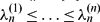 be the eigenvalues of the reciprocal power LCM matrix
 ![$(\frac{1}{[x_i, x_j]^r})$](//static.cambridge.org/binary/version/id/urn:cambridge.org:id:binary:20160115092625273-0634:S0017089507003953_inline4.gif?pub-status=live) having the reciprocal power
having the reciprocal power ![${1\over {[x_i, x_j]^r}}$](//static.cambridge.org/binary/version/id/urn:cambridge.org:id:binary:20160115092625273-0634:S0017089507003953_inline5.gif?pub-status=live) of the least common multiple of xi and xj as its i, j-entry. We show that the sequence
of the least common multiple of xi and xj as its i, j-entry. We show that the sequence  converges and
  . We show that the sequence
  converges if
  and
and  . We show also that if r> 1, then the sequence
  converges and
  , where t and l are given positive integers such that t≤l−1.
 be an arbitrary strictly increasing infinite sequence of positive integers. For an integer n≥1, let
  . Let r>0 be a real number and q≥ 1 a given integer. Let
  be the eigenvalues of the reciprocal power LCM matrix
 ![$(\frac{1}{[x_i, x_j]^r})$](http://static.cambridge.org/binary/version/id/urn:cambridge.org:id:binary:20160115092625273-0634:S0017089507003953_inline4.gif?pub-status=live) having the reciprocal power
having the reciprocal power ![${1\over {[x_i, x_j]^r}}$](http://static.cambridge.org/binary/version/id/urn:cambridge.org:id:binary:20160115092625273-0634:S0017089507003953_inline5.gif?pub-status=live) of the least common multiple of x
of the least common multiple of x converges and
  . We show that the sequence
  converges if
  and
and  . We show also that if r> 1, then the sequence
  converges and
  , where t and l are given positive integers such that t≤l−1.
POINCARÉ DUALITY FOR K-THEORY OF EQUIVARIANT COMPLEX PROJECTIVE SPACES
-
- Journal:
- Glasgow Mathematical Journal / Volume 50 / Issue 1 / January 2008
- Published online by Cambridge University Press:
- 01 January 2008, pp. 111-127
-
- Article
-
- You have access
- Export citation
The Critical Phase for Random Graphs with a Given Degree Sequence
-
- Journal:
- Combinatorics, Probability and Computing / Volume 17 / Issue 1 / January 2008
- Published online by Cambridge University Press:
- 01 January 2008, pp. 67-86
-
- Article
- Export citation
The Distribution of Patterns in Random Trees
-
- Journal:
- Combinatorics, Probability and Computing / Volume 17 / Issue 1 / January 2008
- Published online by Cambridge University Press:
- 01 January 2008, pp. 21-59
-
- Article
- Export citation
-
Let
 denote the set of unrooted labelled trees of size n and let ℳ be a particular (finite, unlabelled) tree. Assuming that every tree of is equally likely, it is shown that the limiting distribution as n goes to infinity of the number of occurrences of ℳ is asymptotically normal with mean value and variance asymptotically equivalent to μn and σ2n, respectively, where the constants μ>0 and σ≥0 are computable.
 denote the set of unrooted labelled trees of size n and let ℳ be a particular (finite, unlabelled) tree. Assuming that every tree of
 The k-Core and Branching Processes
-
- Journal:
- Combinatorics, Probability and Computing / Volume 17 / Issue 1 / January 2008
- Published online by Cambridge University Press:
- 01 January 2008, pp. 111-136
-
- Article
- Export citation
THE UNIT SUM NUMBER OF SOME PROJECTIVE MODULES
-
- Journal:
- Glasgow Mathematical Journal / Volume 50 / Issue 1 / January 2008
- Published online by Cambridge University Press:
- 01 January 2008, pp. 71-74
-
- Article
-
- You have access
- Export citation
-
The unit sum number u(R) of a ring R is the least k such that every element is the sum of k units; if there is no such k then u(R) is ω or ∞ depending whether the units generate R additively or not. If RM is a left R-module, then the unit sum number of M is defined to be the unit sum number of the endomorphism ring of M. Here we show that if R is a ring such that R/J(R) is semisimple and
 is not a factor of R/J(R) and if P is a projective R-module such that JP ≪ P, (JP small in P), then u(P)= 2. As a result we can see that if P is a projective module over a perfect ring then u(P)=2.
 is not a factor of R/J(R) and if P is a projective R-module such that JP ≪ P, (JP small in P), then