Refine search
Actions for selected content:
26080 results in Abstract analysis
LINEAR FRACTIONAL RELATIONS IN BANACH SPACES: INTERIOR POINTS IN THE DOMAIN AND ANALOGUES OF THE LIOUVILLE THEOREM
-
- Journal:
- Glasgow Mathematical Journal / Volume 49 / Issue 2 / May 2007
- Published online by Cambridge University Press:
- 09 August 2007, pp. 257-268
-
- Article
-
- You have access
- Export citation
-
In this paper we study linear fractional relations defined in the following way. Let
 i, 'i, i = 1,2, be Banach spaces. We denote the space of bounded linear operators by
  . Let T ε ( 1 ⊕ 2, '1 ⊕ '2). To each such operator there corresponds a 2 × 2 operator matrix of the form(*)
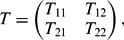 where T ij ε ( j , 'i . For each such T we define a set-valued map G T from ( 1, 2) into the set of closed affine subspaces of ('1, '2) by
The map G T is called a linear fractional relation.
The paper is devoted to the following two problems.
-
• Characterization of operator matrices of the form (*) for which the set G T(K) is non-empty for each K in some open ball of the space
(1,2). -
• Characterizations of quadruples (
1, 2, '1, '2) of Banach spaces such that linear fractional relations defined for such spaces satisfy the natural analogue of the Liouville theorem “a bounded entire function is constant”.
-

 . Let T ε
ON THE SQUARE-FREE PARTS OF ⌊en!⌋
-
- Journal:
- Glasgow Mathematical Journal / Volume 49 / Issue 2 / May 2007
- Published online by Cambridge University Press:
- 09 August 2007, pp. 391-403
-
- Article
-
- You have access
- Export citation
-
In this note, we show that if we write ⌊en!⌋ = s(n)u(n)2, where s(n) is square-free then
![\[S(N)=\prod_{n\le N} s(n)
/]](//static.cambridge.org/content/id/urn%3Acambridge.org%3Aid%3Aarticle%3AS0017089507003734/resource/name/S0017089507003734_eqnU1.gif?pub-status=live) has at least C log log N distinct prime factors for some absolute constant C > 0 and sufficiently large N. A similar result is obtained for the total number of distinct primes dividing the mth power-free part of s(n) as n ranges from 1 to N, where m ≥ 3 is a positive integer. As an application of such results, we give an upper bound on the number of n ≤ N such that ⌊en!⌋ is a square.
has at least C log log N distinct prime factors for some absolute constant C > 0 and sufficiently large N. A similar result is obtained for the total number of distinct primes dividing the mth power-free part of s(n) as n ranges from 1 to N, where m ≥ 3 is a positive integer. As an application of such results, we give an upper bound on the number of n ≤ N such that ⌊en!⌋ is a square.
![\[S(N)=\prod_{n\le N} s(n)
/]](http://static.cambridge.org/content/id/urn%3Acambridge.org%3Aid%3Aarticle%3AS0017089507003734/resource/name/S0017089507003734_eqnU1.gif?pub-status=live)
BANACH SPACES WITH SEPARABLE DUALS SUPPORT DUAL HYPERCYCLIC OPERATORS
-
- Journal:
- Glasgow Mathematical Journal / Volume 49 / Issue 2 / May 2007
- Published online by Cambridge University Press:
- 09 August 2007, pp. 281-290
-
- Article
-
- You have access
- Export citation
RIGIDITY THEOREMS FOR HYPERSURFACES WITH CONSTANT SCALAR CURVATURE IN A UNIT SPHERE
-
- Journal:
- Glasgow Mathematical Journal / Volume 49 / Issue 2 / May 2007
- Published online by Cambridge University Press:
- 09 August 2007, pp. 235-241
-
- Article
-
- You have access
- Export citation
-
In this paper, we give a characterization of Clifford tori
 and
and  in a unit sphere S n+1 (1). Our results extend the results due to Cheng and Yau [4], and Wang and Xia [11].
 and
and  in a unit sphere S
 POSITIVE SOLUTIONS FOR ASYMPTOTICALLY LINEAR ELLIPTIC SYSTEMS
-
- Journal:
- Glasgow Mathematical Journal / Volume 49 / Issue 2 / May 2007
- Published online by Cambridge University Press:
- 09 August 2007, pp. 377-390
-
- Article
-
- You have access
- Export citation
-
In this paper, we show that the semilinear elliptic systems of the form(0.1)
![\begin{equation}
\label{0.1} \left\{\arraycolsep=1.5pt \begin{array}{@{}lll@{}} -\Delta u+\mu\Delta v=g(x, v), \quad -\Delta v+\lambda\Delta u=f(x, u) & (x\in \Omega),\\[2mm] \quad u=v=0, & (x\in \partial \Omega) \end{array} \right. \end{equation}](//static.cambridge.org/content/id/urn%3Acambridge.org%3Aid%3Aarticle%3AS0017089507003588/resource/name/S0017089507003588_eqn1.gif?pub-status=live) possess at least one positive solution pair (u, v) ∈ H 1 0(Ω) × H 1 0(Ω), where Ω is a smooth bounded domain in
possess at least one positive solution pair (u, v) ∈ H 1 0(Ω) × H 1 0(Ω), where Ω is a smooth bounded domain in  , f(x,t) and g(x, t) are continuous functions on
  and asymptotically linear at infinity.
![\begin{equation}
\label{0.1} \left\{\arraycolsep=1.5pt \begin{array}{@{}lll@{}} -\Delta u+\mu\Delta v=g(x, v), \quad -\Delta v+\lambda\Delta u=f(x, u) & (x\in \Omega),\\[2mm] \quad u=v=0, & (x\in \partial \Omega) \end{array} \right. \end{equation}](http://static.cambridge.org/content/id/urn%3Acambridge.org%3Aid%3Aarticle%3AS0017089507003588/resource/name/S0017089507003588_eqn1.gif?pub-status=live)
 , f(x,t) and g(x, t) are continuous functions on
  and asymptotically linear at infinity.
PROPERTIES OF CERTAIN SUBALGEBRAS OF DALES-DAVIE ALGEBRAS
-
- Journal:
- Glasgow Mathematical Journal / Volume 49 / Issue 2 / May 2007
- Published online by Cambridge University Press:
- 09 August 2007, pp. 225-233
-
- Article
-
- You have access
- Export citation
-
We study an interesting class of Banach function algebras of infinitely differentiable functions on perfect, compact plane sets. These algebras were introduced by H. G. Dales and A. M. Davie in 1973, called Dales-Davie algebras and denoted by D(X, M), where X is a perfect, compact plane set and M = {M n }∞ n = 0 is a sequence of positive numbers such that M 0 = 1 and (m + n)!/M m+n ≤ (m!/M m )(n!/M n ) for m, n ∈ N. Let d = lim sup(n!/Mn )1/n and Xd = {z ∈ C : dist(z, X) ≤ d}. We show that, under certain conditions on X, every f ∈ D(X, M) has an analytic extension to X d . Let DP [D R ]) be the subalgebra of all f ∈ D(X, M) that can be approximated by the restriction to X of polynomials [rational functions with poles off X]. We show that the maximal ideal space of D P is
 , the polynomial convex hull of X d , and the maximal ideal space of D R is X d . Using some formulae from combinatorial analysis, we find the maximal ideal space of certain subalgebras of Dales-Davie algebras.
 , the polynomial convex hull of X
 MORSE INEQUALITIES ON CERTAIN INFINITE 2-COMPLEXES
-
- Journal:
- Glasgow Mathematical Journal / Volume 49 / Issue 2 / May 2007
- Published online by Cambridge University Press:
- 09 August 2007, pp. 155-165
-
- Article
-
- You have access
- Export citation
Transient effects in oilfield cementing flows: Qualitative behaviour
-
- Journal:
- European Journal of Applied Mathematics / Volume 18 / Issue 4 / August 2007
- Published online by Cambridge University Press:
- 01 August 2007, pp. 477-512
-
- Article
- Export citation
Model of an electro-rheological shock absorber and coupled problem for partial and ordinary differential equations with variable unknown domain
-
- Journal:
- European Journal of Applied Mathematics / Volume 18 / Issue 4 / August 2007
- Published online by Cambridge University Press:
- 01 August 2007, pp. 513-536
-
- Article
- Export citation
A general construction of fractal interpolation functions on grids of
 n
n
-
- Journal:
- European Journal of Applied Mathematics / Volume 18 / Issue 4 / August 2007
- Published online by Cambridge University Press:
- 01 August 2007, pp. 449-476
-
- Article
- Export citation
-
We generalise the notion of fractal interpolation functions (FIFs) to allow data sets of the form
 where I=[0,1]n. We introduce recurrent iterated function systems whose attractors G are graphs of continuous functions f:I→


Quasi-steady Stokes flow of multiphase fluids with shear-dependent viscosity
-
- Journal:
- European Journal of Applied Mathematics / Volume 18 / Issue 4 / August 2007
- Published online by Cambridge University Press:
- 01 August 2007, pp. 417-434
-
- Article
- Export citation
Moment-free numerical approximation of highly oscillatory integrals with stationary points
-
- Journal:
- European Journal of Applied Mathematics / Volume 18 / Issue 4 / August 2007
- Published online by Cambridge University Press:
- 01 August 2007, pp. 435-447
-
- Article
- Export citation
Riesz transforms related to Bessel operators
-
- Journal:
- Proceedings of the Royal Society of Edinburgh. Section A: Mathematics / Volume 137 / Issue 4 / August 2007
- Published online by Cambridge University Press:
- 23 July 2007, pp. 701-725
- Print publication:
- August 2007
-
- Article
- Export citation
On a non-local equation arising in population dynamics
-
- Journal:
- Proceedings of the Royal Society of Edinburgh. Section A: Mathematics / Volume 137 / Issue 4 / August 2007
- Published online by Cambridge University Press:
- 23 July 2007, pp. 727-755
- Print publication:
- August 2007
-
- Article
- Export citation
Jost solutions for a class of slowly decaying potentials
-
- Journal:
- Proceedings of the Royal Society of Edinburgh. Section A: Mathematics / Volume 137 / Issue 4 / August 2007
- Published online by Cambridge University Press:
- 23 July 2007, pp. 807-818
- Print publication:
- August 2007
-
- Article
- Export citation
Holomorphic extendibility and mapping degree
-
- Journal:
- Proceedings of the Royal Society of Edinburgh. Section A: Mathematics / Volume 137 / Issue 4 / August 2007
- Published online by Cambridge University Press:
- 23 July 2007, pp. 799-806
- Print publication:
- August 2007
-
- Article
- Export citation
An inequality of rearrangements on the unit circle
-
- Journal:
- Proceedings of the Royal Society of Edinburgh. Section A: Mathematics / Volume 137 / Issue 4 / August 2007
- Published online by Cambridge University Press:
- 23 July 2007, pp. 757-769
- Print publication:
- August 2007
-
- Article
- Export citation
On the asymptotic summation of difference systems
-
- Journal:
- Proceedings of the Royal Society of Edinburgh. Section A: Mathematics / Volume 137 / Issue 4 / August 2007
- Published online by Cambridge University Press:
- 23 July 2007, pp. 771-797
- Print publication:
- August 2007
-
- Article
- Export citation
Travelling wavefronts in combustion and chemical reaction models
-
- Journal:
- Proceedings of the Royal Society of Edinburgh. Section A: Mathematics / Volume 137 / Issue 4 / August 2007
- Published online by Cambridge University Press:
- 23 July 2007, pp. 671-700
- Print publication:
- August 2007
-
- Article
- Export citation
The mean value of Hardy sums over short intervals
-
- Journal:
- Proceedings of the Royal Society of Edinburgh. Section A: Mathematics / Volume 137 / Issue 4 / August 2007
- Published online by Cambridge University Press:
- 23 July 2007, pp. 885-894
- Print publication:
- August 2007
-
- Article
- Export citation
