Refine search
Actions for selected content:
26080 results in Abstract analysis
Size and Weight of Shortest Path Trees with Exponential Link Weights
-
- Journal:
- Combinatorics, Probability and Computing / Volume 15 / Issue 6 / November 2006
- Published online by Cambridge University Press:
- 15 August 2006, pp. 903-926
-
- Article
- Export citation
A Characterization of Easily Testable Induced Subgraphs
-
- Journal:
- Combinatorics, Probability and Computing / Volume 15 / Issue 6 / November 2006
- Published online by Cambridge University Press:
- 14 August 2006, pp. 791-805
-
- Article
- Export citation
A Multidimensional Central Sets Theorem
-
- Journal:
- Combinatorics, Probability and Computing / Volume 15 / Issue 6 / November 2006
- Published online by Cambridge University Press:
- 14 August 2006, pp. 807-814
-
- Article
- Export citation
Randomized Algorithms for Determining the Majority on Graphs
-
- Journal:
- Combinatorics, Probability and Computing / Volume 15 / Issue 6 / November 2006
- Published online by Cambridge University Press:
- 14 August 2006, pp. 823-834
-
- Article
- Export citation
The Complexity of Ferromagnetic Ising with Local Fields
-
- Journal:
- Combinatorics, Probability and Computing / Volume 16 / Issue 1 / January 2007
- Published online by Cambridge University Press:
- 14 August 2006, pp. 43-61
-
- Article
- Export citation
Extremal Functions for Shortening Sets of Paths
-
- Journal:
- Combinatorics, Probability and Computing / Volume 15 / Issue 6 / November 2006
- Published online by Cambridge University Press:
- 14 August 2006, pp. 927-932
-
- Article
- Export citation
Simulating a Random Walk with Constant Error
-
- Journal:
- Combinatorics, Probability and Computing / Volume 15 / Issue 6 / November 2006
- Published online by Cambridge University Press:
- 14 August 2006, pp. 815-822
-
- Article
- Export citation
On an Online Spanning Tree Problem in Randomly Weighted Graphs
-
- Journal:
- Combinatorics, Probability and Computing / Volume 16 / Issue 1 / January 2007
- Published online by Cambridge University Press:
- 14 August 2006, pp. 127-144
-
- Article
- Export citation
Edge Distribution of Graphs with Few Copies of a Given Graph
-
- Journal:
- Combinatorics, Probability and Computing / Volume 15 / Issue 6 / November 2006
- Published online by Cambridge University Press:
- 14 August 2006, pp. 895-902
-
- Article
- Export citation
Positive Influence and Negative Dependence
-
- Journal:
- Combinatorics, Probability and Computing / Volume 16 / Issue 1 / January 2007
- Published online by Cambridge University Press:
- 14 August 2006, pp. 29-41
-
- Article
- Export citation
Strong Refutation Heuristics for Random k-SAT
-
- Journal:
- Combinatorics, Probability and Computing / Volume 16 / Issue 1 / January 2007
- Published online by Cambridge University Press:
- 14 August 2006, pp. 5-28
-
- Article
- Export citation
On Polyhedral Embeddings of Cubic Graphs
-
- Journal:
- Combinatorics, Probability and Computing / Volume 15 / Issue 6 / November 2006
- Published online by Cambridge University Press:
- 10 August 2006, pp. 877-893
-
- Article
- Export citation
Parametrized Tutte Polynomials of Graphs and Matroids
-
- Journal:
- Combinatorics, Probability and Computing / Volume 15 / Issue 6 / November 2006
- Published online by Cambridge University Press:
- 10 August 2006, pp. 835-854
-
- Article
- Export citation
The Expected Length of a Minimal Spanning Tree of a Cylinder Graph
-
- Journal:
- Combinatorics, Probability and Computing / Volume 16 / Issue 1 / January 2007
- Published online by Cambridge University Press:
- 10 August 2006, pp. 63-83
-
- Article
- Export citation
On an extended clarifier-thickener model with singular source and sink terms
-
- Journal:
- European Journal of Applied Mathematics / Volume 17 / Issue 3 / June 2006
- Published online by Cambridge University Press:
- 08 August 2006, pp. 257-292
-
- Article
- Export citation
Convergence of a heat flow on a Hilbert manifold
-
- Journal:
- Proceedings of the Royal Society of Edinburgh. Section A: Mathematics / Volume 136 / Issue 4 / August 2006
- Published online by Cambridge University Press:
- 12 July 2007, pp. 851-862
- Print publication:
- August 2006
-
- Article
- Export citation
On maps that preserve orthogonality in normed spaces
-
- Journal:
- Proceedings of the Royal Society of Edinburgh. Section A: Mathematics / Volume 136 / Issue 4 / August 2006
- Published online by Cambridge University Press:
- 12 July 2007, pp. 709-716
- Print publication:
- August 2006
-
- Article
- Export citation
The two-well problem with surface energy
-
- Journal:
- Proceedings of the Royal Society of Edinburgh. Section A: Mathematics / Volume 136 / Issue 4 / August 2006
- Published online by Cambridge University Press:
- 12 July 2007, pp. 795-805
- Print publication:
- August 2006
-
- Article
- Export citation
-
Let Ω be a bounded Lipschitz domain in R2, let H be a 2 × 2 diagonal matrix with det(H) = 1. Let ε > 0 and consider the functional
 over AF ∩ W2,1(Ω), where AF is the class of functions from Ω satisfying affine boundary condition F. It can be shown by convex integration that there exists F ∉ SO(2) ∪ SO(2)H and u ∈ AF with I0(u) = 0. Let 0 < ζ1 < 1 < ζ2 < ∞,
 .
.In this paper we begin the study of the asymptotics of mε ≔ infBF∩W2,1Iε for such F. This is one of the simplest minimization problems involving surface energy for which we can hope to see the effects of convex integration solutions. The only known lower bounds are lim infε→0mε/ε = ∞.
We link the behaviour of mε to the minimum of I0 over a suitable class of piecewise affine functions. Let {τi} be a triangulation of Ω by triangles of diameter less than h and let
denote the class of continuous functions that are piecewise affine on a triangulation {τi}. For the function u ∈ BF let
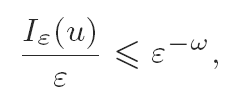 then, for h = ε(1+6399ω)/3201, the interpolant
 Note that it is trivial that
An asymptotic formula for the voltage potential in a perturbed ε-periodic composite medium containing misplaced inclusions of size ε
-
- Journal:
- Proceedings of the Royal Society of Edinburgh. Section A: Mathematics / Volume 136 / Issue 4 / August 2006
- Published online by Cambridge University Press:
- 12 July 2007, pp. 669-700
- Print publication:
- August 2006
-
- Article
- Export citation
Asymptotic behaviour of positive steady states to a predator—prey model
-
- Journal:
- Proceedings of the Royal Society of Edinburgh. Section A: Mathematics / Volume 136 / Issue 4 / August 2006
- Published online by Cambridge University Press:
- 12 July 2007, pp. 759-778
- Print publication:
- August 2006
-
- Article
- Export citation
