Refine search
Actions for selected content:
26078 results in Abstract analysis
Corrigendum
-
- Journal:
- Proceedings of the Royal Society of Edinburgh. Section A: Mathematics / Volume 133 / Issue 1 / February 2003
- Published online by Cambridge University Press:
- 12 July 2007, p. 1
- Print publication:
- February 2003
-
- Article
-
- You have access
- Export citation
A singular perturbation problem and the existence of non-commutative non-rotationally symmetric scalar solitons
-
- Journal:
- Proceedings of the Royal Society of Edinburgh. Section A: Mathematics / Volume 133 / Issue 1 / February 2003
- Published online by Cambridge University Press:
- 12 July 2007, pp. 151-156
- Print publication:
- February 2003
-
- Article
- Export citation
Asymptotics toward the diffusion wave for a one-dimensional compressible flow through porous media
-
- Journal:
- Proceedings of the Royal Society of Edinburgh. Section A: Mathematics / Volume 133 / Issue 1 / February 2003
- Published online by Cambridge University Press:
- 12 July 2007, pp. 177-196
- Print publication:
- February 2003
-
- Article
- Export citation
-
Consider the Cauchy problem for a one-dimensional compressible flow through porous media,
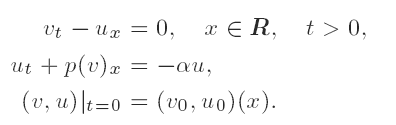 Hsiao and Liu showed that the solution (υ, u) behaves as the diffusion wave (ῡ, ū), i.e. the solution of the porous-media equation due to the Darcy law. The optimal convergence rates have been obtained by Nishihara and co-workers. When υ0(x) has the same constant state at x = ±∞, the convergence rate ‖(υ − ῡ)(·,t)‖L∞ = O(t−1) obtained is ‘optimal’, since ‖ῡ(·,t)‖∞ = O(t−1/2). However, this ‘optimal’ convergence rate is less sufficient to determine the location of the diffusion wave. Our aim in this paper is to obtain the ‘truly optimal’ convergence rate by choosing suitably located diffusion waves.
On the existence and ‘blow-up’ of solutions to a two-dimensional nonlinear boundary-value problem arising in corrosion modelling
-
- Journal:
- Proceedings of the Royal Society of Edinburgh. Section A: Mathematics / Volume 133 / Issue 1 / February 2003
- Published online by Cambridge University Press:
- 12 July 2007, pp. 119-149
- Print publication:
- February 2003
-
- Article
- Export citation
The structure of rank-one convex quadratic forms on linear elastic strains
-
- Journal:
- Proceedings of the Royal Society of Edinburgh. Section A: Mathematics / Volume 133 / Issue 1 / February 2003
- Published online by Cambridge University Press:
- 12 July 2007, pp. 213-224
- Print publication:
- February 2003
-
- Article
- Export citation
Duality of the distance to closed operator ideals
-
- Journal:
- Proceedings of the Royal Society of Edinburgh. Section A: Mathematics / Volume 133 / Issue 1 / February 2003
- Published online by Cambridge University Press:
- 12 July 2007, pp. 197-212
- Print publication:
- February 2003
-
- Article
- Export citation
Singular limits in polymer-stabilized liquid crystals
-
- Journal:
- Proceedings of the Royal Society of Edinburgh. Section A: Mathematics / Volume 133 / Issue 1 / February 2003
- Published online by Cambridge University Press:
- 12 July 2007, pp. 11-34
- Print publication:
- February 2003
-
- Article
- Export citation
Stability enhancement of output for a class of linear parabolic systems
-
- Journal:
- Proceedings of the Royal Society of Edinburgh. Section A: Mathematics / Volume 133 / Issue 1 / February 2003
- Published online by Cambridge University Press:
- 12 July 2007, pp. 157-175
- Print publication:
- February 2003
-
- Article
- Export citation
The functional Fučik spectrum has empty interior
-
- Journal:
- Proceedings of the Royal Society of Edinburgh. Section A: Mathematics / Volume 133 / Issue 1 / February 2003
- Published online by Cambridge University Press:
- 12 July 2007, pp. 3-10
- Print publication:
- February 2003
-
- Article
- Export citation
Extension of order-preserving maps on a cone
-
- Journal:
- Proceedings of the Royal Society of Edinburgh. Section A: Mathematics / Volume 133 / Issue 1 / February 2003
- Published online by Cambridge University Press:
- 12 July 2007, pp. 35-59
- Print publication:
- February 2003
-
- Article
- Export citation
Comparison results for PDEs with a singular potential
-
- Journal:
- Proceedings of the Royal Society of Edinburgh. Section A: Mathematics / Volume 133 / Issue 1 / February 2003
- Published online by Cambridge University Press:
- 12 July 2007, pp. 61-83
- Print publication:
- February 2003
-
- Article
- Export citation
The projection of a rectifiable Legendrian set is C2-rectifiable: a simplified proof
-
- Journal:
- Proceedings of the Royal Society of Edinburgh. Section A: Mathematics / Volume 133 / Issue 1 / February 2003
- Published online by Cambridge University Press:
- 12 July 2007, pp. 85-96
- Print publication:
- February 2003
-
- Article
- Export citation
On the Distribution of the Number of Missing Words in Random Texts
-
- Journal:
- Combinatorics, Probability and Computing / Volume 12 / Issue 1 / January 2003
- Published online by Cambridge University Press:
- 28 January 2003, pp. 73-87
-
- Article
- Export citation
Cycles and Unicyclic Components in Random Graphs
-
- Journal:
- Combinatorics, Probability and Computing / Volume 12 / Issue 1 / January 2003
- Published online by Cambridge University Press:
- 28 January 2003, pp. 27-52
-
- Article
- Export citation
Upper and Lower Bounds for the Kagomé Lattice Bond Percolation Critical Probability
-
- Journal:
- Combinatorics, Probability and Computing / Volume 12 / Issue 1 / January 2003
- Published online by Cambridge University Press:
- 28 January 2003, pp. 95-111
-
- Article
- Export citation
Equitable Colourings of d-degenerate Graphs
-
- Journal:
- Combinatorics, Probability and Computing / Volume 12 / Issue 1 / January 2003
- Published online by Cambridge University Press:
- 28 January 2003, pp. 53-60
-
- Article
- Export citation
An Average Set Size Theorem
-
- Journal:
- Combinatorics, Probability and Computing / Volume 12 / Issue 1 / January 2003
- Published online by Cambridge University Press:
- 28 January 2003, pp. 89-93
-
- Article
- Export citation
A General Spectral Bound for Distant Vertex Subsets
-
- Journal:
- Combinatorics, Probability and Computing / Volume 12 / Issue 1 / January 2003
- Published online by Cambridge University Press:
- 28 January 2003, pp. 17-26
-
- Article
- Export citation
Packing Digraphs with Directed Closed Trails
-
- Journal:
- Combinatorics, Probability and Computing / Volume 12 / Issue 1 / January 2003
- Published online by Cambridge University Press:
- 28 January 2003, pp. 1-15
-
- Article
- Export citation
-
It has been shown [2] that if n is odd and m1,…,mt are integers with mi[ges ]3 and [sum ]i=1tmi=|E(Kn)| then Kn can be decomposed as an edge-disjoint union of closed trails of lengths m1,…,mt. This result was later generalized [3] to all sufficiently dense Eulerian graphs G in place of Kn. In this article we consider the corresponding questions for directed graphs. We show that the complete directed graph <?TeX \displaystyle{\mathop{K}^{\raise-2pt\hbox{$\scriptstyle\leftrightarrow$}}}_{n}?>
can be decomposed as an edge-disjoint union of directed closed trails of lengths m1,…,mt whenever mi[ges ]2 and <?TeX \sum_{i=1}^t m_{i}=\vert E({\leftrightarrow}_{n})\vert ?>
The Largest Eigenvalue of Sparse Random Graphs
-
- Journal:
- Combinatorics, Probability and Computing / Volume 12 / Issue 1 / January 2003
- Published online by Cambridge University Press:
- 28 January 2003, pp. 61-72
-
- Article
- Export citation
