Refine search
Actions for selected content:
26078 results in Abstract analysis
MODULES OVER IWASAWA ALGEBRAS
-
- Journal:
- Journal of the Institute of Mathematics of Jussieu / Volume 2 / Issue 1 / January 2003
- Published online by Cambridge University Press:
- 27 January 2003, pp. 73-108
- Print publication:
- January 2003
-
- Article
- Export citation
IRREDUCIBLE AUTOMORPHISMS OF $F_{n}$ HAVE NORTH–SOUTH DYNAMICS ON COMPACTIFIED OUTER SPACE
-
- Journal:
- Journal of the Institute of Mathematics of Jussieu / Volume 2 / Issue 1 / January 2003
- Published online by Cambridge University Press:
- 27 January 2003, pp. 59-72
- Print publication:
- January 2003
-
- Article
- Export citation
SUR QUELQUES REPRÉSENTATIONS MODULAIRES ET $p$-ADIQUES DE $\mathrm{GL}_2(\bm{Q}_{p})$. II
-
- Journal:
- Journal of the Institute of Mathematics of Jussieu / Volume 2 / Issue 1 / January 2003
- Published online by Cambridge University Press:
- 27 January 2003, pp. 23-58
- Print publication:
- January 2003
-
- Article
- Export citation
NON-ABELIAN UNIPOTENT PERIODS AND MONODROMY OF ITERATED INTEGRALS
-
- Journal:
- Journal of the Institute of Mathematics of Jussieu / Volume 2 / Issue 1 / January 2003
- Published online by Cambridge University Press:
- 27 January 2003, pp. 145-168
- Print publication:
- January 2003
-
- Article
- Export citation
ENDPOINT MAPPING PROPERTIES OF SPHERICAL MAXIMAL OPERATORS
-
- Journal:
- Journal of the Institute of Mathematics of Jussieu / Volume 2 / Issue 1 / January 2003
- Published online by Cambridge University Press:
- 27 January 2003, pp. 109-144
- Print publication:
- January 2003
-
- Article
- Export citation
Asymptotic analysis of the American call option with dividends
-
- Journal:
- European Journal of Applied Mathematics / Volume 13 / Issue 6 / December 2002
- Published online by Cambridge University Press:
- 12 December 2002, pp. 587-616
-
- Article
- Export citation
Monotone increasing solutions of the Painlevé 1 equation y″ = y2+x and their role in the stability of the plasma-sheath transition
-
- Journal:
- European Journal of Applied Mathematics / Volume 13 / Issue 6 / December 2002
- Published online by Cambridge University Press:
- 12 December 2002, pp. 663-680
-
- Article
- Export citation
Multi-components chemotactic system in the absence of conflicts
-
- Journal:
- European Journal of Applied Mathematics / Volume 13 / Issue 6 / December 2002
- Published online by Cambridge University Press:
- 12 December 2002, pp. 641-661
-
- Article
- Export citation
Removing false singular points as a method of solving ordinary differential equations
-
- Journal:
- European Journal of Applied Mathematics / Volume 13 / Issue 6 / December 2002
- Published online by Cambridge University Press:
- 12 December 2002, pp. 617-639
-
- Article
- Export citation
Direct construction method for conservation laws of partial differential equations Part II: General treatment
-
- Journal:
- European Journal of Applied Mathematics / Volume 13 / Issue 5 / October 2002
- Published online by Cambridge University Press:
- 03 December 2002, pp. 567-585
-
- Article
- Export citation
Ill-posedness issues for a class of parabolic equations
-
- Journal:
- Proceedings of the Royal Society of Edinburgh. Section A: Mathematics / Volume 132 / Issue 6 / December 2002
- Published online by Cambridge University Press:
- 12 July 2007, pp. 1407-1416
- Print publication:
- December 2002
-
- Article
- Export citation
-
We prove that the Cauchy problem for the one-dimensional parabolic equations
, with initial data in Hs(R), cannot be solved by an iterative scheme based on the Duhamel formula for s < −1 if (k, d) = (2, 0) and s < sc(k, d) = ½ − (2 − d)/(k − 1) otherwise. This exactly completes the positive results on the Cauchy problem in Hs(R) for these equations and shows the particularity of the case (k, d) = (2, 0), for which we prove that the critical space Hsc(R) = H−3/2(R), by standard scaling arguments, cannot be reached. Our results also hold in the periodic setting.
On conservation laws and necessary conditions in the calculus of variations
-
- Journal:
- Proceedings of the Royal Society of Edinburgh. Section A: Mathematics / Volume 132 / Issue 6 / December 2002
- Published online by Cambridge University Press:
- 12 July 2007, pp. 1361-1371
- Print publication:
- December 2002
-
- Article
- Export citation
Existence of stationary solutions with transition layers for a class of cross-diffusion systems
-
- Journal:
- Proceedings of the Royal Society of Edinburgh. Section A: Mathematics / Volume 132 / Issue 6 / December 2002
- Published online by Cambridge University Press:
- 12 July 2007, pp. 1493-1511
- Print publication:
- December 2002
-
- Article
- Export citation
Lagrangian and Hamiltonian formalism for constrained variational problems
-
- Journal:
- Proceedings of the Royal Society of Edinburgh. Section A: Mathematics / Volume 132 / Issue 6 / December 2002
- Published online by Cambridge University Press:
- 12 July 2007, pp. 1417-1437
- Print publication:
- December 2002
-
- Article
- Export citation
Nonlinear eigenvalue problems for a class of ordinary differential equations
-
- Journal:
- Proceedings of the Royal Society of Edinburgh. Section A: Mathematics / Volume 132 / Issue 6 / December 2002
- Published online by Cambridge University Press:
- 12 July 2007, pp. 1333-1359
- Print publication:
- December 2002
-
- Article
- Export citation
-
We consider the class of nonlinear eigenvalue problems
 where yp* = |y|p sgn y, pi > 0 and p0p1 … pn−1 = r, with various boundary conditions. We prove the existence of eigenvalues and study the zero properties and structure of the corresponding eigenfunctions.
Half-eigenvalues of elliptic operators
-
- Journal:
- Proceedings of the Royal Society of Edinburgh. Section A: Mathematics / Volume 132 / Issue 6 / December 2002
- Published online by Cambridge University Press:
- 12 July 2007, pp. 1439-1451
- Print publication:
- December 2002
-
- Article
- Export citation
-
Suppose that L is a second-order self-adjoint elliptic partial differential operator on a bounded domain Ω ⊂ Rn, n ≥ 2, and a, b ∈ L∞(Ω). If the equation Lu = au+ − bu− + λu (where λ ∈ R and u±(x) = max{±u(x), 0}) has a non-trivial solution u, then λ is said to be a half-eigenvalue of (L; a, b). In this paper, we obtain some general properties of the half-eigenvalues of (L; a, b) and also show that, generically, the half-eigenvalues are ‘simple’.
We also consider the semilinear problem
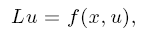 where f : Ω × R → R is a Carathéodory function such that, for a.e. x ∈ Ω,
 and we relate the solvability properties of this problem to the location of the half-eigenvalues of (L; a, b).
A finitely generated variety of combinatorial inverse semigroups having uncountably many subvarieties
-
- Journal:
- Proceedings of the Royal Society of Edinburgh. Section A: Mathematics / Volume 132 / Issue 6 / December 2002
- Published online by Cambridge University Press:
- 12 July 2007, pp. 1373-1394
- Print publication:
- December 2002
-
- Article
- Export citation
Nonlinear eigenvalue–eigenvector problems for STP matrices
-
- Journal:
- Proceedings of the Royal Society of Edinburgh. Section A: Mathematics / Volume 132 / Issue 6 / December 2002
- Published online by Cambridge University Press:
- 12 July 2007, pp. 1307-1331
- Print publication:
- December 2002
-
- Article
- Export citation
-
Let Ai, i = 1, …, m, be a set of Ni × Ni−1 strictly totally positive (STP) matrices, with N0 = Nm = N. For a vector x = (x1, …, xN) ∈ RN and arbitrary p > 0, set
 We consider the eigenvalue-eigenvector problem
 where p1 … pm−1 = r. We prove an analogue of the classical Gantmacher-Krein theorem for the eigenvalue-eigenvector structure of STP matrices in the case where pi ≥ 1 for each i, plus various extensions thereof.
Schauder estimates for fully nonlinear elliptic difference operators
-
- Journal:
- Proceedings of the Royal Society of Edinburgh. Section A: Mathematics / Volume 132 / Issue 6 / December 2002
- Published online by Cambridge University Press:
- 12 July 2007, pp. 1395-1406
- Print publication:
- December 2002
-
- Article
- Export citation
Existence and decay rates of smooth solutions for a non-uniformly parabolic equation
-
- Journal:
- Proceedings of the Royal Society of Edinburgh. Section A: Mathematics / Volume 132 / Issue 6 / December 2002
- Published online by Cambridge University Press:
- 12 July 2007, pp. 1477-1491
- Print publication:
- December 2002
-
- Article
- Export citation
