Refine search
Actions for selected content:
9084 results in Discrete Mathematics, Information Theory and Coding
Index to Volume 44
-
- Journal:
- Mathematika / Volume 44 / Issue 2 / December 1997
- Published online by Cambridge University Press:
- 26 February 2010, pp. 439-440
- Print publication:
- December 1997
-
- Article
- Export citation
MTK volume 44 issue 2 Cover and Front matter
-
- Journal:
- Mathematika / Volume 44 / Issue 2 / December 1997
- Published online by Cambridge University Press:
- 26 February 2010, pp. f1-f2
- Print publication:
- December 1997
-
- Article
-
- You have access
- Export citation
G. Baumslag. Topics in Combinatorial Group Theory. Birkhauser. 1993, ISBN 3 7643 2921 1, (1993), 164 pp., 38 Swiss Francs. - L. Berggren, J. Borwein and P. Borwein, Editors. Pi: A Source Book. Springer. 1997, ISBN 0 387 94924 0; 716 pp., £38·50. - D. Berlinski. A Tour of the Calculus. Heinemann. 1996, ISBN 0 434 09844 2; 331 pp., paperback, £8·99. - M. R. Darnel. Theory of lattice-ordered groups. M. Dekker. 1995, ISBN 0 8247 9326 9; 539 pp., $165. - D. M. Evans, Editor. Model Theory of Groups and Automorphism Groups. L.M.S. Lecture Notes, 244. Cambridge University Press. 1997, ISBN 0 521 58955 X; 212 pp., paperback, £24·95. - W. Fulton. Young Tableaux: With Applications to Representation Theory and Geometry, L.M.S. Student Texts, 35. Cambridge University Press. 1997, ISBN 0 521 56724 6; 260 pp., paperback £14·95. - H. Groemer. Geometric Applications of Fourier Series and Spherical Harmonics. Cambridge University Press. 1996, ISBN 0 521 47318 7; 329 pp., hardback, £40. - W. Hodges. A shorter Model Theory. Cambridge University Press. 1997, ISBN 0 521 58713 1; 310 pp., paperback, £22·95. - M. N. Huxley. Area, Lattice Points and Exponential Sums. L.M.S. Monograph, New Series, 13. Clarendon Press. 1996, ISBN 0 19 853466 3; 494 pp., hardback, £85. - N. Jacobson. Finite-dimensional Division Algebras over Fields. Springer. 1996, ISBN 3 540 57029 2; 278 pp., £42·50. - D. L. Johnson. Presentations of Groups. L.M.S. Student Texts, 15, 2nd Edition. Cambridge University Press. 1997, ISBN 0 521 58542 2; 216 pp., paperback, £17·95. - D. Jungnickel and S. A. Vanstone, Editors. Coding Theory, Design Theory, Group Theory. Proceedings of the Marshall Hall Conference. J. Wiley. 1993, ISBN 0 471 55703 X; 299 pp., £71. - P.-L. Lions. Mathematical Topics in Fluid Mechanics, Vol. I, Incompressible Models. Clarendon Press. 1996, ISBN 0 19 851487 5; 237 pp., hardback, £29·50. - P. Lounesto. Clifford Algebras and Spinors, L.M.S. Lecture Notes, 239. Cambridge University Press. 1997, ISBN 0 521 59916 4; 306 pp., paperback, £27·95. - H. T. Nguyen and E. A. Walker. A first course in Fuzzy Logic. CRC Press, Boca Raton. 1977. ISBN 0 8493 9477 5; 266 pp., £49. - C. Peskine. An algebraic Introduction to Complex Projective Geometry, I. Commutative Algebra. Cambridge University Press. 1996, ISBN 0 521 48072 8; 230 pp., hardback, £25. - L. A. Petrosjan and V. V. Mazalov, Editors. Game Theory and Applications. Nova Science Publications. Vol. I, 1995, ISBN 1 56072 266 5; 219 pp., $79. Vol. II, 1996, ISBN 1 56072 390 4; 257 pp., $69. - L. Schneps and P. Lochak, Editors. Geometric Galois Action. Vol. 1, Around Grothendieck's Esquisse d'un Programme. Vol. 2, The Inverse Galois Problem, Moduli Spaces and Mapping Class Groups. L.M.S. Lecture Notes 242 and 243. Cambridge University Press. Vol. 1, 1997, ISBN 0 521 59642 4; 293 pp., paperback, £24'95. Vol. 2, 1997, ISBN 0 521 59641 6; 347 pp., £24·95. - J.-P. Serre. Galois cohomology. Springer. 1997, ISBN 3 540 61990 9; 210 pp., £32. - I. R. Shafarevich. Basic Notions of Algebra. Springer. 1997, ISBN 3 540 61221 1; 258 pp., paperback, £32. - A. C. Thompson. Minkowski Geometry. Cambridge University Press. 1996, ISBN 0 521 40472 X; 346 pp., hardback, £40. - T. A. Whitelaw. Introduction to Abstract Algebra. Blackie Academic & Professional. 1995, ISBN 0 7514 0147 1; 247 pp., paperback, £19·99.
-
- Journal:
- Mathematika / Volume 44 / Issue 2 / December 1997
- Published online by Cambridge University Press:
- 26 February 2010, pp. 434-438
- Print publication:
- December 1997
-
- Article
- Export citation
Almost-prime k-tuples
- Part of
-
- Journal:
- Mathematika / Volume 44 / Issue 2 / December 1997
- Published online by Cambridge University Press:
- 26 February 2010, pp. 245-266
- Print publication:
- December 1997
-
- Article
- Export citation
Asymptotic expansions and inequalities for hypergeometric function
-
- Journal:
- Mathematika / Volume 44 / Issue 2 / December 1997
- Published online by Cambridge University Press:
- 26 February 2010, pp. 278-301
- Print publication:
- December 1997
-
- Article
- Export citation
The resultant and the Koszul complex of a set of forms
- Part of
-
- Journal:
- Mathematika / Volume 44 / Issue 2 / December 1997
- Published online by Cambridge University Press:
- 26 February 2010, pp. 348-356
- Print publication:
- December 1997
-
- Article
- Export citation
-
For i = 1,…, n let ai be a homogeneous polynomial of degree ri(>0) in the graded polynomial ring R[x1, …, xm], or R[x] for short, where R is a commutative ring with unity and x1, …, xm are indeterminates of degree 1. Let
 of degree - 1 be a formal inverse of xj and let U denote the graded R[x]-module
  In [2, §2] we introduced a graded complex of r-modules.
 of degree - 1 be a formal inverse of
  In [2, §2] we introduced a graded complex of
 Few points to generate a random polytope
- Part of
-
- Journal:
- Mathematika / Volume 44 / Issue 2 / December 1997
- Published online by Cambridge University Press:
- 26 February 2010, pp. 325-331
- Print publication:
- December 1997
-
- Article
- Export citation
-
A random polytope, Kn, is the convex hull of n points chosen randomly, independently, and uniformly from a convex body
 It is shown here that, with high probability, Kn can be obtained by taking the convex hull of m = o(n) points chosen independently and uniformly from a small neighbourhood of the boundary of K.
 It is shown here that, with high probability,
 Average densities and linear rectifiability of measures
- Part of
-
- Journal:
- Mathematika / Volume 44 / Issue 2 / December 1997
- Published online by Cambridge University Press:
- 26 February 2010, pp. 313-324
- Print publication:
- December 1997
-
- Article
- Export citation
The number of blocks with a given defect group
- Part of
-
- Journal:
- Mathematika / Volume 44 / Issue 2 / December 1997
- Published online by Cambridge University Press:
- 26 February 2010, pp. 368-373
- Print publication:
- December 1997
-
- Article
- Export citation
An Average-Case Analysis of the Gaussian Algorithm for Lattice Reduction
-
- Journal:
- Combinatorics, Probability and Computing / Volume 6 / Issue 4 / December 1997
- Published online by Cambridge University Press:
- 01 December 1997, pp. 397-433
-
- Article
- Export citation
A note on the separation of slow viscous flow near a sharp edge
- Part of
-
- Journal:
- Mathematika / Volume 44 / Issue 2 / December 1997
- Published online by Cambridge University Press:
- 26 February 2010, pp. 239-244
- Print publication:
- December 1997
-
- Article
- Export citation
Recovering Set Systems and Graph Entropy
-
- Journal:
- Combinatorics, Probability and Computing / Volume 6 / Issue 4 / December 1997
- Published online by Cambridge University Press:
- 01 December 1997, pp. 481-491
-
- Article
- Export citation
The stability of the Strokes layer in periodic orbital flow around a circular cylinder
- Part of
-
- Journal:
- Mathematika / Volume 44 / Issue 2 / December 1997
- Published online by Cambridge University Press:
- 26 February 2010, pp. 225-238
- Print publication:
- December 1997
-
- Article
- Export citation
Strong shift equivalence of 2 by 2 non-negative integral matrices
- Part of
-
- Journal:
- Mathematika / Volume 44 / Issue 2 / December 1997
- Published online by Cambridge University Press:
- 26 February 2010, pp. 302-312
- Print publication:
- December 1997
-
- Article
- Export citation
Maximal Spacing Configurations in Graphs
-
- Journal:
- Combinatorics, Probability and Computing / Volume 6 / Issue 4 / December 1997
- Published online by Cambridge University Press:
- 01 December 1997, pp. 455-463
-
- Article
- Export citation
Radial variation of functions in Dirichlet-type spaces
- Part of
-
- Journal:
- Mathematika / Volume 44 / Issue 2 / December 1997
- Published online by Cambridge University Press:
- 26 February 2010, pp. 267-277
- Print publication:
- December 1997
-
- Article
- Export citation
-
Let W denote a positive, increasing and continuous function on [1, ∞]. We write
 to denote the Dirichlettype space of functions f that are holomorphic in the unit disc
  and for which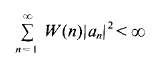
Where
 If W(x) = x for all x, then is the classicial Dirichlet space for which
  Note also that
  for every
  so, by Fatu's theoreum, every function in . ha finite radial(and angular) limits a.e. on the boundary of U. The question of the existence a.e. on ∂U of certain tangential limits for functions in has been considered in [6,11], but we shall be concerned here with the radial variation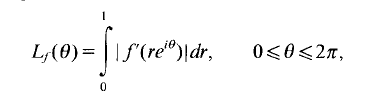
i.e., the length of the image of the ray from 0 to eiθ under the mapping w = f(z), and, in particular, with the size of the set of values of θ for which Lf(θ) can be infinite when

 to denote the Dirichlettype space of functions
  and for which
 If
If  Note also that
  for every
  so, by Fatu's theoreum, every function in

3 - Combinatorial Functional Equations
-
- Book:
- Combinatorial Species and Tree-like Structures
- Published online:
- 05 May 2013
- Print publication:
- 13 November 1997, pp 162-276
-
- Chapter
- Export citation
Bibliography
-
- Book:
- Combinatorial Species and Tree-like Structures
- Published online:
- 05 May 2013
- Print publication:
- 13 November 1997, pp 434-446
-
- Chapter
- Export citation
2 - Complements on Species of Structures
-
- Book:
- Combinatorial Species and Tree-like Structures
- Published online:
- 05 May 2013
- Print publication:
- 13 November 1997, pp 59-161
-
- Chapter
- Export citation
Appendix 1 - Group Actions and Pólya Theory
-
- Book:
- Combinatorial Species and Tree-like Structures
- Published online:
- 05 May 2013
- Print publication:
- 13 November 1997, pp 393-407
-
- Chapter
- Export citation
