Refine search
Actions for selected content:
9084 results in Discrete Mathematics, Information Theory and Coding
Is there a different proof of the Erdős-Rado theorem?
-
-
- Book:
- A Tribute to Paul Erdos
- Published online:
- 05 March 2012
- Print publication:
- 13 December 1990, pp 27-38
-
- Chapter
- Export citation
Hypergraph games and the chromatic number
-
-
- Book:
- A Tribute to Paul Erdos
- Published online:
- 05 March 2012
- Print publication:
- 13 December 1990, pp 201-206
-
- Chapter
- Export citation
On graphs not containing prescribed induced subgraphs
-
-
- Book:
- A Tribute to Paul Erdos
- Published online:
- 05 March 2012
- Print publication:
- 13 December 1990, pp 111-120
-
- Chapter
- Export citation
Graphs with no unfriendly partitions
-
-
- Book:
- A Tribute to Paul Erdos
- Published online:
- 05 March 2012
- Print publication:
- 13 December 1990, pp 373-384
-
- Chapter
- Export citation
Partitions sans petits sommants
-
-
- Book:
- A Tribute to Paul Erdos
- Published online:
- 05 March 2012
- Print publication:
- 13 December 1990, pp 121-152
-
- Chapter
- Export citation
Large α-preserving sets in infinite α-connected graphs
-
-
- Book:
- A Tribute to Paul Erdos
- Published online:
- 05 March 2012
- Print publication:
- 13 December 1990, pp 445-450
-
- Chapter
- Export citation
Hamilton cycles in random graphs of minimal degree at least k
-
-
- Book:
- A Tribute to Paul Erdos
- Published online:
- 05 March 2012
- Print publication:
- 13 December 1990, pp 59-96
-
- Chapter
- Export citation
Sum-free subsets
-
-
- Book:
- A Tribute to Paul Erdos
- Published online:
- 05 March 2012
- Print publication:
- 13 December 1990, pp 13-26
-
- Chapter
- Export citation
On the greatest prime factor of an arithmetical progression
-
-
- Book:
- A Tribute to Paul Erdos
- Published online:
- 05 March 2012
- Print publication:
- 13 December 1990, pp 385-390
-
- Chapter
- Export citation
Some recent results on interpolation
-
-
- Book:
- A Tribute to Paul Erdos
- Published online:
- 05 March 2012
- Print publication:
- 13 December 1990, pp 451-458
-
- Chapter
- Export citation
A remark on heights of subspaces
-
-
- Book:
- A Tribute to Paul Erdos
- Published online:
- 05 March 2012
- Print publication:
- 13 December 1990, pp 359-360
-
- Chapter
- Export citation
On the mean convergence of derivatives of Lagrange interpolation
-
-
- Book:
- A Tribute to Paul Erdos
- Published online:
- 05 March 2012
- Print publication:
- 13 December 1990, pp 397-404
-
- Chapter
- Export citation
A Galvin–Hajnal conjecture on uncountably chromatic graphs
-
-
- Book:
- A Tribute to Paul Erdos
- Published online:
- 05 March 2012
- Print publication:
- 13 December 1990, pp 313-316
-
- Chapter
- Export citation
BOOK REVIEWS - D. J. Acheson. Elementary Fluid Dynamics. Clarendon Press. 1990, 397 pp., £15. - C. D. Aliprantis and O. Burkinshaw. Principles of Real Analysis. 2nd Edition. Academic Press. 1990, 295 pp., $39.95. - C. D. Aliprantis and O. Burkinshaw. Problems in Real Analysis. Academic Press. 1990, 285 pp., $29.95. - M. Aoki. Optimization of Stochastic Systems: Topics in Discrete-Time Dynamics. Academic Press. 1989, 417 pp., $64.95. - J. Borwein and P. Borwein. A Dictionary of Real Numbers. Wadsworth and Brooks/Cole. 1990, 424 pp., £55-50. - Y. A. Brychkov and A. P. Prudnikov. Integral Transforms of Generalized Functions. Gordon & Breach. 1989, 343 pp., $140. - A. J. Chorin. Computational Fluid Mechanics: Selected Papers. Academic Press. 1989, 223 pp., $35. - C. Clapham. The Concise Oxford Dictionary of Mathematics. Oxford University Press. 1990, 204 pp., £4-95. - P. Constantin and C. Foias. Navier-Stokes Equations. University of Chicago Press. 1988, 190 pp., £27-95. - S. Dineen. The Schwarz Lemma. Clarendon Press. 1989, 248 pp., £25. - P. Dita and V. Georgescu, Editors. Conformal Invariance and String Theory. Academic Press. 1989, 557 pp., $59.95. - L. Eldén and L. Wittmeyer-Koch. Numerical Analysis–an Introduction. Academic Press. 1990, 347 pp., $39.95. - K. D. Elworthy and J.-C. Zambrini. Stochastic Analysis, Path Integration and Dynamics. Longman. 1989, 263 pp., £18. - R. V. Gamkrelidze, Editor. Analysis I: Integral Representations and Asymptotic Methods. Springer. 1989, 238 pp., DM 128. - S. Gelbart and F. Shahidi. Analytic properties of automorphic L-functions. Academic Press. 1988, 131 pp., $18.75. - T. A. Grandine. The Numerical Methods Programming Projects Book. Oxford. 1990, 146 pp., £9-95 - M. H. J. Gruber. Regression Estimators: a Comparative Study. Academic Press. 1990, 347 pp., $49.95. - F. R. Harvey. Spinors and Calibrations. Academic Press. 1990, 313 pp., $39.95. - W. K. Hayman. Subharmonic Functions, Vol. 2. Academic Press. 1989, 590 pp., £53-50. - J. Kevorkian. Partial Differential Equations: Analytical Solution Techniques. Wadsworth and Brooks/Cole. 1990, 547 pp., £14-95. - H.-O. Kreiss and J. Lorenz. Initial-Boundary Value Problems and the Navier Stokes Equations. Academic Press. 1989, 402 pp., $54.50. - S. Lang. A First Course in Calculus. Fifth Edition. Springer. 1986, 280 pp., DM 128. - P. D. Lax and R. S. Phillips. Scattering Theory, 2nd Edition. Academic Press. 1989, 309 pp., $44.95. - J. C. Morgan II. Point set theory. Marcel Dekker. 1990, 296 pp., $119.50. - M. Pavel. Fundamentals of Pattern Recognition. Marcel Dekker. 1989, 183 pp., $107.50. - J. Roitman. Introduction to Modern Set Theory. Wiley. 1990, 156 pp., £32-15. - C. Rogers and W. F. Ames. Nonlinear Boundary Value Problems in Science and Engineering. Academic Press. 1989, 417 pp., $69.9 - D. E. Rowe and J. Mccleary, Editors. The History of Modern Mathematics. Vol. II: Institutions and Applications. Academic Press. 1989, 325 pp., $37.50. - D. Ruelle. Elements of Differentiable Dynamics and Bifurcation Theory. Academic Press. 1989, 187 pp., $27.50 - Y. A. Ryzhov, U. G. Pirumov and V. N. Gorbunov. Nonequilibrium condensation in high-speed gas flows. Gordon and Breach. 1989, 290 pp., $199. - Y. G. Sinai, Editor. Dynamical Systems II. Springer. 1989, 281 pp., DM 128. - V. I. Arnold and S. P. Novikov, Editors. Dynamical Systems IV. Springer. 1990, 283 pp., DM 128. - P. Smith and R. C. Smith. Mechanics. 2nd Edition. Wiley. 1990, 316 pp., £13-95. - G. Stépán. Retarded dynamical systems: stability and characteristic functions. Longman. 1989, 151 pp., £16-50. - G. Toth. Harmonic maps and minimal immersions through representation theory. Academic Press. 1990, 154 pp., $24.95. - M. Vaughan-Lee. The restricted Burnside problem. Oxford University Press. 1990, 209 pp., £27-50. - F. Verhulst. Nonlinear Differential Equations and Dynamical Systems. Springer. 1990, 277 pp., DM38. - A. G. Vitushkin, Editor. Several Complex Variables, I. Springer. 1990, 248 pp., DM128. - W. L. Wood. Practical Time-stepping Schemes. Clarendon Press. 1990, 373 pp., £17-50. - H. S. Wilf. Generating functionology. Academic Press. 1990, 184 pp., $29.95. - M. Young. The Technical Writer's Handbook. Oxford University Press. 1989, 232 pp., £14-95. - E. Zauderer. Partial Differential Equations of Applied Mathematics, 2nd Edition. Wiley. 1989, 891 pp., £51.30 hardback, £29.75 paperback.
-
- Journal:
- Mathematika / Volume 37 / Issue 2 / December 1990
- Published online by Cambridge University Press:
- 07 April 2017, pp. 332-340
- Print publication:
- December 1990
-
- Article
- Export citation
On the union of convex bodies with no interior point in common
- Part of
-
- Journal:
- Mathematika / Volume 37 / Issue 2 / December 1990
- Published online by Cambridge University Press:
- 26 February 2010, pp. 245-250
- Print publication:
- December 1990
-
- Article
- Export citation
-
Let K1, K2,…, Kd+1 be d+1 convex bodies in Ed, the interiors of which have no point in common. If mX denotes the measure of set X, we prove

and this inequality is best possible.
Sums of powers of the zeros of the Bessel polynomials
-
- Journal:
- Mathematika / Volume 37 / Issue 2 / December 1990
- Published online by Cambridge University Press:
- 26 February 2010, pp. 305-315
- Print publication:
- December 1990
-
- Article
- Export citation
-
Let
 be the sum of the m-th powers of the zeros of the Bessel polynomial yn(x). It is known that for m = 0, 1, 2, …,
where cm(v) is the Hawkins polynomial. In this paper we find rational functions wm(v) such that for m = 0, 1, 2, …

 be the sum of the
Small zeros of quadratic congruences modulo pq
-
- Journal:
- Mathematika / Volume 37 / Issue 2 / December 1990
- Published online by Cambridge University Press:
- 26 February 2010, pp. 261-272
- Print publication:
- December 1990
-
- Article
- Export citation
-
Let Q(x) = Q(x1, x2,…, xn) be a quadratic form with integer coefficients. Schinzel, Schickewei and Schmidt [9, Theorem 1] have shown that for any modulus m there exists a nonzero
 such that
and ║x║≤m(1/2)+(1/2(n-1)), where ║x║ = max |xi|. When m is a prime Heath-Brown [8] has obtained a nonzero solution of (1) with ║x║≤m1/2 log m. Yuan [10] has extended Heath-Brown's work to all finite fields. We have proved related results in [5] and [6]. In this paper we extend Heath-Brown's work to moduli which are a product of two primes. Throughout the paper we shall assume that n is even and n>2. For any odd prime p let
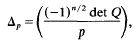
where det Q is the determinant of the integer matrix representing Q and
 is the Legendre symbol.
 such that
 is the Legendre symbol.
On the lower bound sieve
-
- Journal:
- Mathematika / Volume 37 / Issue 2 / December 1990
- Published online by Cambridge University Press:
- 26 February 2010, pp. 273-286
- Print publication:
- December 1990
-
- Article
- Export citation
Görtler vortices in growing boundary layers: The leading edge receptivity problem, linear growth and the nonlinear breakdown stage
- Part of
-
- Journal:
- Mathematika / Volume 37 / Issue 2 / December 1990
- Published online by Cambridge University Press:
- 26 February 2010, pp. 151-189
- Print publication:
- December 1990
-
- Article
- Export citation
Index to volume 37
-
- Journal:
- Mathematika / Volume 37 / Issue 2 / December 1990
- Published online by Cambridge University Press:
- 26 February 2010, p. 341
- Print publication:
- December 1990
-
- Article
- Export citation
