Refine search
Actions for selected content:
9084 results in Discrete Mathematics, Information Theory and Coding
Dimension prints
- Part of
-
- Journal:
- Mathematika / Volume 35 / Issue 1 / June 1988
- Published online by Cambridge University Press:
- 26 February 2010, pp. 1-27
- Print publication:
- June 1988
-
- Article
- Export citation
An inequality, with applications to Cantor measures and normal numbers
-
- Journal:
- Mathematika / Volume 35 / Issue 1 / June 1988
- Published online by Cambridge University Press:
- 26 February 2010, pp. 87-94
- Print publication:
- June 1988
-
- Article
- Export citation
-
Suppose x1, x2Є[0,1] and α = log 3/ log 4. Then

The relation is readily seen to be satisfied with equality for both of X1, x2 equal to any of the values 0, ½, 1 so that the value of α is “best possible”.
On the length of faithful nuclear representations of finite rank operators
- Part of
-
- Journal:
- Mathematika / Volume 35 / Issue 1 / June 1988
- Published online by Cambridge University Press:
- 26 February 2010, pp. 126-143
- Print publication:
- June 1988
-
- Article
- Export citation
-
We study the minimal length of faithful nuclear representations of operators acting between finite-dimensional Banach spaces and the related minimal number of contact points of the John ellipsoid of maximal volume contained in the unit ball of a finite-dimensional Banach space. In both cases the classical upper estimates, which follow from the Caratheodory theorem, are shown to be exact. Related isometric characterizations of
 are proved.
 are proved.
The fractional part of αnk
-
- Journal:
- Mathematika / Volume 35 / Issue 1 / June 1988
- Published online by Cambridge University Press:
- 26 February 2010, pp. 28-37
- Print publication:
- June 1988
-
- Article
- Export citation
-
Let α be a real number and k a positive integer. We shall be interested in integer values of n for which ║αnk║ is small. For the case k = 1 we have Dirichlet's Theorem. For any N ≥ 1 there exists n ≤ N with


Metric Diophantine approximation with two restricted variables II: A prime and a square-free integer
-
- Journal:
- Mathematika / Volume 35 / Issue 1 / June 1988
- Published online by Cambridge University Press:
- 26 February 2010, pp. 59-68
- Print publication:
- June 1988
-
- Article
- Export citation
-
In this paper we continue the investigation begun in [6] concerning the number of solutions of the inequality

for almost all α (in the sense of Lebesgue measure on ℝ), where β is a given real number,
 , and both m and n are confined to sets of numbertheoretic interest. Our aim is to extend existing results ([7], [8], [5] for example), where only n is restricted. Here we shall prove the following result where, as elsewhere in this paper, p denotes a prime, and a square-free integer may be positive or negative.
 , and both
 Realising wreath products of cyclic groups as Galois groups
-
- Journal:
- Mathematika / Volume 35 / Issue 1 / June 1988
- Published online by Cambridge University Press:
- 26 February 2010, pp. 101-113
- Print publication:
- June 1988
-
- Article
- Export citation
-
Let K be any field of characteristic 0 and let T and X be algebraically independent over K. For n ≥ 1 let k(n) ≥ 2 be an integer and let fn(X, T) = xk(n) + T ε K [X, T]. We shall regard T as a “parameter” and X as a “variable”. We put F1(X, T) = f1(X, T) and define, for n ≥ 1,

A note on polynomials with minimal value set over finite fields
-
- Journal:
- Mathematika / Volume 35 / Issue 1 / June 1988
- Published online by Cambridge University Press:
- 26 February 2010, pp. 144-148
- Print publication:
- June 1988
-
- Article
- Export citation
-
Let f(x) be a polynomial of degree d over Fq, the finite field with q = pn elements. Let V(f) denote the number of distinct values of f(x), xєFq. Then, it is easy to see that

where [x] denotes the greatest integer ≤x. A polynomial for which equality is achieved in (1) is called a minimal value set polynomial. Minimal value set polynomials have been studied in [1] and [3].
The homological grade of a module
-
- Journal:
- Mathematika / Volume 35 / Issue 1 / June 1988
- Published online by Cambridge University Press:
- 26 February 2010, pp. 114-125
- Print publication:
- June 1988
-
- Article
- Export citation
-
For an ideal A of a commutative ring R with identity and a unitary R-module E the notion of an E-sequence of length d in A can be extended as follows. For d = 0 the E-sequence is empty, and for d = 1 it is a subset {ai|i ∈ I} = α ⊆ A such that
 . For d > 1 we may define, inductively, an E-sequence of length d in A as a sequence
of subsets of A such that a, is an E-sequence of length 1 in A and α2,…, αd is a
 -sequence of length d − 1 in A. Thus in the standard notion of E-sequence the sets αj, are singletons, and, in effect, the extended notion due to Hochster [1] and Northcott [3] the sets a; are finite. Many of the standard results concerning E-sequences when E is Noetherian extend to the above generalization when the Noetherian condition is dropped. For example it follows from the results of the present note that every maximal E-sequence has the same length (which may be infinite) and every E-sequence can be extended to a maximal E-sequence. This maximal length is inf
  which we call the homological grade of E in A and denote by hgrR (A; E). So 0 ≤ hgrR (A; E) ≤ ∞, hgrR (A; E) = 0, if, and only if, 0:EA≠0 and hgrg (A; E) = ∞, if, and only if,
  for all nєℤ.
 . For
. For 
 -sequence of length
  which we call the
  for all nєℤ.
Multiplicative functions on arithmetic progressions
-
- Journal:
- Mathematika / Volume 34 / Issue 2 / December 1987
- Published online by Cambridge University Press:
- 26 February 2010, pp. 199-206
- Print publication:
- December 1987
-
- Article
- Export citation
A maximally symmetric polyhedron of genus 3 with 10 vertices
- Part of
-
- Journal:
- Mathematika / Volume 34 / Issue 2 / December 1987
- Published online by Cambridge University Press:
- 26 February 2010, pp. 237-242
- Print publication:
- December 1987
-
- Article
- Export citation
Index to Volume 34
-
- Journal:
- Mathematika / Volume 34 / Issue 2 / December 1987
- Published online by Cambridge University Press:
- 26 February 2010, p. 287
- Print publication:
- December 1987
-
- Article
- Export citation
On Hua's estimates for exponential sums
-
- Journal:
- Mathematika / Volume 34 / Issue 2 / December 1987
- Published online by Cambridge University Press:
- 26 February 2010, pp. 115-123
- Print publication:
- December 1987
-
- Article
- Export citation
-
Let

and let p denote any prime. The p-content vp(f) of f is denned by

Maximally symmetric polyhedral realizations of Dyck's regular map
- Part of
-
- Journal:
- Mathematika / Volume 34 / Issue 2 / December 1987
- Published online by Cambridge University Press:
- 26 February 2010, pp. 229-236
- Print publication:
- December 1987
-
- Article
- Export citation
Internal characterization of fragmentable spaces
- Part of
-
- Journal:
- Mathematika / Volume 34 / Issue 2 / December 1987
- Published online by Cambridge University Press:
- 26 February 2010, pp. 243-257
- Print publication:
- December 1987
-
- Article
- Export citation
Spherical averages of Fourier transforms of measures with finite energy; dimensions of intersections and distance sets
- Part of
-
- Journal:
- Mathematika / Volume 34 / Issue 2 / December 1987
- Published online by Cambridge University Press:
- 26 February 2010, pp. 207-228
- Print publication:
- December 1987
-
- Article
- Export citation
-
Let μ, be a positive Radon measure with compact support in the euclidean n-space ℝn. Introducing the Fourier transform
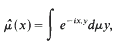
and the averages over the spheres

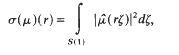
we can write the α-energy, 0 < α < n, of μ as
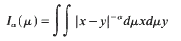
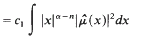
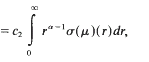
where the positive constants c1 and c2 depend only on n and α. The second equality is based on the Plancherel formula and the fact that
 where
where  .
.
 where
where  .
.Additive Diophantine inequalities with mixed powers II
-
- Journal:
- Mathematika / Volume 34 / Issue 2 / December 1987
- Published online by Cambridge University Press:
- 26 February 2010, pp. 131-140
- Print publication:
- December 1987
-
- Article
- Export citation
-
A classical problem in the additive theory of numbers is the determination of the minimal s such that for all sufficiently large n the equation

is solvable in natural numbers xk. Improving on earlier results the author [2] has been able to prove that one may take s = 18. In a survey article W. Schwarz asked for an analogue for diophantine inequalities [6]. As a first contribution to this subject we prove
Theorem. Let λ2, …, λ23 be nonzero real numbers, λ2/λ3 irrational. Then the values taken by

at integer points ( x1, …, x22) are dense on the real line.

MTK volume 34 issue 2 Cover and Front matter
-
- Journal:
- Mathematika / Volume 34 / Issue 2 / December 1987
- Published online by Cambridge University Press:
- 26 February 2010, pp. f1-f4
- Print publication:
- December 1987
-
- Article
-
- You have access
- Export citation
T-invariant algebras on Riemann surfaces
- Part of
-
- Journal:
- Mathematika / Volume 34 / Issue 2 / December 1987
- Published online by Cambridge University Press:
- 26 February 2010, pp. 160-171
- Print publication:
- December 1987
-
- Article
- Export citation
-
The main purpose of this article is to outline for non-compact Riemann surfaces the development of a theory of T-invariant algebras similar to that developed by T. W. Gamelin [7] in the case of the plane. The main idea is to introduce, using the global local uniformizer of R. C. Gunning and R. Narashimhan, a Cauchy transform operator for the Riemann surface which operates on measures and solves an inhomogeneous
 -equation. This, in turn, can be used, analogously to the Cauchy transform on the plane, to develop meromorphic (rational) approximation theory. We sketch the path of the development but omit most of the details when they are very much similar to the planar case. Our presentation follows closely that of [7]. The original motivation for this study was to obtain more information on Gleason parts useful in the study of Carleman (tangential) approximation theory (see [5]).
 -equation. This, in turn, can be used, analogously to the Cauchy transform on the plane, to develop meromorphic (rational) approximation theory. We sketch the path of the development but omit most of the details when they are very much similar to the planar case. Our presentation follows closely that of [7]. The original motivation for this study was to obtain more information on Gleason parts useful in the study of Carleman (tangential) approximation theory (see [5]).
Construction of polynomials on a number of pseudoconvex domains
-
- Journal:
- Mathematika / Volume 34 / Issue 2 / December 1987
- Published online by Cambridge University Press:
- 26 February 2010, pp. 172-177
- Print publication:
- December 1987
-
- Article
- Export citation
A note on the Jeffery paradox
- Part of
-
- Journal:
- Mathematika / Volume 34 / Issue 2 / December 1987
- Published online by Cambridge University Press:
- 26 February 2010, pp. 178-186
- Print publication:
- December 1987
-
- Article
- Export citation
