Refine search
Actions for selected content:
9084 results in Discrete Mathematics, Information Theory and Coding
On the oscillation of solutions of linear differential equations
- Part of
-
- Journal:
- Mathematika / Volume 31 / Issue 2 / December 1984
- Published online by Cambridge University Press:
- 26 February 2010, pp. 214-226
- Print publication:
- December 1984
-
- Article
- Export citation
-
We consider the second order linear differential equation

where p and q are real-valued and p(t) > 0 for all t ≥ T. Our interest here is the oscillatory nature of solutions of (1.1). More particularly we consider the following questions, (I), (II) and (III).
Theories for the diffraction of three-dimensional surface waves by plane vertical obstacles
- Part of
-
- Journal:
- Mathematika / Volume 31 / Issue 2 / December 1984
- Published online by Cambridge University Press:
- 26 February 2010, pp. 178-195
- Print publication:
- December 1984
-
- Article
- Export citation
Integers free of large prime factors and the Riemann hypothesis
-
- Journal:
- Mathematika / Volume 31 / Issue 2 / December 1984
- Published online by Cambridge University Press:
- 26 February 2010, pp. 258-271
- Print publication:
- December 1984
-
- Article
- Export citation
-
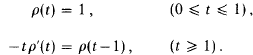
For x, y ≥ 1, let Ψ(x, y) denote the number of positive integers less than or equal to x and free of prime factors greater than y. The behaviour of the function Ψ(x, y) has been the object of numerous articles (see e.g. Norton's memoir [5] and the bibliography there). It turns out that a good approximation to ψ(x, y)/x is given by ρ(log x/log y), where the function ρ(t) is defined for t ≥ 0 as the continuous solution of the equations
On the additivity and cofinality of Radon measures
- Part of
-
- Journal:
- Mathematika / Volume 31 / Issue 2 / December 1984
- Published online by Cambridge University Press:
- 26 February 2010, pp. 323-335
- Print publication:
- December 1984
-
- Article
- Export citation
Universal graphs without large bipartite subgraphs
-
- Journal:
- Mathematika / Volume 31 / Issue 2 / December 1984
- Published online by Cambridge University Press:
- 26 February 2010, pp. 282-290
- Print publication:
- December 1984
-
- Article
- Export citation
-
Let 1 ≤ α ≤ β ≤ γ be cardinals, and let
 denote the class of all graphs on γ vertices having no subgraph isomorphic to Kα,β. A graph
  is called universal if every
  can be embedded into Go as a subgraph. We prove that, if α < ω ≤ γ and the General Continuum Hypothesis is assumed, then
  has a universal element, if, and only if, (i) γ > ω or (ii) γ = ω, α = 1 and β ≤ 3. Using the Axiom of Constructibility, we also show that there does not exist a universal graph in
  .
.
 denote the class of all graphs on γ vertices having no subgraph isomorphic to
  is called universal if every
  can be embedded into
  has a universal element, if, and only if, (i) γ >
  .
.Gale transforms and closed faces of infinite dimensional polytopes
-
- Journal:
- Mathematika / Volume 31 / Issue 2 / December 1984
- Published online by Cambridge University Press:
- 26 February 2010, pp. 291-304
- Print publication:
- December 1984
-
- Article
- Export citation
Short-length instabilities, breakdown and initial value problems in dynamic stall
-
- Journal:
- Mathematika / Volume 31 / Issue 2 / December 1984
- Published online by Cambridge University Press:
- 26 February 2010, pp. 163-177
- Print publication:
- December 1984
-
- Article
- Export citation
On the representation of integers with large square factors by positive definite ternary quadratic forms
-
- Journal:
- Mathematika / Volume 31 / Issue 2 / December 1984
- Published online by Cambridge University Press:
- 26 February 2010, pp. 252-257
- Print publication:
- December 1984
-
- Article
- Export citation
Centrally symmetric convex bodies
- Part of
-
- Journal:
- Mathematika / Volume 31 / Issue 2 / December 1984
- Published online by Cambridge University Press:
- 26 February 2010, pp. 305-322
- Print publication:
- December 1984
-
- Article
- Export citation
Fourier transforms and descriptive set theory
- Part of
-
- Journal:
- Mathematika / Volume 31 / Issue 2 / December 1984
- Published online by Cambridge University Press:
- 26 February 2010, pp. 336-339
- Print publication:
- December 1984
-
- Article
- Export citation
-
We state some definitions belonging to the two halves of the title, going far enough to state our main results.
Fourier transforms. Let μ be a finite, complex-valued measure on R and
 its Fourier-Stieltjes transform. We define ℛ to be the set of μ with
  When μ ∈ ℛ and φ is of class
  (continuously differentiable of compact support), the identity
  shows that θ · μ ∈ ℛ.
 its Fourier-Stieltjes transform. We define ℛ to be the set of μ with
  When μ ∈ ℛ and φ is of class
  (continuously differentiable of compact support), the identity
  shows that θ · μ ∈ ℛ.
Weierstrass equations and the minimal discriminant of an elliptic curve
- Part of
-
- Journal:
- Mathematika / Volume 31 / Issue 2 / December 1984
- Published online by Cambridge University Press:
- 26 February 2010, pp. 245-251
- Print publication:
- December 1984
-
- Article
- Export citation
MTK volume 31 issue 2 Front matter
-
- Journal:
- Mathematika / Volume 31 / Issue 2 / December 1984
- Published online by Cambridge University Press:
- 26 February 2010, pp. f1-f2
- Print publication:
- December 1984
-
- Article
-
- You have access
- Export citation
Continuous dependence and uniqueness theorems in boundary-initial value problems for a class of porous bodies occupying bounded or unbounded domains
- Part of
-
- Journal:
- Mathematika / Volume 31 / Issue 2 / December 1984
- Published online by Cambridge University Press:
- 26 February 2010, pp. 196-213
- Print publication:
- December 1984
-
- Article
- Export citation
Index to volume 31
-
- Journal:
- Mathematika / Volume 31 / Issue 2 / December 1984
- Published online by Cambridge University Press:
- 26 February 2010, pp. 340-341
- Print publication:
- December 1984
-
- Article
- Export citation
On a construction of the universal field of fractions of a free algebra
-
- Journal:
- Mathematika / Volume 31 / Issue 2 / December 1984
- Published online by Cambridge University Press:
- 26 February 2010, pp. 227-233
- Print publication:
- December 1984
-
- Article
- Export citation
An Fσ semigroup of zero measure which contains a translate of every countable set
- Part of
-
- Journal:
- Mathematika / Volume 31 / Issue 2 / December 1984
- Published online by Cambridge University Press:
- 26 February 2010, pp. 272-281
- Print publication:
- December 1984
-
- Article
- Export citation
-
In 1942 Piccard [10] gave an example of a set of real numbers whose sum set has zero Lebesgue measure but whose difference set contains an interval. About thirty years later various authors (Connolly, Jackson, Williamson and Woodall) in a series of papers constructed F σ sets E in ℝ such that E – E contains an interval while the K-fold sum set

has zero Lebesgue measure for progressively larger values of k.
The average orders of Hooley's Δr-functions
-
- Journal:
- Mathematika / Volume 31 / Issue 1 / June 1984
- Published online by Cambridge University Press:
- 26 February 2010, pp. 98-109
- Print publication:
- June 1984
-
- Article
- Export citation
-
In this paper we are concerned with upper bounds for the sums
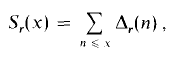
where

and Δ2(n) is written simply as Δ(n). These functions were introduced by Hooley [4] and applied in a novel way to problems related to Waring's, and in Diophantine approximation. Thus Hooley deduced from his result about S2(x) that for any irrational θ, real γ, and fixed ε > 0, the inequality

holds for infinitely many n. His result for S3(x) led to a proof that

where r8(n) denotes the number of representations of n as the sum of eight positive cubes.
The divisor function at consecutive integers
-
- Journal:
- Mathematika / Volume 31 / Issue 1 / June 1984
- Published online by Cambridge University Press:
- 26 February 2010, pp. 141-149
- Print publication:
- June 1984
-
- Article
- Export citation
Some relations connecting measures of convergence for series with non-increasing terms
- Part of
-
- Journal:
- Mathematika / Volume 31 / Issue 1 / June 1984
- Published online by Cambridge University Press:
- 26 February 2010, pp. 17-24
- Print publication:
- June 1984
-
- Article
- Export citation
-
Let an be a non-increasing real sequence such that
 converges; then clearly an ↓ 0. We shall ignore the trivial case where an = 0 for all large n, and so we assume that an > 0 for all n, from now onwards. In [1] J. B. Wilker introduced certain new sequences associated with the rate of convergence of , and obtained various relations between them, in order to investigate packing problems in convex geometry. Let us define
We write P, Q and T respectively for the inferior limits of pn, qn and tn, and P1, Q1 and T1 for the corresponding superior limits. Further, we put

It is immediately clear from these definitions and our assumptions about an that

the latter since nan → 0 by Olivier's theorem [2, p. 124].
 converges; then clearly
An application of Siegel's formula over quaternion orders
-
- Journal:
- Mathematika / Volume 31 / Issue 1 / June 1984
- Published online by Cambridge University Press:
- 26 February 2010, pp. 12-16
- Print publication:
- June 1984
-
- Article
- Export citation
-
Let Φ : L → ℤ be a positive definite even unimodular quadratic form, L ≅ ℤn; we put f(x) = Φ(x)/2 and call (L, f) a lattice, for short. Let min f be the minimum of the numbers f(x) ≠ 0. Fixing n (a multiple of 8), one is interested in the largest possible minimum. It follows from the theory of modular forms (cf. Sloane [6]) that

