Refine search
Actions for selected content:
9084 results in Discrete Mathematics, Information Theory and Coding
Index to volume 15
-
- Journal:
- Mathematika / Volume 15 / Issue 2 / December 1968
- Published online by Cambridge University Press:
- 26 February 2010, p. 228
- Print publication:
- December 1968
-
- Article
- Export citation
Diagrams for centrally symmetric polytopes
-
- Journal:
- Mathematika / Volume 15 / Issue 2 / December 1968
- Published online by Cambridge University Press:
- 26 February 2010, pp. 123-138
- Print publication:
- December 1968
-
- Article
- Export citation
On the group of automorphisms of the Euclidean hypersphere
-
- Journal:
- Mathematika / Volume 15 / Issue 2 / December 1968
- Published online by Cambridge University Press:
- 26 February 2010, pp. 193-198
- Print publication:
- December 1968
-
- Article
- Export citation
-
Let Cn be the n-dimensional complex number space of the complex variables z1,…, zn and
 be the unit hypersphere. Further, let G be the group of all holomorphic automorphisms of K, then G is a n(n + 2)-dimensional real Lie group. In [3] the author has proved that for any P∈∂K (the boundary of K) there exists a decomposition of G in the form
  , where G0 is the group of all analytic rotations about the origin and
  is a 2n-dimensional real Lie group, whose underlying topological space is K, which acts transitively on K and P is a fixed point of all elements of .
 be the unit hypersphere. Further, let
  , where
  is a 2
Specialization of Cremona transformations
-
- Journal:
- Mathematika / Volume 15 / Issue 2 / December 1968
- Published online by Cambridge University Press:
- 26 February 2010, pp. 171-177
- Print publication:
- December 1968
-
- Article
- Export citation
-
Let V = V2n be the Segre product variety
 of two n–dimensional complex projective spaces. Then any Cremona transformation of Sn into
  (regarded as an irreducible algebraic system of ∞n ordered pairs of points) is represented on V by an irreducible n-dimensional subvariety H which satisfies (on V) the algebraic equivalence
where Si, j is a subvariety
 of V and m1, …, mn–1 are positive integers. We call m1, …, mn–1 the characters of T noting that, numerically,
 of two
  (regarded as an irreducible algebraic system of ∞
 of
of 
On Hausdorff dimension of projections
-
- Journal:
- Mathematika / Volume 15 / Issue 2 / December 1968
- Published online by Cambridge University Press:
- 26 February 2010, pp. 153-155
- Print publication:
- December 1968
-
- Article
- Export citation
Irrotational gravity waves of finite height: a numerical study
-
- Journal:
- Mathematika / Volume 15 / Issue 2 / December 1968
- Published online by Cambridge University Press:
- 26 February 2010, pp. 139-148
- Print publication:
- December 1968
-
- Article
- Export citation
Linear forms in the logarithms of algebraic numbers (IV)
-
- Journal:
- Mathematika / Volume 15 / Issue 2 / December 1968
- Published online by Cambridge University Press:
- 26 February 2010, pp. 204-216
- Print publication:
- December 1968
-
- Article
- Export citation
Corrigendum: Mathematika Volume 14, 1967
-
- Journal:
- Mathematika / Volume 15 / Issue 2 / December 1968
- Published online by Cambridge University Press:
- 26 February 2010, p. 227
- Print publication:
- December 1968
-
- Article
-
- You have access
- Export citation
MTK volume 15 issue 2 Front matter
-
- Journal:
- Mathematika / Volume 15 / Issue 2 / December 1968
- Published online by Cambridge University Press:
- 26 February 2010, pp. f1-f2
- Print publication:
- December 1968
-
- Article
-
- You have access
- Export citation
On nodes of degree two in random trees
-
- Journal:
- Mathematika / Volume 15 / Issue 2 / December 1968
- Published online by Cambridge University Press:
- 26 February 2010, pp. 188-192
- Print publication:
- December 1968
-
- Article
- Export citation
-
Let T(n, k) denote the number of trees
 n with n labelled nodes of which exactly k have degree two. We shall derive a formula for T(n, k) and then determine the asymptotic behaviour of T(n,0); this will enable us to calculate the limiting distribution of Xn the number of nodes of degree two in a random tree n. Rényi [5] has treated the corresponding problem for nodes of degree one in random trees.

Integral domains in which each non-zero ideal is divisorial
-
- Journal:
- Mathematika / Volume 15 / Issue 2 / December 1968
- Published online by Cambridge University Press:
- 26 February 2010, pp. 164-170
- Print publication:
- December 1968
-
- Article
- Export citation
-
Let D be an integral domain with identity having quotient field K. A non-zero fractional ideal F of D is said to be divisorial if F is an intersection of principal fractional ideals of D[4; 2]. Equivalently, F is divisorial if there is a non-zero fractional ideal E of D such that

Divisorial ideals arose in the investigations of Van der Waerden, Artin, and Krull in the 1930's and were called v-ideals by Krull [9; 118]. The concept has played an important role in the development of multiplicative ideal theory.
Asymptotic expansions in certain second order nonhomogeneous differential equations
-
- Journal:
- Mathematika / Volume 15 / Issue 1 / June 1968
- Published online by Cambridge University Press:
- 26 February 2010, pp. 30-38
- Print publication:
- June 1968
-
- Article
- Export citation
On acyclic simplicial complexes
-
- Journal:
- Mathematika / Volume 15 / Issue 1 / June 1968
- Published online by Cambridge University Press:
- 26 February 2010, pp. 115-122
- Print publication:
- June 1968
-
- Article
- Export citation
A theorem on the existence of non-σ-finite subsets
-
- Journal:
- Mathematika / Volume 15 / Issue 1 / June 1968
- Published online by Cambridge University Press:
- 26 February 2010, pp. 60-62
- Print publication:
- June 1968
-
- Article
- Export citation
-
Let Ω be a compact metric space of non-σ-finite Λh-measure, where Λh denotes the Hausdorff measure corresponding to some continuous increasing real function h(t), denned for t ≥ 0 and with h(t) > 0 and h(t) > 0 for t > 0. C. A. Rogers has drawn attention to two problems that have remained unsolved for some years, and which seem to present considerable difficulty:
I. Does Ω necessarily have subsets of finite positive Λh-measure?
II. Does Ω. necessarily contain a system of
 disjoint closed subsets each of non-σ-finite Λh-measure ?
The answers are affirmative when Ω is a subset of a Euclidean space (see [1], [2], [3], [4], [5]); recently D. G. Larman ([8], [9]) was able to extend each of these results to the case of the “finite-dimensional” compact metric spaces that he introduced in [7]. Both of his proofs depend on the detailed structure of such spaces; the aim of the present paper is to establish a general theorem, from which it follows in particular that Larman's second result is a consequence of his first, and that an affirmative answer to I would imply an affirmative answer to II. (Since it seems likely that I must be answered negatively in general, and II affirmatively, the present theorem may well be of only ephemeral significance; the nature of the proof reinforces this expectation.)

On the distribution of Fekete points
-
- Journal:
- Mathematika / Volume 15 / Issue 1 / June 1968
- Published online by Cambridge University Press:
- 26 February 2010, pp. 70-75
- Print publication:
- June 1968
-
- Article
- Export citation
-
Let E be a continuum and n ≥ 4 a given positive integer. A system of points z1,…, zn єE that maximizes
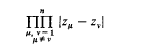
is called a system of Fekete points. Such a system may be not unique.
On a two-dimensional exterior Stokes flow with mixed boundary conditions
-
- Journal:
- Mathematika / Volume 15 / Issue 1 / June 1968
- Published online by Cambridge University Press:
- 26 February 2010, pp. 103-114
- Print publication:
- June 1968
-
- Article
- Export citation
The average of the least primitive root
-
- Journal:
- Mathematika / Volume 15 / Issue 1 / June 1968
- Published online by Cambridge University Press:
- 26 February 2010, pp. 39-50
- Print publication:
- June 1968
-
- Article
- Export citation
-
The problem of estimating accurately the order of magnitude of the least primitive root g(p) to a large prime modulus p is as yet unsolved. The first non-trivial estimate was obtained by I. M. Vinogradov (see [5]) who in about 1919 showed that

On an integral equation
-
- Journal:
- Mathematika / Volume 15 / Issue 1 / June 1968
- Published online by Cambridge University Press:
- 26 February 2010, pp. 22-29
- Print publication:
- June 1968
-
- Article
- Export citation
-
The integral equation

occurs in the theory of the motion of an electrically conducting fluid, occupying the space between two electrodes at different potentials, in the presence of a strong magnetic fluid [Hunt and Malcolm 1]. In this theory a solution is required in which

and one of the principal properties of the solution to be determined is

Christoffel's problem for general convex bodies
-
- Journal:
- Mathematika / Volume 15 / Issue 1 / June 1968
- Published online by Cambridge University Press:
- 26 February 2010, pp. 7-21
- Print publication:
- June 1968
-
- Article
- Export citation
A note on Thue's theorem
-
- Journal:
- Mathematika / Volume 15 / Issue 1 / June 1968
- Published online by Cambridge University Press:
- 26 February 2010, pp. 76-87
- Print publication:
- June 1968
-
- Article
- Export citation
-
If θ is a real algebraic number of degree r ≥ 2, there is a computable number c = c(θ) > 0 such that
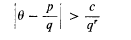
for all rational numbers p/q (q > 0). This follows directly from the definition of an algebraic number, as was shown by Liouville in 1843; and if r = 2 there is no more to be said. Axel Thue was the first to prove a stronger result when r ≥ 3; he showed that if

there are at most finitely many rational numbers p/q that satisfy

