Refine search
Actions for selected content:
9084 results in Discrete Mathematics, Information Theory and Coding
The spread of a matrix
-
- Journal:
- Mathematika / Volume 3 / Issue 2 / December 1956
- Published online by Cambridge University Press:
- 26 February 2010, pp. 127-130
- Print publication:
- December 1956
-
- Article
- Export citation
Dilational and distortional vibrations of semi-infinite solids and plates
-
- Journal:
- Mathematika / Volume 3 / Issue 2 / December 1956
- Published online by Cambridge University Press:
- 26 February 2010, pp. 153-163
- Print publication:
- December 1956
-
- Article
- Export citation
On a result of Marshall Hall
-
- Journal:
- Mathematika / Volume 3 / Issue 2 / December 1956
- Published online by Cambridge University Press:
- 26 February 2010, pp. 109-110
- Print publication:
- December 1956
-
- Article
- Export citation
-
Marshall Hall has proved that every real number is representable as the sum of two continued fractions with partial quotients at most 4. This implies that for any real β1, β2 there exists a real α such that

for all integers x > 0 and y, where C is a positive constant. In this note I prove a generalization to r numbers β2, …, βr. The case r = 2 implies a result similar to Marshall Hall's but with a larger number (71) in place of 4.
MTK volume 3 issue 2 Front matter
-
- Journal:
- Mathematika / Volume 3 / Issue 2 / December 1956
- Published online by Cambridge University Press:
- 26 February 2010, pp. f1-f2
- Print publication:
- December 1956
-
- Article
-
- You have access
- Export citation
Note on irregularities of distribution
-
- Journal:
- Mathematika / Volume 3 / Issue 2 / December 1956
- Published online by Cambridge University Press:
- 26 February 2010, pp. 131-135
- Print publication:
- December 1956
-
- Article
- Export citation
-
Let (x1, y1), …, (xN, yN) be N points in the square 0 ≤ x < 1, 0 ≤ y < 1. For any point (ξ, η) in this square, let S(ξ, η) denote the number of points of the set satisfying

Measurable almost periodic functions
-
- Journal:
- Mathematika / Volume 3 / Issue 2 / December 1956
- Published online by Cambridge University Press:
- 26 February 2010, pp. 140-143
- Print publication:
- December 1956
-
- Article
- Export citation
-
A complex-valued function ƒ is said by W. Maak [1] to be almost periodic (a.p.) on Rn if for every positive number ε there is a decomposition of Rn into a finite number of sets S such that

for all h in Rn and all pairs x, y belonging to the same S. This definition is equivalent to that of Bohr when ƒ is continuous.
Indefinite quadratic forms in many variables
-
- Journal:
- Mathematika / Volume 3 / Issue 2 / December 1956
- Published online by Cambridge University Press:
- 26 February 2010, pp. 81-101
- Print publication:
- December 1956
-
- Article
- Export citation
Semi-regular local rings
-
- Journal:
- Mathematika / Volume 3 / Issue 2 / December 1956
- Published online by Cambridge University Press:
- 26 February 2010, pp. 117-126
- Print publication:
- December 1956
-
- Article
- Export citation
Thin circular plates under certain distributions of normal loading
-
- Journal:
- Mathematika / Volume 3 / Issue 2 / December 1956
- Published online by Cambridge University Press:
- 26 February 2010, pp. 144-152
- Print publication:
- December 1956
-
- Article
- Export citation
-
The problem of a concentrated normal force at any point of a thin clamped circular plate was treated in terms of infinite series by Clebsch [1], who gave the general solution of the biharmonic equation D∇4w = p. Using the method of inversion Michell [2] found a solution for the same problem in finite terms. The method of complex potentials was used by Dawoud [3] to solve the problem of an isolated load on a circular plate under certain boundary conditions. Applying Muskhelishvili's method Washizu [4] obtained the same results for clamped and hinged boundaries. The complex variable method was applied by the authors [5] to obtain solutions for a thin circular plate having an eccentric circular patch symmetrically loaded with respect to its centre under a particular form of boundary condition defining certain types of boundary constraints which include the usual clamped and hinged boundaries as well as other special cases. Flügge [6] gave the solution for a linearly varying load over the complete simply supported circular plate. Using complex variable methods Bassali [7] found the solution for the same load distributed over the area of an eccentric circle under the boundary conditions mentioned before [5], and the authors [8] obtained the solutions for general loads of the type
 cos nϑ(or sinnϑ), spread over the area of a circle concentric with the plate. In this paper the solutions for a circular plate subjected to the same boundary conditions are obtained when the plate is acted upon by the following types of loading: (a) a concentrated load at an arbitrary point; (b) a line load spread on any part of a diameter; (c) a load distributed over the area of a sector of the plate; (d) a concentrated couple at an arbitrary point of the plate. As a limiting case we find the deflexion at any point of a thin elastic plate having the form of a half plane clamped along the straight edge and subject to an isolated couple at any point.
 cos nϑ(or sin
Extended computation of the Riemann zeta-function
-
- Journal:
- Mathematika / Volume 3 / Issue 2 / December 1956
- Published online by Cambridge University Press:
- 26 February 2010, pp. 102-108
- Print publication:
- December 1956
-
- Article
- Export citation
-
In 1955 a programme of study of the first 10000 zeros of the Riemann Zeta-function
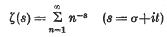
was completed. Use was made of the high-speed digital computer SWAC and a report of this programme has appeared recently [1]. More recently still, the programme has been extended to the first 25000 zeros. All these zeros have σ= ½ The purpose of this paper is to summarize the methods needed for this (and possibly future) work from the highspeed computer point of view.
Indefinite quadratic polynomials in n variables
-
- Journal:
- Mathematika / Volume 3 / Issue 2 / December 1956
- Published online by Cambridge University Press:
- 26 February 2010, pp. 111-116
- Print publication:
- December 1956
-
- Article
- Export citation
-
Let

denote an indefinite quadratic form in n variables with real coefficients and with determinant Δn≠0. Blaney ([1], Theorem 2) proved that for any γ ≥0 there is a number Γ = Γ(γ, n) such that the inequalities

are soluble in integers x1, …, xn for any real α1, …, αn The object of this note is to establish an estimate for Γ as a function of γ. The result obtained, which is naturally only significant if γ is large, is as follows.
Index to volume 3
-
- Journal:
- Mathematika / Volume 3 / Issue 2 / December 1956
- Published online by Cambridge University Press:
- 26 February 2010, p. 164
- Print publication:
- December 1956
-
- Article
- Export citation
Covering space by spheres
-
- Journal:
- Mathematika / Volume 3 / Issue 2 / December 1956
- Published online by Cambridge University Press:
- 26 February 2010, pp. 136-139
- Print publication:
- December 1956
-
- Article
- Export citation
-
Let Λ be a lattice in three-dimensional space with the property that the spheres of radius 1 centred at the points of Λ cover the whole of space. In other words, every point of space is at a distance not more than 1 from some point of Λ. It was proved by Bambah that then
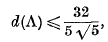
equality occurring if and only if Λ is a body-centred cubic lattice with the side of the cube equal to 4/√5. Another way of stating the result is to say that the least density of covering of three-dimensional space by equal spheres, subject to the condition that the centres of the spheres form a lattice, is
 . Another proof of Bambah's result was given recently by Barnes. Both proofs depend on the theory of reduction of ternary quadratic forms.
 . Another proof of Bambah's result was given recently by Barnes. Both proofs depend on the theory of reduction of ternary quadratic forms.
On the minimal points of positive definite quadratic forms
-
- Journal:
- Mathematika / Volume 3 / Issue 1 / June 1956
- Published online by Cambridge University Press:
- 26 February 2010, pp. 15-24
- Print publication:
- June 1956
-
- Article
- Export citation
-
Let
 be a positive definite quadratic form in n variables. Here x denotes a column vector with components x1, x2, …, xn, and we write A for the symmetric matrix {ajk} so that
 be a positive definite quadratic form in
Monotonicity of partition functions
-
- Journal:
- Mathematika / Volume 3 / Issue 1 / June 1956
- Published online by Cambridge University Press:
- 26 February 2010, pp. 1-14
- Print publication:
- June 1956
-
- Article
- Export citation
Note on the two-dimensional theory of anisotropic dielectrics
-
- Journal:
- Mathematika / Volume 3 / Issue 1 / June 1956
- Published online by Cambridge University Press:
- 26 February 2010, pp. 63-68
- Print publication:
- June 1956
-
- Article
- Export citation
Complete quadrics and collineations in Sn
-
- Journal:
- Mathematika / Volume 3 / Issue 1 / June 1956
- Published online by Cambridge University Press:
- 26 February 2010, pp. 69-79
- Print publication:
- June 1956
-
- Article
- Export citation
A note on Alexander's duality
-
- Journal:
- Mathematika / Volume 3 / Issue 1 / June 1956
- Published online by Cambridge University Press:
- 26 February 2010, pp. 40-46
- Print publication:
- June 1956
-
- Article
- Export citation
Characteristic directions of certain equations of plasticity
-
- Journal:
- Mathematika / Volume 3 / Issue 1 / June 1956
- Published online by Cambridge University Press:
- 26 February 2010, pp. 56-62
- Print publication:
- June 1956
-
- Article
- Export citation
A property of the star domain |xy| ≤ 1
-
- Journal:
- Mathematika / Volume 3 / Issue 1 / June 1956
- Published online by Cambridge University Press:
- 26 February 2010, p. 80
- Print publication:
- June 1956
-
- Article
- Export citation
-
It is well known that the star domain

in the plane is boundedly reducible, that is, it contains a bounded star body with the same lattice determinant, namely √5. Hence the bounded star domain

has the same lattice determinant as K has if r is sufficiently large. The following result is therefore perhaps a little surprising.

