Refine search
Actions for selected content:
9084 results in Discrete Mathematics, Information Theory and Coding
MTK volume 3 issue 1 Front matter
-
- Journal:
- Mathematika / Volume 3 / Issue 1 / June 1956
- Published online by Cambridge University Press:
- 26 February 2010, pp. f1-f3
- Print publication:
- June 1956
-
- Article
-
- You have access
- Export citation
On the inhomogeneous minimum of the product of n linear forms
-
- Journal:
- Mathematika / Volume 3 / Issue 1 / June 1956
- Published online by Cambridge University Press:
- 26 February 2010, pp. 25-39
- Print publication:
- June 1956
-
- Article
- Export citation
-
The following well-known conjecture is generally attributed to Minkowski:
Let L1, …, Ln be n real homogeneous linear forms of determinant Δ ≠ 0 in the n variables x1, …, xn; and let (x1′, …, xn′) be any point. Then there exists a point (x1, xn) congruent to (x1′, …, xn′) (mod 1) at which

The Reidemeister-Schreier and Kuroš subgroup theorems
-
- Journal:
- Mathematika / Volume 3 / Issue 1 / June 1956
- Published online by Cambridge University Press:
- 26 February 2010, pp. 47-55
- Print publication:
- June 1956
-
- Article
- Export citation
Sums of ordered intervals and distances
-
- Journal:
- Mathematika / Volume 2 / Issue 2 / December 1955
- Published online by Cambridge University Press:
- 26 February 2010, pp. 150-159
- Print publication:
- December 1955
-
- Article
- Export citation
Index to volume 2
-
- Journal:
- Mathematika / Volume 2 / Issue 2 / December 1955
- Published online by Cambridge University Press:
- 26 February 2010, p. 169
- Print publication:
- December 1955
-
- Article
- Export citation
Projective geometry over an algebra
-
- Journal:
- Mathematika / Volume 2 / Issue 2 / December 1955
- Published online by Cambridge University Press:
- 26 February 2010, pp. 105-115
- Print publication:
- December 1955
-
- Article
- Export citation
Corrigendum
-
- Journal:
- Mathematika / Volume 2 / Issue 2 / December 1955
- Published online by Cambridge University Press:
- 26 February 2010, p. 168
- Print publication:
- December 1955
-
- Article
- Export citation
-
On page 2 of my paper “Rational approximations to algebraic numbers” [Mathematika 2 (1955), 1–20], I referred to possible generalizations of my theorem, and mentioned that I had proved the following:
Let α be any algebraic number, not rational. If the inequality
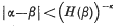
is satisfied by infinitely many algebraic numbers β of degree g, then κ ≤ 2g.
Riemann equivalence of functions
-
- Journal:
- Mathematika / Volume 2 / Issue 2 / December 1955
- Published online by Cambridge University Press:
- 26 February 2010, pp. 97-104
- Print publication:
- December 1955
-
- Article
- Export citation
-
Two finite real functions ƒ(x) and g(x), defined for — ∞ < x < ∞, are said to be Riemann equivalent if |ƒ(x)—g(x)| has a zero Riemann integral over every finite interval; we then write ƒ~g or
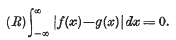
N. G. de Bruijn conjectured that if ƒ(x+h)~ƒ(x) for every real number h, then ƒ~c where c is a constant; this was proved by P. Erdös [1]. In this note we associate with an arbitrary function ƒ the additive group
 (ƒ) of all numbers h which make ƒ(x)~ƒ(x+h), i.e. which make
 (
(
Almost periodic functions
-
- Journal:
- Mathematika / Volume 2 / Issue 2 / December 1955
- Published online by Cambridge University Press:
- 26 February 2010, pp. 128-131
- Print publication:
- December 1955
-
- Article
- Export citation
The shortest path and the shortest road through n points
-
- Journal:
- Mathematika / Volume 2 / Issue 2 / December 1955
- Published online by Cambridge University Press:
- 26 February 2010, pp. 141-144
- Print publication:
- December 1955
-
- Article
- Export citation
-
Consider a set of n points lying in a square of side 1. Verblunsky has shown that, if n is sufficiently large, there is some path through all n points whose length does not exceed (2·8n)1/2+2. L. Fejes Tóth has drawn attention to the case when the n points consist of all points of a regular hexagonal lattice lying in the unit square, in which case the length of the shortest path is easily seen to be asymptotically equal to

A remark on Siegel's theorem on algebraic curves
-
- Journal:
- Mathematika / Volume 2 / Issue 2 / December 1955
- Published online by Cambridge University Press:
- 26 February 2010, pp. 116-127
- Print publication:
- December 1955
-
- Article
- Export citation
-
The main case of Siegel's theorem on algebraic curves may be stated as follows:
THEOREM 1. Let

be an irreducible algebraic curve of genus g≥1, ƒ(x, y) being a polynomial with algebraic coefficients. Let K be an algebraic field of finite degree over the rational field; let o be the ring of integers in K; and let j be a positive rational integer. Then there are at most finitely many points (x, y) on ℭ for which jxεο and yεK.

MTK volume 2 issue 2 Front matter
-
- Journal:
- Mathematika / Volume 2 / Issue 2 / December 1955
- Published online by Cambridge University Press:
- 26 February 2010, pp. f1-f2
- Print publication:
- December 1955
-
- Article
-
- You have access
- Export citation
Some Diophantine inequalities
-
- Journal:
- Mathematika / Volume 2 / Issue 2 / December 1955
- Published online by Cambridge University Press:
- 26 February 2010, pp. 145-149
- Print publication:
- December 1955
-
- Article
- Export citation
-
Let →(X) be a function of the n variables (X) = (X1, …, Xn) defined for all real (X). A fundamental problem in the theory of Diophantine approximation is to prove the existence of real numbers (X) ≡ (x) (mod 1), where (x) = (x1, …, xn) is any given set of real numbers, for which

On a method of Mordell in the geometry of numbers
-
- Journal:
- Mathematika / Volume 2 / Issue 2 / December 1955
- Published online by Cambridge University Press:
- 26 February 2010, pp. 132-140
- Print publication:
- December 1955
-
- Article
- Export citation
The solubility of certain Diophantine inequalities
-
- Journal:
- Mathematika / Volume 2 / Issue 2 / December 1955
- Published online by Cambridge University Press:
- 26 February 2010, pp. 81-96
- Print publication:
- December 1955
-
- Article
- Export citation
-
The method devised by Hardy and Littlewood for the solution of Waring's Problem, and further developed by Vinogradov, applies quite generally to Diophantine equations of an additive type. One particular result that can be proved by this method is that if a1, …, as are integers not all of the same sign, and if s is greater than a certain number depending only on k, the Diophantine equation

has infinitely many solutions in positive integers x1, …, xs, provided that the corresponding congruence has a non-zero solution to every prime power modulus. A result of a similar kind holds if on the right of (1) there stands an arbitrary integer in place of 0.
Rational approximations to algebraic numbers
-
- Journal:
- Mathematika / Volume 2 / Issue 2 / December 1955
- Published online by Cambridge University Press:
- 26 February 2010, pp. 160-167
- Print publication:
- December 1955
-
- Article
- Export citation
-
It was proved in a recent paper that if α is any algebraic number, not rational, then for any ζ > 0 the inequality

has only a finite number of solutions in relatively prime integers h, q. Our main purpose in the present note is to deduce, from the results of that paper, an explicit estimate for the number of solutions.
Rational approximations to algebraic numbers
-
- Journal:
- Mathematika / Volume 2 / Issue 1 / June 1955
- Published online by Cambridge University Press:
- 26 February 2010, pp. 1-20
- Print publication:
- June 1955
-
- Article
-
- You have access
- Export citation
-
It was remarked by Liouville in 1844 that there is an obvious limit to the accuracy with which algebraic numbers can be approximated by rational numbers; if α is an algebraic number of degree n (at least 2) then
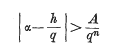
for all rational numbers h/q, where A is a positive number depending only on α.
Duality in homotopy theory
-
- Journal:
- Mathematika / Volume 2 / Issue 1 / June 1955
- Published online by Cambridge University Press:
- 26 February 2010, pp. 56-80
- Print publication:
- June 1955
-
- Article
- Export citation
On the steady rotation of a sphere in a viscous fluid
-
- Journal:
- Mathematika / Volume 2 / Issue 1 / June 1955
- Published online by Cambridge University Press:
- 26 February 2010, pp. 42-47
- Print publication:
- June 1955
-
- Article
- Export citation
Sets of constant width contained in a set of given minimal width
-
- Journal:
- Mathematika / Volume 2 / Issue 1 / June 1955
- Published online by Cambridge University Press:
- 26 February 2010, pp. 48-55
- Print publication:
- June 1955
-
- Article
- Export citation
