Refine search
Actions for selected content:
9084 results in Discrete Mathematics, Information Theory and Coding
MTK volume 2 issue 1 Front matter
-
- Journal:
- Mathematika / Volume 2 / Issue 1 / June 1955
- Published online by Cambridge University Press:
- 26 February 2010, pp. f1-f3
- Print publication:
- June 1955
-
- Article
-
- You have access
- Export citation
Representation of integers by indefinite quadratic forms
-
- Journal:
- Mathematika / Volume 2 / Issue 1 / June 1955
- Published online by Cambridge University Press:
- 26 February 2010, pp. 32-38
- Print publication:
- June 1955
-
- Article
- Export citation
An elementary proof of Kato's lemma
-
- Journal:
- Mathematika / Volume 2 / Issue 1 / June 1955
- Published online by Cambridge University Press:
- 26 February 2010, pp. 39-41
- Print publication:
- June 1955
-
- Article
- Export citation
-
A well-known method of calculating an approximate value of an eigenvalue λ of a self-adjoint operator H employs an approximation, say w, to the corresponding eigenfunction ψ. Since

the exact value of λ is given by


Witt groups and hyperexponential groups
-
- Journal:
- Mathematika / Volume 2 / Issue 1 / June 1955
- Published online by Cambridge University Press:
- 26 February 2010, pp. 21-31
- Print publication:
- June 1955
-
- Article
- Export citation
The Minkowski-Hlawka theorem
-
- Journal:
- Mathematika / Volume 1 / Issue 2 / June 1954
- Published online by Cambridge University Press:
- 26 February 2010, pp. 111-124
- Print publication:
- June 1954
-
- Article
- Export citation
On the steady motion of viscous liquid past a flat plate
-
- Journal:
- Mathematika / Volume 1 / Issue 2 / June 1954
- Published online by Cambridge University Press:
- 26 February 2010, pp. 143-156
- Print publication:
- June 1954
-
- Article
- Export citation
A two dimensional magnetic boundary layer problem
-
- Journal:
- Mathematika / Volume 1 / Issue 2 / June 1954
- Published online by Cambridge University Press:
- 26 February 2010, pp. 131-142
- Print publication:
- June 1954
-
- Article
- Export citation
Partial well-ordering of sets of vectors
-
- Journal:
- Mathematika / Volume 1 / Issue 2 / June 1954
- Published online by Cambridge University Press:
- 26 February 2010, pp. 89-95
- Print publication:
- June 1954
-
- Article
- Export citation
MTK volume 1 issue 2 Front matter
-
- Journal:
- Mathematika / Volume 1 / Issue 2 / June 1954
- Published online by Cambridge University Press:
- 26 February 2010, pp. f1-f2
- Print publication:
- June 1954
-
- Article
-
- You have access
- Export citation
A note on Stokes's stream-function for the slow steady motion of viscous fluid before plane and spherical boundaries
-
- Journal:
- Mathematika / Volume 1 / Issue 2 / June 1954
- Published online by Cambridge University Press:
- 26 February 2010, pp. 125-130
- Print publication:
- June 1954
-
- Article
- Export citation
On irregularities of distribution
-
- Journal:
- Mathematika / Volume 1 / Issue 2 / June 1954
- Published online by Cambridge University Press:
- 26 February 2010, pp. 73-79
- Print publication:
- June 1954
-
- Article
- Export citation
The representation of integers by positive ternary quadratic forms
-
- Journal:
- Mathematika / Volume 1 / Issue 2 / June 1954
- Published online by Cambridge University Press:
- 26 February 2010, pp. 104-110
- Print publication:
- June 1954
-
- Article
- Export citation
-
Let f = f(x, y, z) be a positive definite form of the type

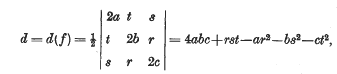
where x, y, z are integral valued variables, and the coefficients a, …, t are integers whose highest common factor is 1. As the determinant of such a form may be fractional, I define
and

thus — C is the discriminant of the binary form f(x, y, 0), and the necessary and sufficient condition for f to be positive definite is that a > 0, C > 0, and d > 0.
The triangle as a geometric variable
-
- Journal:
- Mathematika / Volume 1 / Issue 2 / June 1954
- Published online by Cambridge University Press:
- 26 February 2010, pp. 80-88
- Print publication:
- June 1954
-
- Article
- Export citation
Torsion of cylinders with inclusions*
-
- Journal:
- Mathematika / Volume 1 / Issue 2 / June 1954
- Published online by Cambridge University Press:
- 26 February 2010, pp. 96-103
- Print publication:
- June 1954
-
- Article
- Export citation
-
The object of this paper is to solve the Saint-Venant torsion problem for those cross-sections with inclusions, which are such that the z-plane boundaries involved can be mapped into concentric circles in a complex ζ-plane by the transformation

with z´(ζ) ≠ 0 or ∞ within the cross-section. We shall consider both solid and hollow inclusions having different elastic rigidities μ. In the case of the solid inclusion we have to restrict the coefficients as to be zero for all negative s, but it is an advantage to leave this restriction to the end of the analysis, since the forms of certain coefficients in the two cases differ only in this respect.
Index to volume 1
-
- Journal:
- Mathematika / Volume 1 / Issue 2 / June 1954
- Published online by Cambridge University Press:
- 26 February 2010, p. 157
- Print publication:
- June 1954
-
- Article
- Export citation
A simple proof of η(— 1/τ)= η(τ)√τ/i
-
- Journal:
- Mathematika / Volume 1 / Issue 1 / June 1954
- Published online by Cambridge University Press:
- 26 February 2010, p. 4
- Print publication:
- June 1954
-
- Article
- Export citation
-
This functional equation for Dedekind's

has been established in many different ways; however, it seems that the following proof, a straightforward application of the theorem of residues, has not been observed before. Since

it suffices to prove that

Simultaneous Diophantine Approximation
-
- Journal:
- Mathematika / Volume 1 / Issue 1 / June 1954
- Published online by Cambridge University Press:
- 26 February 2010, pp. 51-72
- Print publication:
- June 1954
-
- Article
- Export citation
-
It is well known that every irrational number θ possesses an infinity of rational approximations p/q satisfying
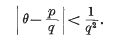
It is also well known that there is a wide class of irrational numbers which admit of no approximations which are essentially better, namely those θ whose continued fractions have bounded partial quotients. For any such θ there is a positive number c such that all rational approximations satisfy

On convergence and summability factors in a sequence
-
- Journal:
- Mathematika / Volume 1 / Issue 1 / June 1954
- Published online by Cambridge University Press:
- 26 February 2010, pp. 24-44
- Print publication:
- June 1954
-
- Article
- Export citation
-
The following theorem is typical of a group of results which have been found to be of importance in the theory of Cesàro summability.
Theorem A. If 0 ≤ ρ ≤ κ (κ, ρ integer), p > −1,p+q −1 and

and ifsn = 0(np) (C, κ), thensn εn = 0(np+q) (C, ρ).
History of Science and Psychology of Invention
-
- Journal:
- Mathematika / Volume 1 / Issue 1 / June 1954
- Published online by Cambridge University Press:
- 26 February 2010, pp. 1-3
- Print publication:
- June 1954
-
- Article
- Export citation
The minimal points of a positive definite quadratic form
-
- Journal:
- Mathematika / Volume 1 / Issue 1 / June 1954
- Published online by Cambridge University Press:
- 26 February 2010, pp. 14-17
- Print publication:
- June 1954
-
- Article
- Export citation
-
Let q(x1; …, xn) be a positive definite quadratic form in n variables with real coefficients. Minkowski defined the successive minima of q as follows. Let S1 denote the least value assumed by q for integers x1 …, xn, not all zero, and let
 be a point at which this value is attained. Let S2 denote the least value assumed by q at integral points which are not multiples of x(1), and let x(2) be such a point at which this value is attained. Let S3 be the least value of q at integral points which are not linearly dependent on x(1) and x(2), and so on. We have
and it is easy to see that these numbers are uniquely defined, even though there may be several choices for the points x(1), …, x(n). The determinant N of the coordinates of the points x(1), …, x(n) is a non-zero integer. We denote by N (q) the least value of this integer (taken positively) for all permissible choices of the n minimal points, and by N′(q) its greatest value. Plainly N(q) and N′(q) are arithmetical invariants of q, that is, they are the same for two forms which are equivalent under a linear substitution with integral coefficients and determinant ±1.
 be a point at which this value is attained. Let
