To save content items to your account,
please confirm that you agree to abide by our usage policies.
If this is the first time you use this feature, you will be asked to authorise Cambridge Core to connect with your account.
Find out more about saving content to .
To save content items to your Kindle, first ensure no-reply@cambridge.org
is added to your Approved Personal Document E-mail List under your Personal Document Settings
on the Manage Your Content and Devices page of your Amazon account. Then enter the ‘name’ part
of your Kindle email address below.
Find out more about saving to your Kindle.
Note you can select to save to either the @free.kindle.com or @kindle.com variations.
‘@free.kindle.com’ emails are free but can only be saved to your device when it is connected to wi-fi.
‘@kindle.com’ emails can be delivered even when you are not connected to wi-fi, but note that service fees apply.
The focus now moves to the regular polytopes and apeirotopes of nearly full rank; this chapter treats those that occur in every dimension. The role played by blended polytopes is discussed first. Next considered is the part played by twisting certain diagrams. There are four infinite families of finite regular polytopes, three related (as one would expect) to the simplices, staurotopes and cubes and one related to half-cubes. Surprisingly, the cubic tiling leads to many families, while yet other families are connected with certain non-string reflexion groups. At this stage, the classification is incomplete, since it relies on that in smaller dimensions. In particular, the 4-dimensional cases are needed to tackle the ‘gateway’ dimension five.
As already observed, the Gosset–Elte polytopes play an important role in the theory of regular polytopes of nearly full rank; this chapter collects some more facts about them. In particular, their realization domains are of interest, since they provide good examples of how the general theory of realizations expounded in Chapters 3 and 4 works. In addition, some simple projections of the Gosset–Elte polytopes into the plane can reveal a lot about their structure. The purpose of these projections is not to display the large amount of their symmetry, but rather to illustrate suitable sections, to show how components of the polytopes fit together. After a brief discussion of the Gosset–Elte polytopes in general terms, with two exceptions they and their realization domains are described. The exceptions have too many vertices to be amenable to our treatment, but in any case they do not underlie regular polytopes of nearly full rank. Two of the cases that are treated also have many vertices; both pose considerable problems.
We give an example of a long range Bernoulli percolation process on a group non-quasi-isometric with ℤ, in which clusters are almost surely finite for all values of the parameter. This random graph admits diverse equivalent definitions, and we study their ramifications. We also study its expected size and point out certain phase transitions.
The final chapter concerns two families of regular 5-polytopes, the second consisting of the double covers of the first. The starting point is a simple group, which is the automorphism group of a regular quotient of a 5-dimensional hyperbolic honeycomb. Armed with only modest information, it is first shown that the realization domain of this polytope is very simple. Two defining relations for the quotient were initially provided; subsequently, it is seen geometrically that one of them is redundant. As in the previous chapter, there is an extended family, among which there are polytopes whose facets and vertex-figures beong to the pentagonal 4-polytopes of Chapter 7 and the family of 4-polytopes described in Chapter 16. The initial quotients are non-orientable; the family of their double covers contains members that are universal as amalgamations. These families of polytopes correspond to actions of the automorphism groups on two of their maximal subgroups. The groups have another maximal subgroup, and though there are no nice related polytopes, nevertheless this gives rise to interesting symmetric sets. There is another quotient and a close relative which one might initially think belong to one of the families; that they do not, with a completely unrelated group, is perhaps surprising.
The bridging concept between the abstract and geometric is the theory of realizations. This chapter concentrates on symmetric sets, namely, finite sets on which a group of permutations acts transitively. After a discussion of their basic properties, the concept of their realizations is introduced, with operations on them (such as blending) showing that the family of their congruences classes has the structure of a convex cone. A key idea is that of the inner product and cosine vectors of realizations, which define them up to congruence. The theory up to this point is then illustrated by some examples. It is next shown that, corresponding to the tensor product of representations, there is a product of realizations. Another fundamental notion is that of orthogonality relations for cosine vectors. The different realizations derived from an irreducible representation of the abstract group may form a subcone of the realization cone that is more than 1-dimensional. These are looked at more closely, leading to a definition of cosine matrices for the general realization domain. There follows a discussion of cuts and their relationship with duality. Cosine vectors may have entries in some subfield of the real numbers, with implications for the corresponding realizations. The chapter ends with a brief account of how representations of groups are related to realizations.
Several regular apeirotopes of nearly full rank in four dimensions have already been found. Unlike in the general case, various operations applied to these lead to many more apeirotopes. In addition, other symmetry groups give rise to families unrelated to these; all of them are described in this chapter. There are connexions that tie together two basic ways of constructing apeirotopes of nearly full rank from polytopes or apeirotopes of full rank which are not available in other dimensions. First to be considered are imprimitive symmetry groups; this is the only dimension in which they can make a contribution to apeirotopes of nearly full rank. The largest family of apeirotopes is derived from the infinite tilings related to the 24-cell; included here those derived from the cubic tiling, since these tilings are closely connected. The final family consists of the apeirotopes related to those with a non-string hyperplane reflexion group discussed in Chapter 9.
As in the case of the 3-dimensional regular apeirohedra described in the previous chapter, the mirror vector plays an important role in the classification of the 4-dimensional regular polyhedra. Thus the first task is to determine the possible mirror vectors of such polyhedra. The polyhedra with mirror vector (3,2,3) and their relatives under standard operations such as Petriality form a specially rich family. One particular family of these polyhedra is treated in detail, with a description of their realization domains. With the mirror vector (2,3,2), most of the standard operations lead to polyhedra in the same class. Though there is a close analogy between the infinite and finite cases, those with mirror vector (2,2,2) have symmetry groups that need not be related to reflexion groups; the treatment here employs quaternions. There are various connexions among these regular polyhedra, the most interesting being the way that the skewing operation takes certain polyhedra in class (3,2,3) into polyhedra of class (2,2,2).
Various operations and constructions on groups, both abstract and geometric, are described, which lead, at least putatively, from old regular polytopes to new ones. Two basic kinds of operations, mixing and twisting, are of fundamental importance. However, there is a certain amount of overlap, and some string C-groups can be derived from other groups by both methods. There is a wide range of mixing operations, which work on an abstract as well as geometric level; they are first treated abstractly. One important case for the future is Petrie contraction, but other operations such as faceting, halving, skewing and so on will occur frequently. Conversely, some twisting operations will not work geometrically, or will only work in restricted circumstances. There are also purely geometric operations, such as replacing one or more generating reflexions of a symmetry group by their products with commuting (geometric) involutions; centriversion and eversion are important special cases. There are general extensions, particularly the abelian extension. Finally, the general notion of constructing regular polytopes in a recursive way suggested by the initial definition of a polytope is investigated; a special case is the abelian extension. This idea concentrates on restrictions on vertex-figures as basic building blocks for regular polytopes of one higher rank when the corank is small.
Building on the previous chapter, this one moves on to the special case of polytopes. Wythoff’s construction is the basic way to obtain a polytope from a representation of an automorphism group, and leads to geometric analogues of some of the core operations on polytopes. Various connexions between rank and dimension of faithful realizations are then considered, in particular the concepts of full and nearly full rank. The important mirror vector lists the dimensions of the reflexion mirrors of a realization. Realizations that are degenerate in some respect also play a part; these are looked at next. Induced cosine vectors come from cuts such as vertex-figures and facets of polytopes; in a number of ways these provide additional tools for determining realization domains. A brief account of the alternating product of polytopes is then given, although these are rarely used. The theory of realizations of regular apeirotopes (infinite polytopes) is somewhat different; it is sketched here. For the most part, descriptions of realization spaces of particular polytopes are postponed until the polytopes themselves have been introduced; however, several basic examples are given including polygons, which are needed to formulate the notion of rigidity in Chapter 6.
As an illustration of realization theory, the realization domain of each finite regular polygon is described, and that of the infinite apeirogon is commented on. In three dimensions, the regular polyhedra and apeirohedra of full rank are also classified. Thus the first non-trivial cases of nearly full rank are the apeirohedra (infinite polyhedra) in ordinary space. Since the blended apeirohedra have already been met, the core of the chapter is therefore the classification of the twelve pure 3-dimensional regular apeirohedra; here, the mirror vector plays an important part. The treatment in ‘Abstract Regular Polytopes’ is expanded on, by displaying new relationships among these apeirohedra; certain of these relationships are then used to describe the automorphism groups of the apeirohedra as abstract polytopes. Last, it is shown that the fine Schläfli symbols for nine of the twelve apeirohedra are rigid; the exceptions are the three apeirohedra with finite skew faces.
This chapter is devoted to a family of abstract regular 4-polytopes, which display remarkable parallels with the 4-dimensional pentagonal polytopes of Chapter 7. Two basic members of the family are quotients of 4-dimensional regular hyperbolic honeycombs. Their common automorphism group, of order 8160, is an extension by an involutory outer automorphism of a simple group. Part of the discussion centres on a certain regular polyhedron, which is closely related to the facet of the sole regular polytope of rank 4 dealt with in Chapter 13 whose symmetry group consists entirely of rotations. The treatment makes substantial use of a permutation representation of the automorphism group.
Classical regular polytopes are those whose symmetry groups are generated by hyperplane reflexions; these were the subject of Coxeter’s monograph ‘Regular Polytopes’, which first appeared in 1948. This chapter classifies these polytopes, and describes relationships among them. A new condition is given here to be a classical regular polytope. First treated are the three sequences of polytopes – simplex, staurotope and cube – that occur in all dimensions. The 24-cell is looked at next, introducing the useful role played by quaternions in several places. Next are described the familiar icosahedron and dodecahedron. Then the regular 600-cell is constructed and its realization domain found. The dual 120-cell is then described, followed by finding the regular star-polytopes and their abstract automorphism groups. Then the discrete regular apeirotopes or honeycombs are classified. The regular compounds of polytopes are then described, including some that are relatively new. Throughout, the Petrie polygons of these regular polytopes are found by elementary means, that is, not by solving trigonometric equations. The realization domain of the 120-cell is left until last, because describing it draws on much of the earlier material in the chapter.
In this paper we develop an in-depth analysis of non-reversible Markov chains on denumerable state space from a similarity orbit perspective. In particular, we study the class of Markov chains whose transition kernel is in the similarity orbit of a normal transition kernel, such as that of birth–death chains or reversible Markov chains. We start by identifying a set of sufficient conditions for a Markov chain to belong to the similarity orbit of a birth–death chain. As by-products, we obtain a spectral representation in terms of non-self-adjoint resolutions of identity in the sense of Dunford [21] and offer a detailed analysis on the convergence rate, separation cutoff and L2-cutoff of this class of non-reversible Markov chains. We also look into the problem of estimating the integral functionals from discrete observations for this class. In the last part of this paper we investigate a particular similarity orbit of reversible Markov kernels, which we call the pure birth orbit, and analyse various possibly non-reversible variants of classical birth–death processes in this orbit.
The theta graph ${\Theta _{\ell ,t}}$ consists of two vertices joined by t vertex-disjoint paths, each of length $\ell $. For fixed odd $\ell $ and large t, we show that the largest graph not containing ${\Theta _{\ell ,t}}$ has at most ${c_\ell }{t^{1 - 1/\ell }}{n^{1 + 1/\ell }}$ edges and that this is tight apart from the value of ${c_\ell }$.
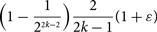
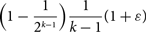
Let c denote the largest constant such that every C6-free graph G contains a bipartite and C4-free subgraph having a fraction c of edges of G. Győri, Kensell and Tompkins showed that 3/8 ⩽ c ⩽ 2/5. We prove that c = 38. More generally, we show that for any ε > 0, and any integer k ⩾ 2, there is a C2k-free graph $G'$ which does not contain a bipartite subgraph of girth greater than 2k with more than a fraction
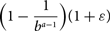
One of our proofs uses the following statement, which we prove using probabilistic ideas, generalizing a theorem of Erdős. For any ε > 0, and any integers a, b, k ⩾ 2, there exists an a-uniform hypergraph H of girth greater than k which does not contain any b-colourable subhypergraph with more than a fraction
of the hyperedges of H. We also prove further generalizations of this theorem.
In addition, we give a new and very short proof of a result of Kühn and Osthus, which states that every bipartite C2k-free graph G contains a C4-free subgraph with at least a fraction 1/(k−1) of the edges of G. We also answer a question of Kühn and Osthus about C2k-free graphs obtained by pasting together C2l’s (with k >l ⩾ 3).