Refine search
Actions for selected content:
9084 results in Discrete Mathematics, Information Theory and Coding
On the Chromatic Number of Matching Kneser Graphs
- Part of
-
- Journal:
- Combinatorics, Probability and Computing / Volume 29 / Issue 1 / January 2020
- Published online by Cambridge University Press:
- 12 September 2019, pp. 1-21
-
- Article
- Export citation
Expansion of Percolation Critical Points for Hamming Graphs
- Part of
-
- Journal:
- Combinatorics, Probability and Computing / Volume 29 / Issue 1 / January 2020
- Published online by Cambridge University Press:
- 05 August 2019, pp. 68-100
-
- Article
- Export citation
-
The Hamming graph H(d, n) is the Cartesian product of d complete graphs on n vertices. Let ${m=d(n-1)}$ be the degree and $V = n^d$ be the number of vertices of H(d, n). Let $p_c^{(d)}$ be the critical point for bond percolation on H(d, n). We show that, for $d \in \mathbb{N}$ fixed and $n \to \infty$,which extends the asymptotics found in [10] by one order. The term
 $$p_c^{(d)} = {1 \over m} + {{2{d^2} - 1} \over {2{{(d - 1)}^2}}}{1 \over {{m^2}}} + O({m^{ - 3}}) + O({m^{ - 1}}{V^{ - 1/3}}),$$ $O(m^{-1}V^{-1/3})$ is the width of the critical window. For $d=4,5,6$ we have $m^{-3} =O(m^{-1}V^{-1/3})$, and so the above formula represents the full asymptotic expansion of $p_c^{(d)}$. In [16] we show that this formula is a crucial ingredient in the study of critical bond percolation on H(d, n) for $d=2,3,4$. The proof uses a lace expansion for the upper bound and a novel comparison with a branching random walk for the lower bound. The proof of the lower bound also yields a refined asymptotics for the susceptibility of a subcritical Erdös–Rényi random graph.


Preface
-
- Journal:
- Combinatorics, Probability and Computing / Volume 28 / Issue 4 / July 2019
- Published online by Cambridge University Press:
- 25 July 2019, pp. 483-484
-
- Article
-
- You have access
- Export citation
Expected Maximum Block Size in Critical Random Graphs
- Part of
-
- Journal:
- Combinatorics, Probability and Computing / Volume 28 / Issue 4 / July 2019
- Published online by Cambridge University Press:
- 25 July 2019, pp. 638-655
-
- Article
- Export citation
-
Let G(n,M) be a uniform random graph with n vertices and M edges. Let ${\wp_{n,m}}$ be the maximum block size of G(n,M), that is, the maximum size of its maximal 2-connected induced subgraphs. We determine the expectation of ${\wp_{n,m}}$ near the critical point M = n/2. When n − 2M ≫ n2/3, we find a constant c1 such thatInside the window of transition of G(n,M) with M = (n/2)(1 + λn−1/3), where λ is any real number, we find an exact analytic expression for
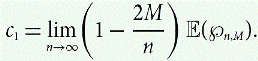 $$c_1 = \lim_{n \rightarrow \infty} \left({1 - \frac{2M}{n}} \right) \,\E({\wp_{n,m}}).$$This study relies on the symbolic method and analytic tools from generating function theory, which enable us to describe the evolution of
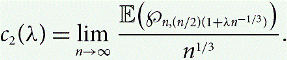 $$c_2(\lambda) = \lim_{n \rightarrow \infty} \frac{\E{\left({\wp_{n,{{(n/2)}({1+\lambda n^{-1/3}})}}}\right)}}{n^{1/3}}.$$ $n^{-1/3}\,\E{\left({\wp_{n,{{(n/2)}({1+\lambda n^{-1/3}})}}}\right)}$ as a function of λ.


On Komlós’ tiling theorem in random graphs
- Part of
-
- Journal:
- Combinatorics, Probability and Computing / Volume 29 / Issue 1 / January 2020
- Published online by Cambridge University Press:
- 25 July 2019, pp. 113-127
-
- Article
- Export citation
-
Given graphs G and H, a family of vertex-disjoint copies of H in G is called an H-tiling. Conlon, Gowers, Samotij and Schacht showed that for a given graph H and a constant γ>0, there exists C>0 such that if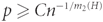 $p \ge C{n^{ - 1/{m_2}(H)}}$, then asymptotically almost surely every spanning subgraph G of the random graph 𝒢(n, p) with minimum degree at least contains an H-tiling that covers all but at most γn vertices. Here, χcr(H) denotes the critical chromatic number, a parameter introduced by Komlós, and m2(H) is the 2-density of H. We show that this theorem can be bootstrapped to obtain an H-tiling covering all but at most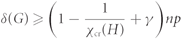 $\delta (G) \ge (1 - \frac{1}{{{\chi _{{\rm{cr}}}}(H)}} + \gamma )np$ $\gamma {(C/p)^{{m_2}(H)}}$ vertices, which is strictly smaller when $p \ge C{n^{ - 1/{m_2}(H)}}$. In the case where H = K3, this answers the question of Balogh, Lee and Samotij. Furthermore, for an arbitrary graph H we give an upper bound on p for which some leftover is unavoidable and a bound on the size of a largest H -tiling for p below this value.

Erratum to ‘On Percolation and the Bunkbed Conjecture’
-
- Journal:
- Combinatorics, Probability and Computing / Volume 28 / Issue 6 / November 2019
- Published online by Cambridge University Press:
- 22 July 2019, pp. 917-918
-
- Article
-
- You have access
- Export citation
On the Size-Ramsey Number of Cycles
- Part of
-
- Journal:
- Combinatorics, Probability and Computing / Volume 28 / Issue 6 / November 2019
- Published online by Cambridge University Press:
- 17 July 2019, pp. 871-880
-
- Article
- Export citation
-
For given graphs G1,…, Gk, the size-Ramsey number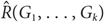 $\hat R({G_1}, \ldots ,{G_k})$ is the smallest integer m for which there exists a graph H on m edges such that in every k-edge colouring of H with colours 1,…,k, H contains a monochromatic copy of Gi of colour i for some 1 ≤ i ≤ k. We denote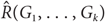 $\hat R({G_1}, \ldots ,{G_k})$ by ${\hat R_k}(G)$ when G1 = ⋯ = Gk = G.
Haxell, Kohayakawa and Łuczak showed that the size-Ramsey number of a cycle Cn is linear in n, ${\hat R_k}({C_n}) \le {c_k}n$ for some constant ck. Their proof, however, is based on Szemerédi’s regularity lemma so no specific constant ck is known.
In this paper, we give various upper bounds for the size-Ramsey numbers of cycles. We provide an alternative proof of ${\hat R_k}({C_n}) \le {c_k}n$, avoiding use of the regularity lemma, where ck is exponential and doubly exponential in k, when n is even and odd, respectively. In particular, we show that for sufficiently large n we have ${\hat R_2}({C_n}) \le {10^5} \times cn$, where c = 6.5 if n is even and c = 1989 otherwise.


Codegree Conditions for Tiling Complete k-Partite k-Graphs and Loose Cycles
- Part of
-
- Journal:
- Combinatorics, Probability and Computing / Volume 28 / Issue 6 / November 2019
- Published online by Cambridge University Press:
- 09 July 2019, pp. 840-870
-
- Article
- Export citation
Positive association of the oriented percolation cluster in randomly oriented graphs
- Part of
-
- Journal:
- Combinatorics, Probability and Computing / Volume 28 / Issue 6 / November 2019
- Published online by Cambridge University Press:
- 08 July 2019, pp. 811-815
-
- Article
- Export citation
Frontmatter
-
- Book:
- Surveys in Combinatorics 2019
- Published online:
- 17 June 2019
- Print publication:
- 27 June 2019, pp i-iv
-
- Chapter
- Export citation
1 - Clique-width for hereditary graph classes
-
-
- Book:
- Surveys in Combinatorics 2019
- Published online:
- 17 June 2019
- Print publication:
- 27 June 2019, pp 1-56
-
- Chapter
-
- You have access
- Export citation
A natural barrier in random greedy hypergraph matching
- Part of
-
- Journal:
- Combinatorics, Probability and Computing / Volume 28 / Issue 6 / November 2019
- Published online by Cambridge University Press:
- 27 June 2019, pp. 816-825
-
- Article
- Export citation
-
Let r ⩾ 2 be a fixed constant and let $ {\cal H} $ be an r-uniform, D-regular hypergraph on N vertices. Assume further that D → ∞ as N → ∞ and that degrees of pairs of vertices in $ {\cal H} $ are at most L where L = D/( log N)ω(1). We consider the random greedy algorithm for forming a matching in $ {\cal H} $. We choose a matching at random by iteratively choosing edges uniformly at random to be in the matching and deleting all edges that share at least one vertex with a chosen edge before moving on to the next choice. This process terminates when there are no edges remaining in the graph. We show that with high probability the proportion of vertices of $ {\cal H} $ that are not saturated by the final matching is at most (L/D)(1/(2(r−1)))+o(1). This point is a natural barrier in the analysis of the random greedy hypergraph matching process.


8 - Some combinatorial and geometric constructions of spherical buildings
-
-
- Book:
- Surveys in Combinatorics 2019
- Published online:
- 17 June 2019
- Print publication:
- 27 June 2019, pp 237-265
-
- Chapter
- Export citation
6 - Delta-matroids for graph theorists
-
-
- Book:
- Surveys in Combinatorics 2019
- Published online:
- 17 June 2019
- Print publication:
- 27 June 2019, pp 167-220
-
- Chapter
- Export citation
3 - Topological connectedness and independent sets in graphs
-
-
- Book:
- Surveys in Combinatorics 2019
- Published online:
- 17 June 2019
- Print publication:
- 27 June 2019, pp 89-114
-
- Chapter
- Export citation
Contents
-
- Book:
- Surveys in Combinatorics 2019
- Published online:
- 17 June 2019
- Print publication:
- 27 June 2019, pp v-vi
-
- Chapter
- Export citation
7 - Extremal theory of vertex or edge ordered graphs
-
-
- Book:
- Surveys in Combinatorics 2019
- Published online:
- 17 June 2019
- Print publication:
- 27 June 2019, pp 221-236
-
- Chapter
- Export citation
4 - Expanders – how to find them, and what to find in them
-
-
- Book:
- Surveys in Combinatorics 2019
- Published online:
- 17 June 2019
- Print publication:
- 27 June 2019, pp 115-142
-
- Chapter
- Export citation
2 - Analytic representations of large graphs
-
-
- Book:
- Surveys in Combinatorics 2019
- Published online:
- 17 June 2019
- Print publication:
- 27 June 2019, pp 57-88
-
- Chapter
- Export citation
5 - Supersingular isogeny graphs in cryptography
-
-
- Book:
- Surveys in Combinatorics 2019
- Published online:
- 17 June 2019
- Print publication:
- 27 June 2019, pp 143-166
-
- Chapter
- Export citation
