Refine search
Actions for selected content:
9084 results in Discrete Mathematics, Information Theory and Coding
A note on the Brown–Erdős–Sós conjecture in groups
- Part of
-
- Journal:
- Combinatorics, Probability and Computing / Volume 29 / Issue 4 / July 2020
- Published online by Cambridge University Press:
- 03 February 2020, pp. 633-640
-
- Article
- Export citation
-
We show that a dense subset of a sufficiently large group multiplication table contains either a large part of the addition table of the integers modulo some k, or the entire multiplication table of a certain large abelian group, as a subgrid. As a consequence, we show that triples systems coming from a finite group contain configurations with t triples spanning $ O(\sqrt t )$ vertices, which is the best possible up to the implied constant. We confirm that for all t we can find a collection of t triples spanning at most t + 3 vertices, resolving the Brown–Erdős–Sós conjecture in this context. The proof applies well-known arithmetic results including the multidimensional versions of Szemerédi’s theorem and the density Hales–Jewett theorem.
This result was discovered simultaneously and independently by Nenadov, Sudakov and Tyomkyn [5], and a weaker result avoiding the arithmetic machinery was obtained independently by Wong [11].


Geometric Regular Polytopes
-
- Published online:
- 30 January 2020
- Print publication:
- 20 February 2020
Minimax functions on Galton–Watson trees
- Part of
-
- Journal:
- Combinatorics, Probability and Computing / Volume 29 / Issue 3 / May 2020
- Published online by Cambridge University Press:
- 06 December 2019, pp. 455-484
-
- Article
- Export citation
The replica symmetric phase of random constraint satisfaction problems
- Part of
-
- Journal:
- Combinatorics, Probability and Computing / Volume 29 / Issue 3 / May 2020
- Published online by Cambridge University Press:
- 03 December 2019, pp. 346-422
-
- Article
- Export citation
Avoiding long Berge cycles: the missing cases k = r + 1 and k = r + 2
- Part of
-
- Journal:
- Combinatorics, Probability and Computing / Volume 29 / Issue 3 / May 2020
- Published online by Cambridge University Press:
- 27 November 2019, pp. 423-435
-
- Article
- Export citation
Sharp concentration of the equitable chromatic number of dense random graphs
- Part of
-
- Journal:
- Combinatorics, Probability and Computing / Volume 29 / Issue 2 / March 2020
- Published online by Cambridge University Press:
- 26 November 2019, pp. 213-233
-
- Article
- Export citation
-
An equitable colouring of a graph G is a vertex colouring where no two adjacent vertices are coloured the same and, additionally, the colour class sizes differ by at most 1. The equitable chromatic number χ=(G) is the minimum number of colours required for this. We study the equitable chromatic number of the dense random graph ${\mathcal{G}(n,m)}$ where $m = \left\lfloor {p\left( \matrix{n \cr 2 \cr}\right)} \right\rfloor $ and 0 < p < 0.86 is constant. It is a well-known question of Bollobás [3] whether for p = 1/2 there is a function f(n) → ∞ such that, for any sequence of intervals of length f(n), the normal chromatic number of ${\mathcal{G}(n,m)}$ lies outside the intervals with probability at least 1/2 if n is large enough. Bollobás proposes that this is likely to hold for f(n) = log n. We show that for the equitable chromatic number, the answer to the analogous question is negative. In fact, there is a subsequence ${({n_j})_j}_{ \in {\mathbb {N}}}$ of the integers where $\chi_=({\mathcal{G}(n_j,m_j)})$ is concentrated on exactly one explicitly known value. This constitutes surprisingly narrow concentration since in this range the equitable chromatic number, like the normal chromatic number, is rather large in absolute value, namely asymptotically equal to n/(2logbn) where b = 1/(1 − p).


Counting higher order tangencies for plane curves
- Part of
-
- Journal:
- Combinatorics, Probability and Computing / Volume 29 / Issue 2 / March 2020
- Published online by Cambridge University Press:
- 26 November 2019, pp. 310-317
-
- Article
- Export citation
7 - Arbitrary Approximate Groups
-
- Book:
- Introduction to Approximate Groups
- Published online:
- 31 October 2019
- Print publication:
- 14 November 2019, pp 130-132
-
- Chapter
- Export citation
8 - Residually Nilpotent Approximate Groups
-
- Book:
- Introduction to Approximate Groups
- Published online:
- 31 October 2019
- Print publication:
- 14 November 2019, pp 133-146
-
- Chapter
- Export citation
4 - Small Doubling in Abelian Groups
-
- Book:
- Introduction to Approximate Groups
- Published online:
- 31 October 2019
- Print publication:
- 14 November 2019, pp 54-80
-
- Chapter
- Export citation
References
-
- Book:
- Introduction to Approximate Groups
- Published online:
- 31 October 2019
- Print publication:
- 14 November 2019, pp 198-201
-
- Chapter
- Export citation
Dedication
-
- Book:
- Introduction to Approximate Groups
- Published online:
- 31 October 2019
- Print publication:
- 14 November 2019, pp v-vi
-
- Chapter
- Export citation
2 - Basic Concepts
-
- Book:
- Introduction to Approximate Groups
- Published online:
- 31 October 2019
- Print publication:
- 14 November 2019, pp 11-34
-
- Chapter
- Export citation
9 - Soluble Approximate Subgroups of GLn(C)
-
- Book:
- Introduction to Approximate Groups
- Published online:
- 31 October 2019
- Print publication:
- 14 November 2019, pp 147-169
-
- Chapter
- Export citation
Preface
-
- Book:
- Introduction to Approximate Groups
- Published online:
- 31 October 2019
- Print publication:
- 14 November 2019, pp xi-xiv
-
- Chapter
- Export citation
10 - Arbitrary Approximate Subgroups of GLn(C)
-
- Book:
- Introduction to Approximate Groups
- Published online:
- 31 October 2019
- Print publication:
- 14 November 2019, pp 170-177
-
- Chapter
- Export citation
1 - Introduction
-
- Book:
- Introduction to Approximate Groups
- Published online:
- 31 October 2019
- Print publication:
- 14 November 2019, pp 1-10
-
- Chapter
- Export citation
Index
-
- Book:
- Introduction to Approximate Groups
- Published online:
- 31 October 2019
- Print publication:
- 14 November 2019, pp 202-205
-
- Chapter
- Export citation
11 - Applications to Growth in Groups
-
- Book:
- Introduction to Approximate Groups
- Published online:
- 31 October 2019
- Print publication:
- 14 November 2019, pp 178-197
-
- Chapter
- Export citation
Edge-statistics on large graphs
- Part of
-
- Journal:
- Combinatorics, Probability and Computing / Volume 29 / Issue 2 / March 2020
- Published online by Cambridge University Press:
- 14 November 2019, pp. 163-189
-
- Article
- Export citation
-
The inducibility of a graph H measures the maximum number of induced copies of H a large graph G can have. Generalizing this notion, we study how many induced subgraphs of fixed order k and size ℓ a large graph G on n vertices can have. Clearly, this number is $\left( {\matrix{n \cr k}}\right)$ for every n, k and $\ell \in \left\{ {0,\left( {\matrix{k \cr 2}} \right)}\right\}$. We conjecture that for every n, k and $0 \lt \ell \lt \left( {\matrix{k \cr 2}}\right)$ this number is at most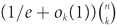 $ (1/e + {o_k}(1)) {\left( {\matrix{n \cr k}} \right)}$. If true, this would be tight for ℓ ∈ {1, k − 1}.
In support of our ‘Edge-statistics Conjecture’, we prove that the corresponding density is bounded away from 1 by an absolute constant. Furthermore, for various ranges of the values of ℓ we establish stronger bounds. In particular, we prove that for ‘almost all’ pairs (k, ℓ) only a polynomially small fraction of the k-subsets of V(G) have exactly ℓ edges, and prove an upper bound of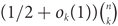 $ (1/2 + {o_k}(1)){\left( {\matrix{n \cr k}}\right)}$ for ℓ = 1.
Our proof methods involve probabilistic tools, such as anti-concentration results relying on fourth moment estimates and Brun’s sieve, as well as graph-theoretic and combinatorial arguments such as Zykov’s symmetrization, Sperner’s theorem and various counting techniques.


