Refine search
Actions for selected content:
9084 results in Discrete Mathematics, Information Theory and Coding
On the union of intersecting families
- Part of
-
- Journal:
- Combinatorics, Probability and Computing / Volume 28 / Issue 6 / November 2019
- Published online by Cambridge University Press:
- 27 June 2019, pp. 826-839
-
- Article
- Export citation
-
A family of sets is said to be intersecting if any two sets in the family have non-empty intersection. In 1973, Erdős raised the problem of determining the maximum possible size of a union of r different intersecting families of k-element subsets of an n-element set, for each triple of integers (n, k, r). We make progress on this problem, proving that for any fixed integer r ⩾ 2 and for any
 $$k \le ({1 \over 2} - o(1))n$$, if X is an n-element set, and
  $${\cal F} = {\cal F}_1 \cup {\cal F}_2 \cup \cdots \cup {\cal F}_r $$, where each
  $$ {\cal F}_i $$ is an intersecting family of k-element subsets of X, then
 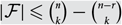 $$|{\cal F}| \le \left( {\matrix{n \cr k \cr } } \right) - \left( {\matrix{{n - r} \cr k \cr } } \right)$$, with equality only if
  $${\cal F} = \{ S \subset X:|S| = k,\;S \cap R \ne \emptyset \} $$ for some R ⊂ X with |R| = r. This is best possible up to the size of the o(1) term, and improves a 1987 result of Frankl and Füredi, who obtained the same conclusion under the stronger hypothesis
  $$k < (3 - \sqrt 5 )n/2$$, in the case r = 2. Our proof utilizes an isoperimetric, influence-based method recently developed by Keller and the authors.

Preface
-
- Book:
- Surveys in Combinatorics 2019
- Published online:
- 17 June 2019
- Print publication:
- 27 June 2019, pp vii-viii
-
- Chapter
- Export citation
On Erdős–Ko–Rado for random hypergraphs I
- Part of
-
- Journal:
- Combinatorics, Probability and Computing / Volume 28 / Issue 6 / November 2019
- Published online by Cambridge University Press:
- 25 June 2019, pp. 881-916
-
- Article
- Export citation
-
A family of sets is intersecting if no two of its members are disjoint, and has the Erdős–Ko–Rado property (or is EKR) if each of its largest intersecting subfamilies has non-empty intersection.
Denote by ${{\cal H}_k}(n,p)$ the random family in which each k-subset of {1, …, n} is present with probability p, independent of other choices. A question first studied by Balogh, Bohman and Mubayi asks:
 \begin{equation} {\rm{For what }}p = p(n,k){\rm{is}}{{\cal H}_k}(n,p){\rm{likely to be EKR}}? \end{equation}
Here, for fixed c < 1/4, and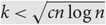 $k \lt \sqrt {cn\log n} $ we give a precise answer to this question, characterizing those sequences p = p(n, k) for which
 \begin{equation} {\mathbb{P}}({{\cal H}_k}(n,p){\rm{is EKR}}{\kern 1pt} ) \to 1{\rm{as }}n \to \infty . \end{equation}

Surveys in Combinatorics 2019
-
- Published online:
- 17 June 2019
- Print publication:
- 27 June 2019
An Improved Upper Bound for Bootstrap Percolation in All Dimensions
- Part of
-
- Journal:
- Combinatorics, Probability and Computing / Volume 28 / Issue 6 / November 2019
- Published online by Cambridge University Press:
- 17 June 2019, pp. 936-960
-
- Article
- Export citation
-
In r-neighbour bootstrap percolation on the vertex set of a graph G, a set A of initially infected vertices spreads by infecting, at each time step, all uninfected vertices with at least r previously infected neighbours. When the elements of A are chosen independently with some probability p, it is natural to study the critical probability pc(G, r) at which it becomes likely that all of V(G) will eventually become infected. Improving a result of Balogh, Bollobás and Morris, we give a bound on the second term in the expansion of the critical probability when G = [n]d and d ⩾ r ⩾ 2. We show that for all d ⩾ r ⩾ 2 there exists a constant cd,r > 0 such that if n is sufficiently large, then
 $$p_c (\left[ n \right]^d ,{\rm{ }}r){\rm{\le }}\left( {\frac{{\lambda (d,r)}}{{\log _{(r - 1)} (n)}} - \frac{{c_{d,r} }}{{(\log _{(r - 1)} (n))^{3/2} }}} \right)^{d - r + 1} ,$$
where λ(d, r) is an exact constant and log(k) (n) denotes the k-times iterated natural logarithm of n.
Logarithmic Sobolev inequalities in discrete product spaces
- Part of
-
- Journal:
- Combinatorics, Probability and Computing / Volume 28 / Issue 6 / November 2019
- Published online by Cambridge University Press:
- 13 June 2019, pp. 919-935
-
- Article
- Export citation
-
The aim of this paper is to prove an inequality between relative entropy and the sum of average conditional relative entropies of the following form: for a fixed probability measure q on
 , (
, ( is a finite set), and any probability measure
  on ,(*)where pi(· |y1, …, yi−1, yi+1, …, yn) and qi(· |x1, …, xi−1, xi+1, …, xn) denote the local specifications for p resp. q, that is, the conditional distributions of the ith coordinate, given the other coordinates. The constant C depends on (the local specifications of) q.
 $$D(p||q){\rm{\le}}C \cdot \sum\limits_{i = 1}^n {{\rm{\mathbb{E}}}_p D(p_i ( \cdot |Y_1 ,{\rm{ }}...,{\rm{ }}Y_{i - 1} ,{\rm{ }}Y_{i + 1} ,...,{\rm{ }}Y_n )||q_i ( \cdot |Y_1 ,{\rm{ }}...,{\rm{ }}Y_{i - 1} ,{\rm{ }}Y_{i + 1} ,{\rm{ }}...,{\rm{ }}Y_n )),} $$
The inequality (*) ismeaningful in product spaces, in both the discrete and the continuous case, and can be used to prove a logarithmic Sobolev inequality for q, provided uniform logarithmic Sobolev inequalities are available for qi(· |x1, …, xi−1, xi+1, …, xn), for all fixed i and fixed (x1, …, xi−1, xi+1, …, xn). Inequality (*) directly implies that the Gibbs sampler associated with q is a contraction for relative entropy.
In this paper we derive inequality (*), and thereby a logarithmic Sobolev inequality, in discrete product spaces, by proving inequalities for an appropriate Wasserstein-like distance.
 , (
, ( is a finite set), and any probability measure
  on
on 
A near-exponential improvement of a bound of Erdős and Lovász on maximal intersecting families
- Part of
-
- Journal:
- Combinatorics, Probability and Computing / Volume 28 / Issue 5 / September 2019
- Published online by Cambridge University Press:
- 04 June 2019, pp. 733-739
-
- Article
- Export citation
A note on polynomial profiles of placement games
-
-
- Book:
- Games of No Chance 5
- Published online:
- 29 May 2025
- Print publication:
- 09 May 2019, pp 243-258
-
- Chapter
- Export citation
Generalized misère play
-
-
- Book:
- Games of No Chance 5
- Published online:
- 29 May 2025
- Print publication:
- 09 May 2019, pp 469-478
-
- Chapter
- Export citation
A PSPACE-complete graph nim
-
-
- Book:
- Games of No Chance 5
- Published online:
- 29 May 2025
- Print publication:
- 09 May 2019, pp 259-270
-
- Chapter
- Export citation
Misère games and misere quotients
-
-
- Book:
- Games of No Chance 5
- Published online:
- 29 May 2025
- Print publication:
- 09 May 2019, pp 169-206
-
- Chapter
- Export citation
Impartial games whose rulesets produce given continued fractions
-
-
- Book:
- Games of No Chance 5
- Published online:
- 29 May 2025
- Print publication:
- 09 May 2019, pp 403-420
-
- Chapter
- Export citation
Geometric analysis of a generalized Wythoff game
-
-
- Book:
- Games of No Chance 5
- Published online:
- 29 May 2025
- Print publication:
- 09 May 2019, pp 343-372
-
- Chapter
- Export citation
Retrospective Author Index
-
- Book:
- Games of No Chance 5
- Published online:
- 29 May 2025
- Print publication:
- 09 May 2019, pp 479-490
-
- Chapter
- Export citation
Endgames in bidding chess
-
-
- Book:
- Games of No Chance 5
- Published online:
- 29 May 2025
- Print publication:
- 09 May 2019, pp 421-438
-
- Chapter
- Export citation
Take-away games on Beatty's theorem and the notion of k-invariance
-
-
- Book:
- Games of No Chance 5
- Published online:
- 29 May 2025
- Print publication:
- 09 May 2019, pp 333-342
-
- Chapter
- Export citation
Wythoff visions
-
-
- Book:
- Games of No Chance 5
- Published online:
- 29 May 2025
- Print publication:
- 09 May 2019, pp 35-88
-
- Chapter
- Export citation
Good pass moves in no-draw HyperHex: two proverbs
-
-
- Book:
- Games of No Chance 5
- Published online:
- 29 May 2025
- Print publication:
- 09 May 2019, pp 387-394
-
- Chapter
- Export citation
Contents
-
- Book:
- Games of No Chance 5
- Published online:
- 29 May 2025
- Print publication:
- 09 May 2019, pp vii-viii
-
- Chapter
- Export citation
About this book
-
-
- Book:
- Games of No Chance 5
- Published online:
- 29 May 2025
- Print publication:
- 09 May 2019, pp 1-20
-
- Chapter
- Export citation
