Refine search
Actions for selected content:
6997 results in Mathematical modeling and methods
MODELLING THE GROWTH OF ZINC OXIDE NANOSTRUCTURES
- Part of
-
- Journal:
- The ANZIAM Journal / Volume 50 / Issue 3 / January 2009
- Published online by Cambridge University Press:
- 03 November 2009, pp. 395-406
-
- Article
-
- You have access
- Export citation
NUMERICAL DETERMINATION OF CRITICAL CONDITIONS FOR THERMAL IGNITION
- Part of
-
- Journal:
- The ANZIAM Journal / Volume 50 / Issue 3 / January 2009
- Published online by Cambridge University Press:
- 03 November 2009, pp. 283-305
-
- Article
-
- You have access
- Export citation
PREFACE TO THIS SPECIAL ISSUE
-
- Journal:
- The ANZIAM Journal / Volume 50 / Issue 3 / January 2009
- Published online by Cambridge University Press:
- 03 November 2009, pp. i-iv
-
- Article
-
- You have access
- Export citation
MATHEMATICAL MODELLING OF WAIRAKEI GEOTHERMAL FIELD
- Part of
-
- Journal:
- The ANZIAM Journal / Volume 50 / Issue 3 / January 2009
- Published online by Cambridge University Press:
- 03 November 2009, pp. 426-434
-
- Article
-
- You have access
- Export citation
AN ANALYTIC SOLUTION FOR ONE-DIMENSIONAL DISSIPATIONAL STRAIN-GRADIENT PLASTICITY
- Part of
-
- Journal:
- The ANZIAM Journal / Volume 50 / Issue 3 / January 2009
- Published online by Cambridge University Press:
- 03 November 2009, pp. 407-420
-
- Article
-
- You have access
- Export citation
A MATHEMATICAL MODEL FOR THE LARGE-SCALE TRANSPORT OF HEAT AND WATER IN THE TAUPO VOLCANIC ZONE OF NEW ZEALAND
- Part of
-
- Journal:
- The ANZIAM Journal / Volume 50 / Issue 3 / January 2009
- Published online by Cambridge University Press:
- 03 November 2009, pp. 343-354
-
- Article
-
- You have access
- Export citation
Objective function design for robust optimalityof linear controlunder state-constraints and uncertainty
-
- Journal:
- ESAIM: Control, Optimisation and Calculus of Variations / Volume 17 / Issue 1 / January 2011
- Published online by Cambridge University Press:
- 30 October 2009, pp. 155-177
- Print publication:
- January 2011
-
- Article
- Export citation
Weighted energy-dissipation functionals for gradient flows
-
- Journal:
- ESAIM: Control, Optimisation and Calculus of Variations / Volume 17 / Issue 1 / January 2011
- Published online by Cambridge University Press:
- 30 October 2009, pp. 52-85
- Print publication:
- January 2011
-
- Article
- Export citation
Stabilization of the Kawahara equationwith localized damping
-
- Journal:
- ESAIM: Control, Optimisation and Calculus of Variations / Volume 17 / Issue 1 / January 2011
- Published online by Cambridge University Press:
- 30 October 2009, pp. 102-116
- Print publication:
- January 2011
-
- Article
- Export citation
The internal stabilization by noiseof the linearized Navier-Stokes equation*
-
- Journal:
- ESAIM: Control, Optimisation and Calculus of Variations / Volume 17 / Issue 1 / January 2011
- Published online by Cambridge University Press:
- 30 October 2009, pp. 117-130
- Print publication:
- January 2011
-
- Article
- Export citation
-
One shows that the linearized Navier-Stokes equation in ${\mathcal{O}}{\subset} R^d,\;d \ge 2$
 , around an unstable equilibriumsolution is exponentially stabilizable in probability by aninternal noise controller $V(t,\xi)=\displaystyle\sum\limits_{i=1}^{N} V_i(t)\psi_i(\xi)\dot\beta_i(t)$
 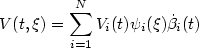 , $\xi\in{\mathcal{O}}$
  , where $\{\beta_i\}^N_{i=1}$
  areindependent Brownian motions in a probability space and $\{\psi_i\}^N_{i=1}$
  is a system of functions on ${\mathcal{O}}$
  withsupport in an arbitrary open subset ${\mathcal{O}}_0\subset {\mathcal{O}}$
  . Thestochastic control input $\{V_i\}^N_{i=1}$
  is found in feedbackform. One constructs also a tangential boundary noise controllerwhich exponentially stabilizes in probability the equilibriumsolution.


Nonlinear Waves
-
- Published online:
- 29 October 2009
- Print publication:
- 30 December 1983

Maximum and Minimum Principles
- A Unified Approach with Applications
-
- Published online:
- 12 October 2009
- Print publication:
- 17 December 1987
A finite element scheme for the evolutionof orientational order in fluid membranes
-
- Journal:
- ESAIM: Mathematical Modelling and Numerical Analysis / Volume 44 / Issue 1 / January 2010
- Published online by Cambridge University Press:
- 09 October 2009, pp. 1-31
- Print publication:
- January 2010
-
- Article
- Export citation
A finite dimensional linear programming approximation of Mather's variational problem
-
- Journal:
- ESAIM: Control, Optimisation and Calculus of Variations / Volume 16 / Issue 4 / October 2010
- Published online by Cambridge University Press:
- 09 October 2009, pp. 1094-1109
- Print publication:
- October 2010
-
- Article
- Export citation
On a semilinear variational problem
-
- Journal:
- ESAIM: Control, Optimisation and Calculus of Variations / Volume 17 / Issue 1 / January 2011
- Published online by Cambridge University Press:
- 09 October 2009, pp. 86-101
- Print publication:
- January 2011
-
- Article
- Export citation
-
We provide a detailed analysis of the minimizers of the functional $u \mapsto \int_{\Bbb R^n} |\nabla u|^2 + D \int_{\Bbb R^n} |u|^{\gamma}$
 , $\gamma \in (0, 2)$
  , subject to the constraint $\|u\|_{L^2} = 1$
  . This problem, e.g., describes the long-time behavior of the parabolic Anderson in probability theory or ground state solutions of a nonlinear Schrödinger equation. While existence can be proved with standard methods, we show that the usual uniqueness results obtained with PDE-methods can be considerably simplified by additional variational arguments. In addition, we investigate qualitative properties of the minimizers and also study their behavior near the critical exponent 2.


Quasistatic crack evolution for a cohesive zone modelwith different response to loading and unloading:a Young measures approach
-
- Journal:
- ESAIM: Control, Optimisation and Calculus of Variations / Volume 17 / Issue 1 / January 2011
- Published online by Cambridge University Press:
- 09 October 2009, pp. 1-27
- Print publication:
- January 2011
-
- Article
- Export citation
Wavelet compression of anisotropic integrodifferential operators on sparse tensor product spaces
-
- Journal:
- ESAIM: Mathematical Modelling and Numerical Analysis / Volume 44 / Issue 1 / January 2010
- Published online by Cambridge University Press:
- 09 October 2009, pp. 33-73
- Print publication:
- January 2010
-
- Article
- Export citation
-
For a class of anisotropic integrodifferential operators ${\cal B}$
 arising as semigroup generators of Markov processes, we present a sparse tensor product wavelet compression scheme for the Galerkin finite element discretization of the corresponding integrodifferential equations ${\cal B}$ u = f on [0,1]n with possibly large n. Under certain conditions on ${\cal B}$ , the scheme is of essentially optimal and dimension independent complexity $\mathcal{O}$
  (h -1| log h |2(n-1)) without corrupting the convergence or smoothness requirements of the original sparse tensor finite element scheme. If the conditions on ${\cal B}$ are not satisfied, thecomplexity can be bounded by $\mathcal{O}$ (h -(1+ε)), whereε $\ll 1$
  tends to zero with increasing number of the wavelets' vanishing moments. Here h denotes the width of the corresponding finite element mesh. The operators under consideration are assumed to be of non-negative (anisotropic) order and admit a non-standard kernel κ $(\cdot,\cdot)$
  that can be singular on all secondary diagonals. Practical examples of such operators from Mathematical Finance are given and some numerical results are presented.


Relaxation and numerical approximation of a two-fluid two-pressure diphasic model
-
- Journal:
- ESAIM: Mathematical Modelling and Numerical Analysis / Volume 43 / Issue 6 / November 2009
- Published online by Cambridge University Press:
- 09 October 2009, pp. 1063-1097
- Print publication:
- November 2009
-
- Article
- Export citation

Nonlinear Diffusive Waves
-
- Published online:
- 01 October 2009
- Print publication:
- 23 July 1987

Matrix Calculus and Zero-One Matrices
- Statistical and Econometric Applications
-
- Published online:
- 14 September 2009
- Print publication:
- 10 December 2001
