Refine search
Actions for selected content:
6997 results in Mathematical modeling and methods

Finite Plastic Deformation of Crystalline Solids
-
- Published online:
- 11 September 2009
- Print publication:
- 27 March 1992
Well-posedness and regularity of hyperbolic boundary control systemson a one-dimensional spatial domain
-
- Journal:
- ESAIM: Control, Optimisation and Calculus of Variations / Volume 16 / Issue 4 / October 2010
- Published online by Cambridge University Press:
- 25 August 2009, pp. 1077-1093
- Print publication:
- October 2010
-
- Article
- Export citation
A finite element discretization of the three-dimensional Navier–Stokes equations with mixed boundary conditions
-
- Journal:
- ESAIM: Mathematical Modelling and Numerical Analysis / Volume 43 / Issue 6 / November 2009
- Published online by Cambridge University Press:
- 21 August 2009, pp. 1185-1201
- Print publication:
- November 2009
-
- Article
- Export citation
Improved successive constraint method based a posteriori error estimate for reduced basis approximationof 2D Maxwell's problem
-
- Journal:
- ESAIM: Mathematical Modelling and Numerical Analysis / Volume 43 / Issue 6 / November 2009
- Published online by Cambridge University Press:
- 21 August 2009, pp. 1099-1116
- Print publication:
- November 2009
-
- Article
- Export citation
Convergence and quasi-optimal complexityof a simple adaptive finite element method
-
- Journal:
- ESAIM: Mathematical Modelling and Numerical Analysis / Volume 43 / Issue 6 / November 2009
- Published online by Cambridge University Press:
- 21 August 2009, pp. 1203-1219
- Print publication:
- November 2009
-
- Article
- Export citation

Calculated Bets
- Computers, Gambling, and Mathematical Modeling to Win
-
- Published online:
- 17 August 2009
- Print publication:
- 06 August 2001
Controllability properties of a class of systems modelingswimming microscopic organisms
-
- Journal:
- ESAIM: Control, Optimisation and Calculus of Variations / Volume 16 / Issue 4 / October 2010
- Published online by Cambridge University Press:
- 11 August 2009, pp. 1053-1076
- Print publication:
- October 2010
-
- Article
- Export citation
Equivalent formulation and numerical analysis of a fire confinement problem
-
- Journal:
- ESAIM: Control, Optimisation and Calculus of Variations / Volume 16 / Issue 4 / October 2010
- Published online by Cambridge University Press:
- 11 August 2009, pp. 974-1001
- Print publication:
- October 2010
-
- Article
- Export citation
-
We consider a class of variationalproblems for differential inclusions, related to thecontrol of wild fires. The area burned by the fire at time t> 0is modelled as the reachable set fora differential inclusion $\dot x$
 ∈F(x), starting froman initial set R 0. To block the fire, a barrier can be constructedprogressively in time. For each t> 0, the portion of the wall constructedwithin time t is described by a rectifiable setγ(t) ⊂ $\mathbb{R}^2$
  . In this paperwe show that the searchfor blocking strategies and for optimal strategies can be reduced toa problem involving one single admissible rectifiable set Γ⊂ $\mathbb{R}^2$ ,rather than the multifunction t $\mapsto$
  γ(t) ⊂ $\mathbb{R}^2$ .Relying on this result, we then developa numerical algorithm for the computation ofoptimal strategies, minimizing the total area burned by the fire.


Necessary and sufficient Lyapunov-like conditions for robust nonlinear stabilization
-
- Journal:
- ESAIM: Control, Optimisation and Calculus of Variations / Volume 16 / Issue 4 / October 2010
- Published online by Cambridge University Press:
- 11 August 2009, pp. 887-928
- Print publication:
- October 2010
-
- Article
- Export citation
Conjugate and cut time in the sub-Riemannian problem on the group of motions of a plane
-
- Journal:
- ESAIM: Control, Optimisation and Calculus of Variations / Volume 16 / Issue 4 / October 2010
- Published online by Cambridge University Press:
- 11 August 2009, pp. 1018-1039
- Print publication:
- October 2010
-
- Article
- Export citation
Existence of classical solutions and feedback stabilization for the flow in gas networks
-
- Journal:
- ESAIM: Control, Optimisation and Calculus of Variations / Volume 17 / Issue 1 / January 2011
- Published online by Cambridge University Press:
- 11 August 2009, pp. 28-51
- Print publication:
- January 2011
-
- Article
- Export citation
Weak solutions of a parabolic-elliptic type systemfor image inpainting
-
- Journal:
- ESAIM: Control, Optimisation and Calculus of Variations / Volume 16 / Issue 4 / October 2010
- Published online by Cambridge University Press:
- 11 August 2009, pp. 1040-1052
- Print publication:
- October 2010
-
- Article
- Export citation
A regularity result for a convex functionaland bounds for the singularset
-
- Journal:
- ESAIM: Control, Optimisation and Calculus of Variations / Volume 16 / Issue 4 / October 2010
- Published online by Cambridge University Press:
- 11 August 2009, pp. 1002-1017
- Print publication:
- October 2010
-
- Article
- Export citation
-
In this paper we prove a regularityresult for local minimizers of functionals of the Calculus of Variations of thetype
$$\int_{\Omega}f(x, Du)\ {\rm d}x$$
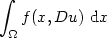
where Ω is a bounded open set in $\mathbb{R}^{n}$
 , u∈ $W^{1,p}_{\rm loc}$
  (Ω; $\mathbb{R}^{N}$
  ), p> 1, n≥ 2 and N≥ 1.We use the technique of difference quotient without the usual assumption on the growth of the second derivatives of the function f. We apply this result to givea bound on the Hausdorff dimension of the singular set of minimizers.


Discretization methods with analytical characteristicmethods for advection-diffusion-reaction equationsand 2d applications
-
- Journal:
- ESAIM: Mathematical Modelling and Numerical Analysis / Volume 43 / Issue 6 / November 2009
- Published online by Cambridge University Press:
- 01 August 2009, pp. 1157-1183
- Print publication:
- November 2009
-
- Article
- Export citation
Finite volume scheme for two-phase flows in heterogeneous porous media involving capillary pressure discontinuities
-
- Journal:
- ESAIM: Mathematical Modelling and Numerical Analysis / Volume 43 / Issue 5 / September 2009
- Published online by Cambridge University Press:
- 01 August 2009, pp. 973-1001
- Print publication:
- September 2009
-
- Article
- Export citation
A heterogeneous alternating-direction methodfor a micro-macro dilute polymeric fluid model
-
- Journal:
- ESAIM: Mathematical Modelling and Numerical Analysis / Volume 43 / Issue 6 / November 2009
- Published online by Cambridge University Press:
- 01 August 2009, pp. 1117-1156
- Print publication:
- November 2009
-
- Article
- Export citation
Convergence analysis of a locally stabilized collocated finite volume scheme for incompressible flows
-
- Journal:
- ESAIM: Mathematical Modelling and Numerical Analysis / Volume 43 / Issue 5 / September 2009
- Published online by Cambridge University Press:
- 01 August 2009, pp. 889-927
- Print publication:
- September 2009
-
- Article
- Export citation
Homogenization of variational problemsin manifold valued Sobolev spaces
-
- Journal:
- ESAIM: Control, Optimisation and Calculus of Variations / Volume 16 / Issue 4 / October 2010
- Published online by Cambridge University Press:
- 31 July 2009, pp. 833-855
- Print publication:
- October 2010
-
- Article
- Export citation
Equivalence of control systems with linear systemson Lie groups and homogeneous spaces
-
- Journal:
- ESAIM: Control, Optimisation and Calculus of Variations / Volume 16 / Issue 4 / October 2010
- Published online by Cambridge University Press:
- 31 July 2009, pp. 956-973
- Print publication:
- October 2010
-
- Article
- Export citation
3 - Conditional Probability
-
- Book:
- Elementary Probability for Applications
- Published online:
- 05 June 2012
- Print publication:
- 31 July 2009, pp 81-113
-
- Chapter
- Export citation
