Refine search
Actions for selected content:
6997 results in Mathematical modeling and methods
Frontmatter
-
- Book:
- Mathematical Modelling in One Dimension
- Published online:
- 05 March 2013
- Print publication:
- 21 February 2013, pp i-iv
-
- Chapter
- Export citation
Minimizing the fuel consumption of a vehicle from the Shell Eco-marathon: a numerical study∗
-
- Journal:
- ESAIM: Control, Optimisation and Calculus of Variations / Volume 19 / Issue 2 / April 2013
- Published online by Cambridge University Press:
- 21 February 2013, pp. 516-532
- Print publication:
- April 2013
-
- Article
- Export citation
4 - Qualitative theory for a single equation
-
- Book:
- Mathematical Modelling in One Dimension
- Published online:
- 05 March 2013
- Print publication:
- 21 February 2013, pp 66-91
-
- Chapter
- Export citation
TOPOLOGY OF STEADY HEAT CONDUCTION IN A SOLID SLAB SUBJECT TO A NONUNIFORM BOUNDARY CONDITION: THE CARSLAW–JAEGER SOLUTION REVISITED
-
- Journal:
- The ANZIAM Journal / Volume 53 / Issue 4 / April 2012
- Published online by Cambridge University Press:
- 18 February 2013, pp. 308-320
-
- Article
-
- You have access
- Export citation
Existence of solutions for a semilinear ellipticsystem
-
- Journal:
- ESAIM: Control, Optimisation and Calculus of Variations / Volume 19 / Issue 2 / April 2013
- Published online by Cambridge University Press:
- 15 February 2013, pp. 574-586
- Print publication:
- April 2013
-
- Article
- Export citation
-
This paper deals with the existence of solutions to the following system:
$$\left\{\begin{array}{l} -\Deltau+u=\frac{\alpha}{\alpha+\beta}a(x)|v|^{\beta} |u|^{\alpha-2}u\quad\mbox{ in}\mathbb{R}^N\\ [0.2cm] -\Delta v+v=\frac{\beta}{\alpha+\beta}a(x)|u|^{\alpha}|v|^{\beta-2}v\quad\mbox{ in }\mathbb{R}^N. \end{array}\right.$$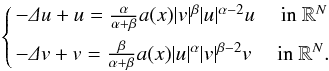
With the help of the Nehari manifold and the linking theorem, we prove the existence ofat least two nontrivial solutions. One of them is positive. Our main tools are theconcentration-compactness principle and the Ekeland’s variational principle.
Time optimal control of the heat equation with pointwisecontrol constraints***
-
- Journal:
- ESAIM: Control, Optimisation and Calculus of Variations / Volume 19 / Issue 2 / April 2013
- Published online by Cambridge University Press:
- 15 February 2013, pp. 460-485
- Print publication:
- April 2013
-
- Article
- Export citation
AN ANALYTICAL AND NUMERICAL STUDY OF UNSTEADY CHANNEL FLOW WITH SLIP
-
- Journal:
- The ANZIAM Journal / Volume 53 / Issue 4 / April 2012
- Published online by Cambridge University Press:
- 08 February 2013, pp. 321-336
-
- Article
-
- You have access
- Export citation
SELECTIVE WITHDRAWAL OF A TWO-LAYER VISCOUS FLUID
-
- Journal:
- The ANZIAM Journal / Volume 53 / Issue 4 / April 2012
- Published online by Cambridge University Press:
- 08 February 2013, pp. 253-277
-
- Article
-
- You have access
- Export citation
-
Selective withdrawal of a two-layer fluid is considered. The fluid layers are weakly compressible, miscible and viscous and therefore flow rotationally. The lower, denser fluid flows with constant velocity out through one or more drain holes in the bottom of a rectangular tank. The drain is opened impulsively and the subsequent draw-down produces waves in the interface which travel outward to the edges of the tank and are reflected back with a $18{0}^{\circ } $ change of phase. The points on the interface that have the highest absolute gradient form regions of high vorticity in the tank, enabling mixing of the fluids. An inviscid linearized interface is computed and compared to contour plots of density for the viscous solution. The two agree closely at early times in the withdrawal process, but as time increases, nonlinear and viscous effects take over. The time at which the lighter fluid starts to flow out of the tank is dependent on the number of drains, their width, and the fluid flow rate and density, and is investigated here.

OPTIMAL CONTROL OF SWITCHED IMPULSIVE SYSTEMS WITH TIME DELAY
-
- Journal:
- The ANZIAM Journal / Volume 53 / Issue 4 / April 2012
- Published online by Cambridge University Press:
- 07 February 2013, pp. 292-307
-
- Article
-
- You have access
- Export citation
A HYBRID MODEL FOR STUDYING SPATIAL ASPECTS OF INFECTIOUS DISEASES
- Part of
-
- Journal:
- The ANZIAM Journal / Volume 54 / Issue 1-2 / October 2012
- Published online by Cambridge University Press:
- 07 February 2013, pp. 37-49
-
- Article
-
- You have access
- Export citation

Introduction to the Network Approximation Method for Materials Modeling
-
- Published online:
- 05 February 2013
- Print publication:
- 13 December 2012
LIFE HISTORIES OFFER A CLUE TO THE FUTURE OF INFECTIOUS DISEASE ON CORAL REEFS
-
- Journal:
- The ANZIAM Journal / Volume 54 / Issue 1-2 / October 2012
- Published online by Cambridge University Press:
- 04 February 2013, pp. 64-73
-
- Article
-
- You have access
- Export citation
EPIDEMIC DYNAMICS ON RANDOM AND SCALE-FREE NETWORKS
-
- Journal:
- The ANZIAM Journal / Volume 54 / Issue 1-2 / October 2012
- Published online by Cambridge University Press:
- 30 January 2013, pp. 3-22
-
- Article
-
- You have access
- Export citation
-
Random networks were first used to model epidemic dynamics in the 1950s, but in the last decade it has been realized that scale-free networks more accurately represent the network structure of many real-world situations. Here we give an analytical and a Monte Carlo method for approximating the basic reproduction number ${R}_{0} $ of an infectious agent on a network. We investigate how final epidemic size depends on ${R}_{0} $ and on network density in random networks and in scale-free networks with a Pareto exponent of 3. Our results show that: (i) an epidemic on a random network has the same average final size as an epidemic in a well-mixed population with the same value of ${R}_{0} $; (ii) an epidemic on a scale-free network has a larger average final size than in an equivalent well-mixed population if ${R}_{0} \lt 1$, and a smaller average final size than in a well-mixed population if ${R}_{0} \gt 1$; (iii) an epidemic on a scale-free network spreads more rapidly than an epidemic on a random network or in a well-mixed population.


Hamilton–Jacobi equations and two-person zero-sum differentialgames with unbounded controls∗
-
- Journal:
- ESAIM: Control, Optimisation and Calculus of Variations / Volume 19 / Issue 2 / April 2013
- Published online by Cambridge University Press:
- 23 January 2013, pp. 404-437
- Print publication:
- April 2013
-
- Article
- Export citation
Γ-limits of convolutionfunctionals
-
- Journal:
- ESAIM: Control, Optimisation and Calculus of Variations / Volume 19 / Issue 2 / April 2013
- Published online by Cambridge University Press:
- 23 January 2013, pp. 486-515
- Print publication:
- April 2013
-
- Article
- Export citation
A posteriori error estimation for semilinearparabolic optimal control problems with application to model reduction by POD∗
-
- Journal:
- ESAIM: Mathematical Modelling and Numerical Analysis / Volume 47 / Issue 2 / March 2013
- Published online by Cambridge University Press:
- 21 January 2013, pp. 555-581
- Print publication:
- March 2013
-
- Article
- Export citation
Optimized Schwarz Methods for the Bidomain system inelectrocardiology
-
- Journal:
- ESAIM: Mathematical Modelling and Numerical Analysis / Volume 47 / Issue 2 / March 2013
- Published online by Cambridge University Press:
- 18 January 2013, pp. 583-608
- Print publication:
- March 2013
-
- Article
- Export citation
Asymptotic behaviour and numerical approximation of optimaleigenvalues of the Robin Laplacian∗
-
- Journal:
- ESAIM: Control, Optimisation and Calculus of Variations / Volume 19 / Issue 2 / April 2013
- Published online by Cambridge University Press:
- 16 January 2013, pp. 438-459
- Print publication:
- April 2013
-
- Article
- Export citation
Analysis of an Asymptotic Preserving Scheme for RelaxationSystems∗
-
- Journal:
- ESAIM: Mathematical Modelling and Numerical Analysis / Volume 47 / Issue 2 / March 2013
- Published online by Cambridge University Press:
- 15 January 2013, pp. 609-633
- Print publication:
- March 2013
-
- Article
- Export citation
A priori error analysis of a fully-mixedfinite element method for a two-dimensional fluid-solid interaction problem∗
-
- Journal:
- ESAIM: Mathematical Modelling and Numerical Analysis / Volume 47 / Issue 2 / March 2013
- Published online by Cambridge University Press:
- 11 January 2013, pp. 471-506
- Print publication:
- March 2013
-
- Article
- Export citation
