To save content items to your account,
please confirm that you agree to abide by our usage policies.
If this is the first time you use this feature, you will be asked to authorise Cambridge Core to connect with your account.
Find out more about saving content to .
To save content items to your Kindle, first ensure no-reply@cambridge.org
is added to your Approved Personal Document E-mail List under your Personal Document Settings
on the Manage Your Content and Devices page of your Amazon account. Then enter the ‘name’ part
of your Kindle email address below.
Find out more about saving to your Kindle.
Note you can select to save to either the @free.kindle.com or @kindle.com variations.
‘@free.kindle.com’ emails are free but can only be saved to your device when it is connected to wi-fi.
‘@kindle.com’ emails can be delivered even when you are not connected to wi-fi, but note that service fees apply.
With the passage of the Viceregno under the control of the Habsburgs in 1707, cultural and artistic exchanges between Naples and Vienna intensified. Sources related to the makeup of the Cappella Reale show two significant trends: the growth of the string section and the introduction and increasing relevance of wind instruments. New documents record the early career in Naples of Francesco Geminiani in connection with the beginnings of the operatic season at the Teatro de’ Fiorentini, where the virtuoso is employed as first violin. Following the outset of the War of the Spanish Succession, Neapolitan musicians were summoned to the Real Capilla of Barcelona, the splendid music chapel established by Archduke Charles of Habsburg to assert his claims to the Spanish throne. When Charles became emperor in 1711 some of these musicians joined the Imperial Chapel in Vienna. The lists of personnel of the Hofmusikkapelle show that a number of virtuosi from Naples formed the core of the string section and contributed to the cosmopolitanism of that ensemble. The prestige of the Neapolitan string school is confirmed by the appointment of Giovanni Antonio Piani, who moved from Paris to Vienna in 1721, at the helm of the Imperial Chapel.
The study aimed to investigate how students in lower secondary schools in England perceive the subject of music in terms of its importance and enjoyment. Following findings from the first survey phase of the project, it specifically sought to shed light on the reasons why the majority of students decide not to choose music as one of their optional subjects at GCSE level. The paper presents interview findings with students in three schools at the north-east of England following the phenomenographic method of data analysis. Among factors found to impact on students’ decision to continue music at Key Stage 4 (ages 14–16 years) were the desire to spend more time learning music, having more choice and autonomy in the classroom, having more information about the content and requirements of GCSE music, feeling disadvantaged due to not being proficient at instrumental playing and having a limited perception of their own musicality or perceiving music as being elite or difficult. The findings are discussed in terms of their practical implications for the teaching and learning of music in secondary schools.
Neapolitan instrumental music has been sidelined by modern scholarship. A focus on opera has for a long time completely obscured the existence of local instrumental traditions in Naples, usually considered peripheral to the main developments of the string repertory. The review of documentary evidence and discovery of new sources brings the reassessment of the central role that the string virtuosi had in the construction of the myth of Naples as music capital. The methodological approaches and criteria used in this study invite a reconsideration of the concepts of center and periphery and of the definition of Neapolitan instrumental “school.” Most of the composers considered were born in the provinces of the kingdom but were trained in the Neapolitan conservatories and thus participated in shared common pedagogical approaches and stylistic trends. A detail from a painting by Paolo de Matteis, which shows the mythical founder of the city, the siren Parthenope, rising from the ocean and accompanying her singing with a violin, is used as a metaphor for the emergence of string music in the early eighteenth century. The development of a distinct string tradition spans from the early career in Naples of virtuosi, such as Lonati and Matteis, after the catastrophic plague of 1656, to the appointment of Alessandro Scarlatti at the helm of the Cappella Reale in 1684.
Through the study of lists of personnel and records of appointments, the chapter looks at Neapolitan music institutions and illustrates in details the central place of the Cappella Reale, the ensemble that participated in all the official ceremonies and represented the sonic embodiment of the Neapolitan royal power. A remarkable example of the court’s representational culture, the Cappella was impacted by the rulers’ shifting political agendas. The chapter traces the evolution of this ensemble, considering in particular the expansion of the string section during the early eighteenth century. The career of violinist Pietro Marchitelli, leader of the ensemble for about thirty years, is emblematic of the opportunities for social mobility available to some string virtuosi. The ascending trajectory of Marchitelli’s professional path – from his birth in a small village in the province of the Neapolitan kingdom, to his training at the Pietà dei Turchini Conservatory, and finally to his appointment in royal ensemble – is retraced through documentary evidence, such as bank accounts and notary contracts, and demonstrates the social status and wealth attained by musicians, with the support of powerful patronage and of cultural and artistic networks.
The chapter describes the central place of the four Neapolitan conservatories in the development of string pedagogy. New archival evidence and a reassessment of known documents allow the analysis of the financial and administrative structure of these educational institutions, the reconstruction of the artistic networks, and the admission process and daily teaching schedule of students. While the conservatories could guarantee a professional future to the children enrolled, the figlioli in turn constituted the main economic resource for these institutions. The pedagogical methods applied in these institutes were based on years of absolute dedication that exploited child labor. This systematic, if arduous, approach to music education played a crucial part in the professional training of the Neapolitan musicians and fostered the emergence of virtuosi whose fame became widespread in Europe. The details of the career of Giovanni Carlo Cailò, a Roman violinist who moved to Naples with Scarlatti and became the most influential string teacher in two of the four conservatories, explain the role and influence of a famed string maestro. A generation of eighteenth-century violin and cello virtuosi formed under Cailò contributed to disseminate the fame of the excellence of the string school established in the Neapolitan conservatories.
The advent of the Bourbon dynasty in 1702 interrupted almost two centuries of Spanish dominion in Naples and opened up channels of artistic exchange between Naples and Paris. Arcangelo Corelli’s visit to Naples to celebrate the new king, Philip V, albeit allegedly ill fated, attests to the significance of the Neapolitan instrumental tradition and emblematically marks the start of the migration of Neapolitan musicians throughout Europe. The string virtuosi trained in the Neapolitan conservatories were the first players to familiarize French audiences with advanced Italian performance practices and had a crucial role in the dissemination of the Italian sonata in France. The initial resistance to the “eccentric” performances of these virtuosi, attested in the chronicles of the time, sparked debates on the respective merits of French and Italian music. Italian music became the expression of a new aesthetic and received the support of powerful aristocratic families and prominent members of the emerging French bourgeoisie, eager to distinguish themselves from the old regime. The new aesthetic approach appears in full display in the collection of solo violin sonatas published in Paris in 1712 by Giovanni Antonio Piani. In the preface to his collection, Piani provides examples of the advanced performance practices carried out by the Neapolitan virtuosi.
The final chapter summarizes the significance of the findings presented in the book and indicates future directions of research. Far from being an obscure aspect of the Neapolitan musical milieu, instrumental music formed a vital element in the artistic culture of the capital. It was used as a tool to display power in the rapid shifting of regimes occurred at the turn of the eighteenth century, and became the expression of the social and professional opportunities open to musicians. The circulation of music and musicians attested the fertile exchanges with other European centers and put Neapolitan music culture along the main political and economic routes. The cultivation of instrumental music in Naples was not interrupted with the creation of an independent kingdom in 1734. If King Charles of Bourbon gave to the opera a new venue with the construction of the San Carlo theater, instrumental music was still performed in the private salons of the aristocracy. The importance of these findings lies in their contribution in delineating neglected paths of research, pointing at common mechanisms of formation, practice, and patronage of instrumental music. Yet aspects such as concert life and venues, and the development of the concerto in Naples with its specific mechanisms of promotion, remain largely unexplored areas.
The Neapolitan string virtuosi who moved to Paris were among the protagonists of the early private and public concert series. The editorial success of Michele Mascitti – nephew and student of Pietro Marchitelli – is paradigmatic of the growing influence of the “public sphere”: revenues from his nine collections of sonatas allowed Mascitti to live for many years as a freelance musician while having a crucial part in the formation of a modern public. Together with Mascitti, Giovanni Antonio Guido, a student of Cailò in Naples, participated to the weekly soirées organized at the residence of the Crozat brothers in Paris. Guido’s presence at these splendid gatherings of the finest intellectuals and artists is attested by his portrait sketched by Antoine Watteau, also a protegé of the Crozat family, during one of these events. The aesthetic approach and performance practice imported in France by the Neapolitan string virtuosi became à la mode in the 1720s. The mixture of the Italian virtuosic approach with the French instrumental tradition that is found in the later sonatas by Mascitti and Guido was typical of the so-called goûts réunis, the “reunited tastes” of French and Italian music that would end up dominating the European scene in the second quarter of the eighteenth century.
Exposes the roots of eighteenth-century musical cosmopolitanism through an investigation of exchanges and collaborations between musicians and dancers from the two major national musical traditions in the early years of the century.
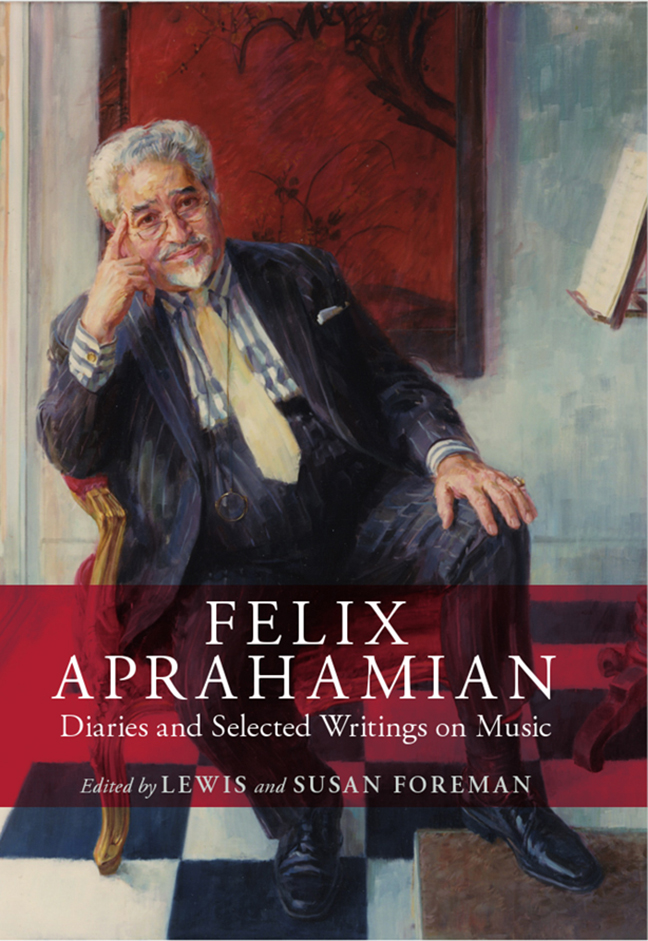
The music critic Felix Aprahamian was a remarkable self-made man – an amateur who became a professional – whose enormous influence in musical circles was deeply rooted in his practical experience of promoting music in London, notably music by British and French composers. Felix long aspired to write his autobiography, and indeed he was informally assured of publication by the publisher John Murray, but without either a contract or, more importantly, a deadline, he never got round to it. He was enormously proud of this prospect – ‘Byron's publisher’, he would tell one – but sadly, despite the prompting of many friends, it remained a chimera. However, Felix's story of a life in music over three-quarters of a century is worth telling for its own sake, for the light it throws on music and musical life – particularly in London – over these years, and for the unique insights he brought regarding those composers in whom he specialized, many of whom he had known personally.
We are fortunate that the mere three pages he completed of his autobiography tell his family history. He was the son of an immigrant Armenian family – his father, Avedis Aprahamian (who had been born Hovanessian), was naturalised at the turn of the century. Felix lived until the end of his life in the family home in Muswell Hill, London, to which they moved on 1 January 1919, not long after the scare his parents had experienced when Felix contracted that great childhood killer of the time, diphtheria. Felix wrote:
I was born on June 5 1914, at 16 Inderwick Road, Crouch End, a suburb of London. My father Avedis Aprahamian, born on January 1, 1870, in Panderma, in the Ottoman Empire, had been a naturalised British subject for years. In 1912, he had married my mother, Araxie Garabedian, a native of Brusa, also in the Ottoman Empire. The ceremony was performed by her father, the Rev. Lazarus Garabedian, in the Protestant Church at Constantinople of which he was Pastor. My paternal grandfather, too, was a Protestant Pastor. His name was Apraham Hovanessian. I was in my teens before I realised that my surname was only as old as my father.