Refine search
Actions for selected content:
238502 results in Physics and Astronomy
9 - Stellar Space Velocities
- from Part I - Stellar Properties
-
- Book:
- Fundamentals of Astrophysics
- Published online:
- 10 November 2025
- Print publication:
- 24 July 2025, pp 54-58
-
- Chapter
- Export citation
12 - Light Intensity and Absorption
- from Part I - Stellar Properties
-
- Book:
- Fundamentals of Astrophysics
- Published online:
- 10 November 2025
- Print publication:
- 24 July 2025, pp 74-81
-
- Chapter
- Export citation
4 - Surface Temperature from a Star’s Color
- from Part I - Stellar Properties
-
- Book:
- Fundamentals of Astrophysics
- Published online:
- 10 November 2025
- Print publication:
- 24 July 2025, pp 25-31
-
- Chapter
- Export citation
Preface to the First Edition
-
- Book:
- Fundamentals of Astrophysics
- Published online:
- 10 November 2025
- Print publication:
- 24 July 2025, pp xvii-xviii
-
- Chapter
- Export citation

Non-monotonic effect of Stokes number on turbulence modulation in particle-laden channel flow
-
- Journal:
- Journal of Fluid Mechanics / Volume 1015 / 25 July 2025
- Published online by Cambridge University Press:
- 24 July 2025, A55
-
- Article
- Export citation
-
The effect of Stokes number on turbulence modulation in particle-laden channel flow is investigated through four-way coupled point-particle direct numerical simulations, with the mass loading fixed at 0.6 and the friction Stokes number $St^+$ varying from 3 to 300. A full transition pathway is observed, from a drag-enhanced to a drag-reduced regime, eventually approaching the single-phase state as $St^+$ increases towards 300. A set of transport equations for the particle phase is derived analytically to characterise the interphase coupling, within the framework of the point-based statistical description of particle-laden turbulence. By virtue of this, two dominant mechanisms are identified and quantitatively characterised: a positive, particle-induced extra transport that decreases monotonically with increasing $St^+$, and a negative, particle-induced extra dissipation that varies non-monotonically with $St^+$. The coupling of these two mechanisms leads to a direct contribution of the particle phase to the shear stress balance, the turbulent kinetic energy budgets and the Reynolds stress budgets. Consequently, as $St^+$ increases, the self-sustaining cycle of near-wall turbulence transitions from being augmented to being suppressed and, eventually, returns to the single-phase state. This gives rise to an indirect effect, manifested as a non-monotonic modulation of Reynolds shear stress and turbulence production rate. Taken together, complex interplays between particle-modified turbulent transport, particle-induced extra transport and extra dissipation are analysed and summarised, providing a holistic physical picture composed of consistent interpretations of turbulence modulation induced by small heavy particles.


Dedication
-
- Book:
- Fundamentals of Astrophysics
- Published online:
- 10 November 2025
- Print publication:
- 24 July 2025, pp v-vi
-
- Chapter
- Export citation
19 - Light Intensity and Absorption
- from Part II - Stellar Structure and Evolution
-
- Book:
- Fundamentals of Astrophysics
- Published online:
- 10 November 2025
- Print publication:
- 24 July 2025, pp 128-136
-
- Chapter
- Export citation
Appendix D - Radiative Transfer
-
- Book:
- Fundamentals of Astrophysics
- Published online:
- 10 November 2025
- Print publication:
- 24 July 2025, pp 291-294
-
- Chapter
- Export citation
Appendices
-
- Book:
- Fundamentals of Astrophysics
- Published online:
- 10 November 2025
- Print publication:
- 24 July 2025, pp 279-294
-
- Chapter
- Export citation
2 - Astronomical Distances
- from Part I - Stellar Properties
-
- Book:
- Fundamentals of Astrophysics
- Published online:
- 10 November 2025
- Print publication:
- 24 July 2025, pp 11-18
-
- Chapter
- Export citation
1 - Introduction
- from Part I - Stellar Properties
-
- Book:
- Fundamentals of Astrophysics
- Published online:
- 10 November 2025
- Print publication:
- 24 July 2025, pp 3-10
-
- Chapter
- Export citation

Undulatory underwater swimming: linking vortex dynamics, thrust and wake structure with a biorobotic fish
-
- Journal:
- Journal of Fluid Mechanics / Volume 1015 / 25 July 2025
- Published online by Cambridge University Press:
- 23 July 2025, A53
-
- Article
- Export citation
Spatio-temporal evolution and phase mixing of dust acoustic waves in plasmas with opposite polarity dust grains
-
- Journal:
- Journal of Plasma Physics / Volume 91 / Issue 4 / August 2025
- Published online by Cambridge University Press:
- 23 July 2025, E108
-
- Article
-
- You have access
- Open access
- HTML
- Export citation
The impact of intrinsic magnetisation and Ohmic diffusion on Jeans instability in strongly magnetised anisotropic quantum plasmas
-
- Journal:
- Journal of Plasma Physics / Volume 91 / Issue 4 / August 2025
- Published online by Cambridge University Press:
- 23 July 2025, E107
-
- Article
-
- You have access
- Open access
- HTML
- Export citation

Ill posedness in shallow multi-phase debris-flow models
-
- Journal:
- Journal of Fluid Mechanics / Volume 1015 / 25 July 2025
- Published online by Cambridge University Press:
- 23 July 2025, A52
-
- Article
-
- You have access
- Open access
- HTML
- Export citation

Characterisation of sea ice kinematics over oceanic eddies
-
- Journal:
- Journal of Fluid Mechanics / Volume 1015 / 25 July 2025
- Published online by Cambridge University Press:
- 23 July 2025, A51
-
- Article
-
- You have access
- Open access
- HTML
- Export citation

Newtonian-like behaviour of starting vortex flow in superfluid helium at high Reynolds numbers
-
- Journal:
- Journal of Fluid Mechanics / Volume 1015 / 25 July 2025
- Published online by Cambridge University Press:
- 23 July 2025, A57
-
- Article
-
- You have access
- Open access
- HTML
- Export citation
-
We study experimentally the starting vortices shed by airfoils accelerating uniformly from rest in superfluid helium-4 (He II). The vortices behave apparently as if they were moving in a classical Newtonian fluid, such as air or water. Specifically, the starting vortex positions obtained from the experimental data are found to be very close to those computed numerically in a Newtonian fluid, at sufficiently small times, when self-similar behaviour is expected to occur, and for Reynolds numbers ranging between approximately $5 \times 10^2$ and $5 \times 10^5$. The result indicates neatly that turbulent flows of He II can be very similar to classical flows of Newtonian fluids, when thermal effects can be neglected and at sufficiently large flow scales, i.e. the study demonstrates that He II could also be employed to study classical Newtonian flows.


Internal shear layers generated by a vertically oscillating cylinder in unbounded and bounded rotating fluids
- Part of
-
- Journal:
- Journal of Fluid Mechanics / Volume 1015 / 25 July 2025
- Published online by Cambridge University Press:
- 22 July 2025, A38
-
- Article
- Export citation
-
In rotating fluids, the viscous smoothing of inviscid singular inertial waves leads to the formation of internal shear layers. In previous works, we analysed the internal shear layers excited by a viscous forcing (longitudinal libration) in a spherical shell geometry (He et al., 2022 J. Fluid Mech. 939, A3; He et al., 2023 J. Fluid Mech. 974, A3). We now consider the stronger inviscid forcing corresponding to the vertical oscillation of the inner boundary. We limit our analysis to two-dimensional geometries but examine three different configurations: freely propagating wave beams in an unbounded domain and two wave patterns (a periodic orbit and an attractor) in a cylindrical shell geometry. The asymptotic structures of the internal shear layers are assumed to follow the similarity solution of Moore & Saffman (1969 Phil. Trans. R. Soc. Lond. A, 264, 597–634) in the small viscous limit. The two undefined parameters of the similarity solution (singularity strength and amplitude) are derived by asymptotically matching the similarity solution with the inviscid solution. For each case, the derivation of the latter is achieved either through separation of variables combined with analytical continuation or the method of characteristics. Global inviscid solutions, when obtained, closely match numerical solutions for small Ekman numbers far from the critical lines, while viscous asymptotic solutions show excellent performance near those lines. The amplitude scalings of the internal shear layers excited by an inviscid forcing are found to be divergent as the Ekman number $E$ decreases, specifically $O(E^{-1/6})$ for the critical-point singularity and $O(E^{-1/3})$ for attractors, in contrast to the convergent scalings found for a viscous forcing.


Interfacial arrest in buoyant viscoplastic injections
-
- Journal:
- Journal of Fluid Mechanics / Volume 1015 / 25 July 2025
- Published online by Cambridge University Press:
- 22 July 2025, A45
-
- Article
-
- You have access
- Open access
- HTML
- Export citation
-
We study buoyant miscible injections of dense viscoplastic fluids into lighter Newtonian fluids in inclined closed-end pipes, at the high-Péclet-number regime. We integrate experiments involving camera imaging and ultrasound Doppler velocimetry, and computational fluid dynamics simulations, to provide a detailed analysis of interfacial dynamics, flow phases/regimes, velocity field, yielded and unyielded zones, and interfacial arrest mechanisms. The flow dynamics is governed by Reynolds ( $Re$), Froude ( $Fr$) and Bingham ( $B$) numbers, the viscosity ratio ( $M$), inclination angle ( $\beta$), or their combinations, such as $\chi \equiv 2Re/Fr^2$. As the interface evolves, our results reveal a transition from an inertial-dominated phase, characterised by linear front advancement at the injection velocity, to a viscoplastic-dominated phase, marked by deceleration and eventual interfacial arrest governed by the yield stress. The critical transition length between these phases $(\mathcal{L} \approx 1.26 Fr^{0.14})$ is determined by a balance between inertial and buoyant stresses. Experimental findings confirm buoyancy-driven slumping in our flows, consistent with the theoretical yield number criterion ( $Y \equiv B/\chi$), with maximum interfacial arrest lengths scaling as $L_s \sim 1/Y$. These results also classify arrested and unhalted interfacial flow regimes on a plane involving ${\chi \cos (\beta )}/{B}$ and $Y$. Furthermore, we demonstrate that the interfacial arrest mechanism arises from interactions between buoyancy, rheology and geometry, as diminishing shear stresses promote unyielded zone expansion near the interface, progressively encompassing the viscoplastic layer and halting flow when stresses fall below the yield stress.


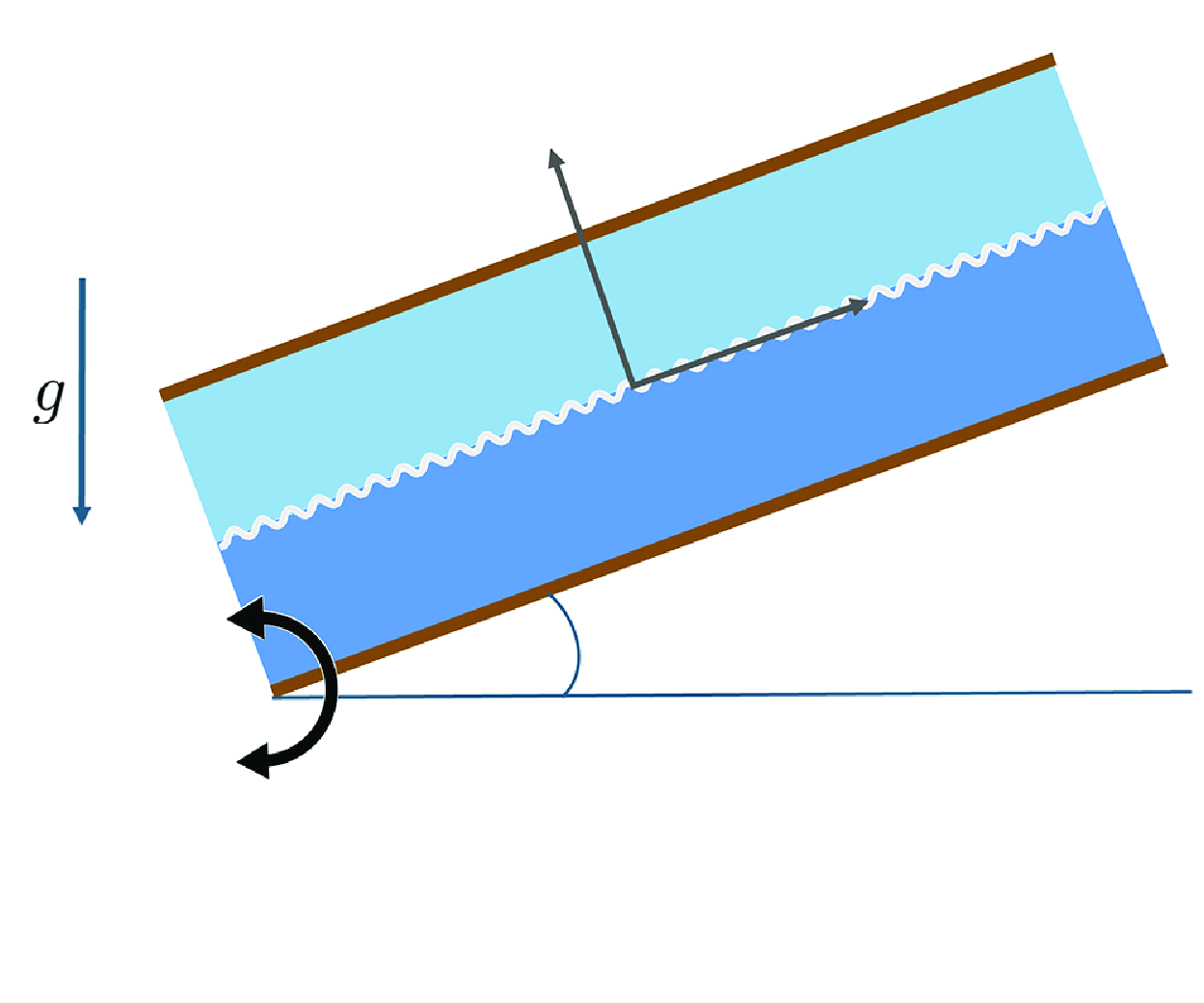
Stability analysis of time-periodic shear flow generated by an oscillating density interface
-
- Journal:
- Journal of Fluid Mechanics / Volume 1015 / 25 July 2025
- Published online by Cambridge University Press:
- 22 July 2025, A27
-
- Article
-
- You have access
- Open access
- HTML
- Export citation
-
We consider the conceptual two-layered oscillating tank of Inoue & Smyth (2009 J. Phys. Oceanogr. vol. 39, no. 5, pp. 1150–1166), which mimics the time-periodic parallel shear flow generated by low-frequency (e.g. semi-diurnal tides) and small-angle oscillations of the density interface. Such self-induced shear of an oscillating pycnocline may provide an alternate pathway to pycnocline turbulence and diapycnal mixing in addition to the turbulence and mixing driven by wind-induced shear of the surface mixed layer. We theoretically investigate shear instabilities arising in the inviscid two-layered oscillating tank configuration and show that the equation governing the evolution of linear perturbations on the density interface is a Schrödinger-type ordinary differential equation with a periodic potential. The necessary and sufficient stability condition is governed by a non-dimensional parameter $\beta$ resembling the inverse Richardson number; for two layers of equal thickness, instability arises when $\beta \,{\gt}\,1/4$. When this condition is satisfied, the flow is initially stable but finally tunnels into the unstable region after reaching the time marking the turning point. Once unstable, perturbations grow exponentially and reveal characteristics of Kelvin–Helmholtz (KH) instability. The modified Airy function method, which is an improved variant of the Wentzel–Kramers–Brillouin theory, is implemented to obtain a uniformly valid, composite approximate solution to the interface evolution. Next, we analyse the fully nonlinear stages of interface evolution by modifying the circulation evolution equation in the standard vortex blob method, which reveals that the interface rolls up into KH billows. Finally, we undertake real case studies of Lake Geneva and Chesapeake Bay to provide a physical perspective.


