Refine search
Actions for selected content:
238160 results in Physics and Astronomy

A length scale for non-local multi-scale gradient interactions in isotropic turbulence
-
- Journal:
- Journal of Fluid Mechanics / Volume 971 / 25 September 2023
- Published online by Cambridge University Press:
- 22 September 2023, A40
-
- Article
-
- You have access
- Open access
- HTML
- Export citation
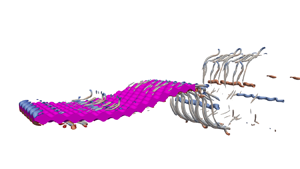
A systematic investigation into the effect of roughness on self-propelled swimming plates
-
- Journal:
- Journal of Fluid Mechanics / Volume 971 / 25 September 2023
- Published online by Cambridge University Press:
- 22 September 2023, A39
-
- Article
-
- You have access
- Open access
- HTML
- Export citation
-
This study examines the effects of surface topography on the flow and performance of a self-propelled swimming (SPS) body. We consider a thin flat plate with an egg-carton roughness texture undergoing prescribed undulatory swimming kinematics at Strouhal number $0.3$ and tail amplitude to length ratio $0.1$; we use plate Reynolds numbers $Re=6$, 12 and $24\times 10^3$, and focus on $12\,000$. As the roughness wavelength is decreased, we find that the undulation wave speed must be increased to overcome the additional drag from the roughness and maintain SPS. Correspondingly, the extra wave speed raises the power required to maintain SPS, making the swimmer less efficient. To decouple the roughness and the kinematics, we compare the rough plates to equivalent smooth cases by matching the kinematic conditions. We find that all but the longest roughness wavelengths reduce the required swimming power and the unsteady amplitude of the forces when compared to a smooth plate undergoing identical kinematics. Additionally, roughness can enhance flow enstrophy by up to 116 % compared to the smooth cases without a corresponding spike in forces; this suggests that the increased mixing is not due to increased vorticity production at the wall. Instead, the enstrophy is found to peak strongly when the roughness wavelength is approximately twice the boundary layer thickness over the $Re$ range, indicating the roughness induces large-scale secondary flow structures that extend to the edge of the boundary layer. This study reveals the nonlinear interaction between roughness and kinematics beyond a simple increase or decrease in drag, illustrating that roughness studies on static shapes do not transfer directly to unsteady swimmers.


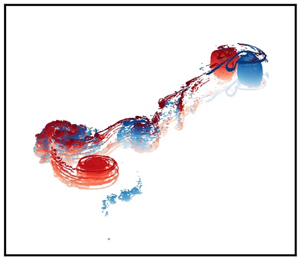
Finite Froude and Rossby numbers counter-rotating vortex pairs
-
- Journal:
- Journal of Fluid Mechanics / Volume 971 / 25 September 2023
- Published online by Cambridge University Press:
- 22 September 2023, A41
-
- Article
-
- You have access
- Open access
- HTML
- Export citation

Instability of the optimal edge trajectory in the Blasius boundary layer
-
- Journal:
- Journal of Fluid Mechanics / Volume 971 / 25 September 2023
- Published online by Cambridge University Press:
- 22 September 2023, A42
-
- Article
-
- You have access
- Open access
- HTML
- Export citation

Tomographic PIV investigation on near-wake structures of a hemisphere immersed in a laminar boundary layer
-
- Journal:
- Journal of Fluid Mechanics / Volume 971 / 25 September 2023
- Published online by Cambridge University Press:
- 22 September 2023, A36
-
- Article
- Export citation
-
The near wake of a hemisphere immersed in a laminar boundary layer is studied utilizing time-resolved tomographic particle image velocimetry (TPIV). Focus is placed on the three-dimensional vortical structures and the formation details of hairpin vortices before the onset of transition. The three-dimensional instantaneous pressure field of the hemisphere wake is reconstructed for better understanding the flow mechanism. Experiments are carried out with Reynolds number $Re_{r}=1370$, based on the hemisphere radius $R$. Features of periodicity of the near wake are analysed using proper orthogonal decomposition and Fourier transformation. The velocity fluctuation in the wall-normal direction is shown to be crucial to the formation of hairpin vortices in the near wake. By investigating the transport of mass and vorticity, and the correlation between pressure and hairpin vortex strength, the formation mechanism is revealed clearly. Specifically, the main hairpin vortices (MHVs) are formed within the reaction of outer high-speed flow and near-wall flow. The formation of the head portion is followed by the leg portion formation. The shedding of the MHVs is highly correlated with the pressure, as well as the pressure gradient in the wall-normal direction. For the side hairpin vortices (SHVs), the leg portion is formed first, followed by the generation of the head portion thanks to induction of the re-oriented standing vortices. The generation of the SHVs can be regarded as the downstream bridging of the standing vortices, similar to the generation of hairpin vortices due to the connection of streamwise vortices in turbulent boundary layers.


Appendix A - A Possible Roadmap to Exobeings
-
- Book:
- Life and Language Beyond Earth
- Published online:
- 16 September 2023
- Print publication:
- 21 September 2023, pp 587-589
-
- Chapter
- Export citation
18 - Consciousness
- from Part IV - The Runaway Brain
-
- Book:
- Life and Language Beyond Earth
- Published online:
- 16 September 2023
- Print publication:
- 21 September 2023, pp 290-315
-
- Chapter
- Export citation
15 - The Brain-to-Body Relationship
- from Part IV - The Runaway Brain
-
- Book:
- Life and Language Beyond Earth
- Published online:
- 16 September 2023
- Print publication:
- 21 September 2023, pp 251-269
-
- Chapter
- Export citation
11 - The Slow Path of Evolution
- from Part III - Our Story on Earth
-
- Book:
- Life and Language Beyond Earth
- Published online:
- 16 September 2023
- Print publication:
- 21 September 2023, pp 143-163
-
- Chapter
- Export citation
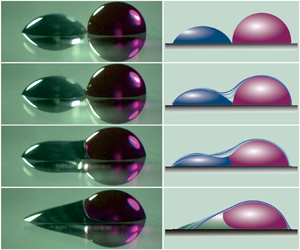
Coalescence of immiscible sessile droplets on a partial wetting surface
-
- Journal:
- Journal of Fluid Mechanics / Volume 971 / 25 September 2023
- Published online by Cambridge University Press:
- 21 September 2023, A34
-
- Article
- Export citation
Chapter 4 - Solutions of the Schrödinger Equation in Three Dimensions
-
- Book:
- Quantum Mechanics with Concept Maps
- Published online:
- 07 September 2023
- Print publication:
- 21 September 2023, pp 95-126
-
- Chapter
- Export citation
Contents
-
- Book:
- Quantum Mechanics with Concept Maps
- Published online:
- 07 September 2023
- Print publication:
- 21 September 2023, pp vii-x
-
- Chapter
- Export citation
Index
-
- Book:
- Life and Language Beyond Earth
- Published online:
- 16 September 2023
- Print publication:
- 21 September 2023, pp 661-672
-
- Chapter
- Export citation
Copyright page
-
- Book:
- Quantum Mechanics with Concept Maps
- Published online:
- 07 September 2023
- Print publication:
- 21 September 2023, pp iv-iv
-
- Chapter
- Export citation
19 - Artificial Intelligence
- from Part IV - The Runaway Brain
-
- Book:
- Life and Language Beyond Earth
- Published online:
- 16 September 2023
- Print publication:
- 21 September 2023, pp 316-326
-
- Chapter
- Export citation
Timelines
-
- Book:
- Life and Language Beyond Earth
- Published online:
- 16 September 2023
- Print publication:
- 21 September 2023, pp 616-623
-
- Chapter
- Export citation
Chapter 3 - Bra-ket Notation
-
- Book:
- Quantum Mechanics with Concept Maps
- Published online:
- 07 September 2023
- Print publication:
- 21 September 2023, pp 67-94
-
- Chapter
- Export citation
17 - Our Cognition
- from Part IV - The Runaway Brain
-
- Book:
- Life and Language Beyond Earth
- Published online:
- 16 September 2023
- Print publication:
- 21 September 2023, pp 280-289
-
- Chapter
- Export citation
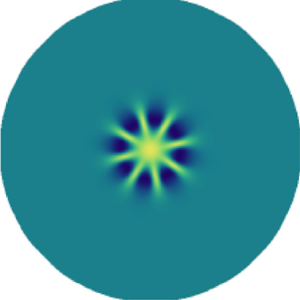
Pattern formation in photo-controlled bioconvection
-
- Journal:
- Journal of Fluid Mechanics / Volume 971 / 25 September 2023
- Published online by Cambridge University Press:
- 21 September 2023, A29
-
- Article
- Export citation
3 - Striving to Understand
- from Part I - Introduction
-
- Book:
- Life and Language Beyond Earth
- Published online:
- 16 September 2023
- Print publication:
- 21 September 2023, pp 31-44
-
- Chapter
- Export citation
