Refine search
Actions for selected content:
238160 results in Physics and Astronomy
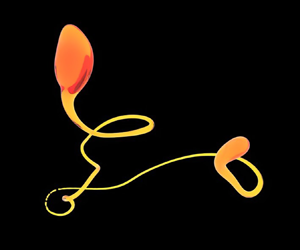
Role of viscosity in turbulent drop break-up
-
- Journal:
- Journal of Fluid Mechanics / Volume 972 / 10 October 2023
- Published online by Cambridge University Press:
- 27 September 2023, A11
-
- Article
-
- You have access
- Open access
- HTML
- Export citation
-
We investigate drop break-up morphology, occurrence, time and size distribution, through large ensembles of high-fidelity direct-numerical simulations of drops in homogeneous isotropic turbulence, spanning a wide range of parameters in terms of the Weber number $We$, viscosity ratio between the drop and the carrier flow $\mu _r=\mu _d/\mu _l$, where d is the drop diameter, and Reynolds ( $Re$) number. For $\mu _r \leq 20$, we find a nearly constant critical $We$, while it increases with $\mu _r$ (and $Re$) when $\mu _r > 20$, and the transition can be described in terms of a drop Reynolds number. The break-up time is delayed when $\mu _r$ increases and is a function of distance to criticality. The first break-up child-size distributions for $\mu _r \leq 20$ transition from M to U shape when the distance to criticality is increased. At high $\mu _r$, the shape of the distribution is modified. The first break-up child-size distribution gives only limited information on the fragmentation dynamics, as the subsequent break-up sequence is controlled by the drop geometry and viscosity. At high $We$, a $d^{-3/2}$ size distribution is observed for $\mu _r \leq 20$, which can be explained by capillary-driven processes, while for $\mu _r > 20$, almost all drops formed by the fragmentation process are at the smallest scale, controlled by the diameter of the very extended filament, which exhibits a snake-like shape prior to break-up.


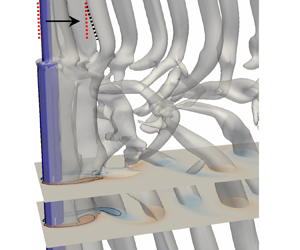
How vortex dynamics affects the structural load in step cylinder flow
-
- Journal:
- Journal of Fluid Mechanics / Volume 972 / 10 October 2023
- Published online by Cambridge University Press:
- 27 September 2023, A10
-
- Article
-
- You have access
- Open access
- HTML
- Export citation
-
The vortex dynamics and the structural load in a step cylinder (consisting of a small, d, and a large, D, cylinder) flow are investigated numerically at Reynolds number ( $Re_D$) 150 for diameter ratios $D/d=2.0, 2.4$ and 2.8. First, the formation mechanism of a non-uniform oblique vortex shedding (the vortex shedding frequency remains unchanged as the oblique shedding angle varies) behind the small cylinder is explained: an increase in the production rate of the vortex strength and a farther downstream movement of the vortex formation position occur simultaneously as the vicinity of the step is approached along the small cylinder. Second, the structural load (the drag and lift) along the step cylinder is investigated, where four local extremes (two local minima and two local maxima) are observed. An in-depth investigation of the vortex dislocation effects on the structural load is provided, showing that the decreased circulation in the near wake and the weakened staggered Kármán vortex shedding pattern cause a major reduction (90 %) of the sectional lift amplitude and a relatively modest reduction (5.7 %) of the sectional drag amplitude, compared with the corresponding sectional force when no vortex dislocation occurs. This new knowledge combined with the three-dimensional effect of the step cylinder wake (caused by the blending of the small and larger cylinder wakes around the step) explain the formation of the four local extremes and the distribution of the structural load between them. Finally, it is found that the increasing $D/d$ amplifies the structural load variation along the step cylinder.


Mitigation of stimulated Raman scattering in a high-power fiber master oscillator power amplifier laser based on a dual-structure fiber grating
-
- Journal:
- High Power Laser Science and Engineering / Volume 11 / 2023
- Published online by Cambridge University Press:
- 27 September 2023, e92
-
- Article
-
- You have access
- Open access
- HTML
- Export citation
Experimental investigation of the stimulated Raman scattering effect in high-power nanosecond superfluorescent fiber source
-
- Journal:
- High Power Laser Science and Engineering / Volume 11 / 2023
- Published online by Cambridge University Press:
- 27 September 2023, e88
-
- Article
-
- You have access
- Open access
- HTML
- Export citation

Interactions enhance dispersion in fluctuating channels via emergent flows
-
- Journal:
- Journal of Fluid Mechanics / Volume 972 / 10 October 2023
- Published online by Cambridge University Press:
- 27 September 2023, A8
-
- Article
-
- You have access
- Open access
- HTML
- Export citation
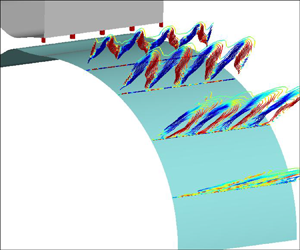
Mixing enhancement of a compressible jet over a convex wall
-
- Journal:
- Journal of Fluid Mechanics / Volume 972 / 10 October 2023
- Published online by Cambridge University Press:
- 26 September 2023, A2
-
- Article
- Export citation
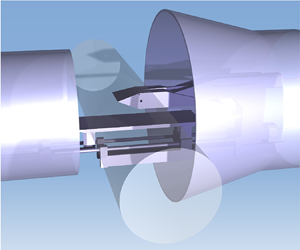
Pressure plateau of separation induced by shock impingement in a Mach 5 flow
-
- Journal:
- Journal of Fluid Mechanics / Volume 972 / 10 October 2023
- Published online by Cambridge University Press:
- 26 September 2023, R1
-
- Article
- Export citation
-
Separation induced by impinging shock is a fundamental feature in supersonic and hypersonic flows; however, it is difficult to predict the pressure plateau due to a limited theoretical understanding of the effect of impinging shock strength. In this study, the evolution of the separation configuration and pressure distribution with changes in impinging shock angle is examined, and a theoretical equation for predicting the pressure plateau based on minimum entropy production is proposed. For validation, an experimental device that can measure wall pressure in the separation region at high spatiotemporal resolution is developed, and schlieren visualization is employed to capture the flow structure. Accordingly, the fine characteristics of pressure distributions along the centreline of the separation region as well as the reattachment region induced by shock impingement at various angles ( $8.5^\circ$ to $30.5^\circ$) are obtained in a flow of Mach number 5 and Reynolds number ${\approx }1.4\times 10^7\ {\rm m}^{-1}$. The experimental results agree well with the theoretical results; both indicate that the pressure distribution is strongly related to the impinging shock strength and that there is a critical flow deflection angle $\alpha ^\ast$ ( ${\approx }20.8^\circ$ for Mach 5). The pressure in the separation region grows nearly linearly with increasing impinging shock strength when the flow deflection angle of the impinging shock is less than $\alpha ^\ast$; the pressure stops growing and resides in a small range when the flow deflection angle is larger than $\alpha ^\ast$. Therefore, the impinging shock strength should be considered a main factor when predicting the pressure plateau.


Shock-induced atomisation of a liquid metal droplet
-
- Journal:
- Journal of Fluid Mechanics / Volume 972 / 10 October 2023
- Published online by Cambridge University Press:
- 26 September 2023, A7
-
- Article
- Export citation
-
The present study uses Galinstan as a test fluid to investigate the shock-induced atomisation of a liquid metal droplet in a high-Weber-number regime $(We \sim 400\unicode{x2013}8000)$. Atomisation dynamics is examined for three test environments: oxidizing (Galinstan–air), inert (Galinstan–nitrogen) and conventional fluids (deionised water–air). Due to the readily oxidizing nature of liquid metals, their atomisation in an industrial scale system is generally carried out in inert atmosphere conditions. However, no previous study has considered gas-induced secondary atomisation of liquid metals in inert conditions. Due to experimental challenges associated with molten metals, laboratory scale models are generally tested for conventional fluids like deionised water, liquid fuels, etc. The translation of results obtained from conventional fluid to liquid metal atomisation is rarely explored. Here a direct multiscale spatial and temporal comparison is provided between the atomisation dynamics of conventional fluid and liquid metals under oxidizing and inert conditions. The liquid metal droplet undergoes breakup through the shear-induced entrainment mode for the studied range of Weber number values. The prevailing mechanism is explained based on the relative dominance of droplet deformation and Kelvin–Helmholtz wave formation. The study provides quantitative and qualitative similarities for the three test cases and explains the differences in morphology of fragmenting secondary droplets in the oxidizing test case (Galinstan–air) due to rapid oxidation of the fragmenting ligaments. A phenomenological framework is postulated for predicting the morphology of secondary droplets. The formation of flake-like secondary droplets in the Galinstan air test case is based on the oxidation rate of liquid metals and the properties of the oxide layer formed on the atomizing ligament surface.
Beam shaping in the high-energy kW-class laser system Bivoj at the HiLASE facility
-
- Journal:
- High Power Laser Science and Engineering / Volume 11 / 2023
- Published online by Cambridge University Press:
- 26 September 2023, e79
-
- Article
-
- You have access
- Open access
- HTML
- Export citation
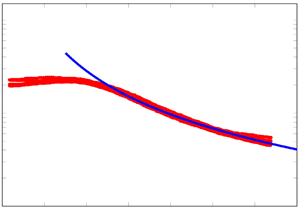
Scaling of boundary-layer disturbances exposed to free-stream turbulence
-
- Journal:
- Journal of Fluid Mechanics / Volume 972 / 10 October 2023
- Published online by Cambridge University Press:
- 26 September 2023, A3
-
- Article
- Export citation
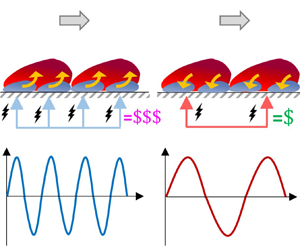
On the relationship between manipulated inter-scale phase and energy-efficient turbulent drag reduction
-
- Journal:
- Journal of Fluid Mechanics / Volume 972 / 10 October 2023
- Published online by Cambridge University Press:
- 26 September 2023, A12
-
- Article
-
- You have access
- Open access
- HTML
- Export citation
Extremely powerful and frequency-tunable terahertz pulses from a table-top laser–plasma wiggler
-
- Journal:
- High Power Laser Science and Engineering / Volume 11 / 2023
- Published online by Cambridge University Press:
- 26 September 2023, e90
-
- Article
-
- You have access
- Open access
- HTML
- Export citation
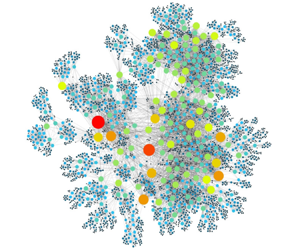
Multifractality and scale-free network topology in a noise-perturbed laminar jet
-
- Journal:
- Journal of Fluid Mechanics / Volume 972 / 10 October 2023
- Published online by Cambridge University Press:
- 26 September 2023, A6
-
- Article
-
- You have access
- Open access
- HTML
- Export citation
-
We present experimental evidence of multifractality and scale-free network topology in a noise-perturbed laminar jet operated in a globally stable regime, prior to the critical point of a supercritical Hopf bifurcation and prior to the saddle-node point of a subcritical Hopf bifurcation. For both types of bifurcation, we find that (i) the degree of multifractality peaks at intermediate noise intensities, (ii) the conditions for peak multifractality produce a complex network whose node degree distribution obeys an inverse power-law scaling with an exponent of $2 < \gamma < 3$, indicating scale-free topology and (iii) the Hurst exponent and the global clustering coefficient can serve as early warning indicators of global instability under specific operating and forcing conditions. By characterising the noise-induced dynamics of a canonical shear flow, we demonstrate that the multifractal and scale-free network dynamics commonly observed in turbulent flows can also be observed in laminar flows under certain stochastic forcing conditions.

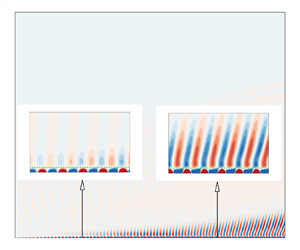
A unified explanation of energy growth sources for unstable modes in flat-plate boundary layers
-
- Journal:
- Journal of Fluid Mechanics / Volume 972 / 10 October 2023
- Published online by Cambridge University Press:
- 26 September 2023, A5
-
- Article
-
- You have access
- Open access
- HTML
- Export citation
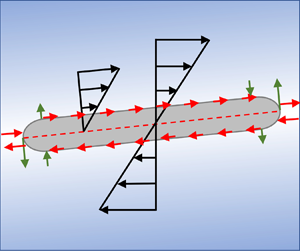
The effect of Navier slip on the rheology of a dilute two-dimensional suspension of plate-like particles
-
- Journal:
- Journal of Fluid Mechanics / Volume 972 / 10 October 2023
- Published online by Cambridge University Press:
- 26 September 2023, A1
-
- Article
-
- You have access
- Open access
- HTML
- Export citation
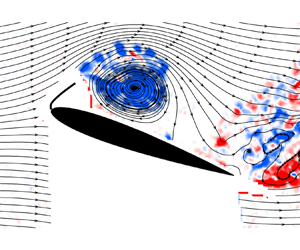
Post-stall flow control on aerofoils by leading-edge flags
-
- Journal:
- Journal of Fluid Mechanics / Volume 972 / 10 October 2023
- Published online by Cambridge University Press:
- 26 September 2023, A4
-
- Article
- Export citation
Nanosecond laser conditioning of multilayer dielectric gratings for picosecond–petawatt laser systems
-
- Journal:
- High Power Laser Science and Engineering / Volume 11 / 2023
- Published online by Cambridge University Press:
- 25 September 2023, e89
-
- Article
-
- You have access
- Open access
- HTML
- Export citation
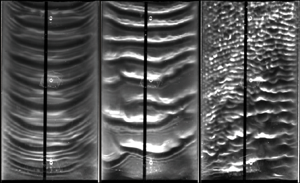
Gas-sheared falling liquid films beyond the absolute instability limit
-
- Journal:
- Journal of Fluid Mechanics / Volume 971 / 25 September 2023
- Published online by Cambridge University Press:
- 25 September 2023, A37
-
- Article
- Export citation
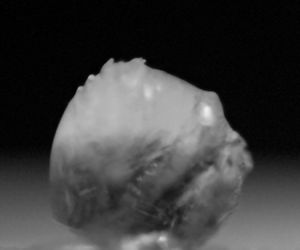
On shock induced aerobreakup of a wall-attached droplet
-
- Journal:
- Journal of Fluid Mechanics / Volume 971 / 25 September 2023
- Published online by Cambridge University Press:
- 25 September 2023, A31
-
- Article
- Export citation
Stochastic particle transport by deep-water irregular breaking waves
-
- Journal:
- Journal of Fluid Mechanics / Volume 971 / 25 September 2023
- Published online by Cambridge University Press:
- 22 September 2023, A38
-
- Article
-
- You have access
- Open access
- HTML
- Export citation
