Refine search
Actions for selected content:
238160 results in Physics and Astronomy

Introduction to Electrodynamics
-
- Published online:
- 06 October 2023
- Print publication:
- 02 November 2023
-
- Textbook
- Export citation
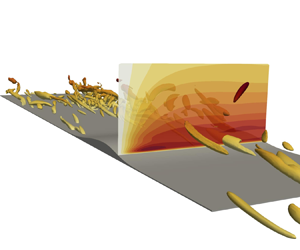
Curvature effects on the structure of near-wall turbulence
-
- Journal:
- Journal of Fluid Mechanics / Volume 972 / 10 October 2023
- Published online by Cambridge University Press:
- 06 October 2023, A39
-
- Article
- Export citation
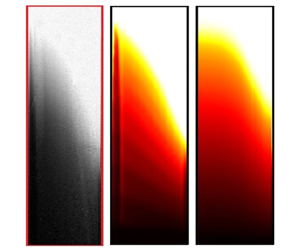
Primary cementing of vertical wells: displacement and dispersion effects in narrow eccentric annuli. Part 2. Flow behaviour and classification
-
- Journal:
- Journal of Fluid Mechanics / Volume 972 / 10 October 2023
- Published online by Cambridge University Press:
- 06 October 2023, A38
-
- Article
-
- You have access
- Open access
- HTML
- Export citation
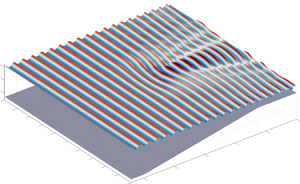
Adjoint-based high-order spectral method of wave simulation for coastal bathymetry reconstruction
-
- Journal:
- Journal of Fluid Mechanics / Volume 972 / 10 October 2023
- Published online by Cambridge University Press:
- 06 October 2023, A41
-
- Article
-
- You have access
- Open access
- HTML
- Export citation
Flow-induced diffusion in a packed lattice of squirmers – ERRATUM
-
- Journal:
- Journal of Fluid Mechanics / Volume 972 / 10 October 2023
- Published online by Cambridge University Press:
- 06 October 2023, E1
-
- Article
-
- You have access
- HTML
- Export citation
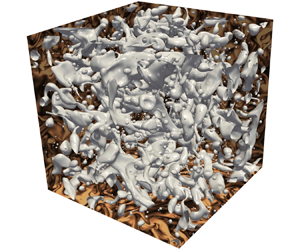
Intermittency in turbulent emulsions
-
- Journal:
- Journal of Fluid Mechanics / Volume 972 / 10 October 2023
- Published online by Cambridge University Press:
- 06 October 2023, A37
-
- Article
- Export citation

Sliding and merging of strongly sheared droplets
-
- Journal:
- Journal of Fluid Mechanics / Volume 972 / 10 October 2023
- Published online by Cambridge University Press:
- 06 October 2023, A40
-
- Article
- Export citation
Nonvarying, affine and extremal geometry of strata of differentials
- Part of
-
- Journal:
- Mathematical Proceedings of the Cambridge Philosophical Society / Volume 176 / Issue 2 / March 2024
- Published online by Cambridge University Press:
- 06 October 2023, pp. 361-371
- Print publication:
- March 2024
-
- Article
-
- You have access
- Open access
- HTML
- Export citation
On the topology of the transversal slice of a quasi-homogeneous map germ
- Part of
-
- Journal:
- Mathematical Proceedings of the Cambridge Philosophical Society / Volume 176 / Issue 2 / March 2024
- Published online by Cambridge University Press:
- 06 October 2023, pp. 339-359
- Print publication:
- March 2024
-
- Article
- Export citation
-
We consider a corank 1, finitely determined, quasi-homogeneous map germ f from $(\mathbb{C}^2,0)$ to $(\mathbb{C}^3,0)$. We describe the embedded topological type of a generic hyperplane section of $f(\mathbb{C}^2)$, denoted by $\gamma_f$, in terms of the weights and degrees of f. As a consequence, a necessary condition for a corank 1 finitely determined map germ $g\,{:}\,(\mathbb{C}^2,0)\rightarrow (\mathbb{C}^3,0)$ to be quasi-homogeneous is that the plane curve $\gamma_g$ has either two or three characteristic exponents. As an application of our main result, we also show that any one-parameter unfolding $F=(f_t,t)$ of f which adds only terms of the same degrees as the degrees of f is Whitney equisingular.



Computational Grains
- Micromechanical Genome for Heterogeneous Materials
-
- Published online:
- 05 October 2023
- Print publication:
- 19 October 2023
Optimal Fractionation in Radiotherapy
-
- Published online:
- 05 October 2023
- Print publication:
- 19 October 2023

Multiphase Flow with Solid Particles
-
- Published online:
- 05 October 2023
- Print publication:
- 19 October 2023
Characterisation of unsteady separation in a turbulent boundary layer: Reynolds stresses and flow dynamics
-
- Journal:
- Journal of Fluid Mechanics / Volume 972 / 10 October 2023
- Published online by Cambridge University Press:
- 05 October 2023, A36
-
- Article
-
- You have access
- Open access
- HTML
- Export citation
-
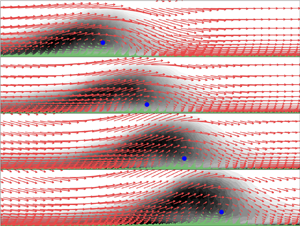
The large-eddy simulation technique was used to investigate the dynamics of unsteady flow separation on a flat-plate turbulent boundary layer. The unsteadiness was generated by imposing an oscillating, wall-normal velocity profile at the top of the computational domain, and a range of reduced frequencies ( $k$), from a very rapid flutter-like motion to a slow quasi-steady oscillation, was studied. Ambrogi et al. (J. Fluid Mech., vol. 945, 2022, A10) showed that the reduced frequency greatly affects the transient separation process, and at a frequency $k=1$, the separation region became unstable and was advected periodically out of the domain. In this paper, we discuss the causes of the observed advection process and the effects of the unsteadiness on the second moments. The time evolution of turbulent kinetic energy, for instance, reveals that an advection-like phenomenon is also present at a very low reduced frequency, but its dynamic behaviour is completely different from that of the intermediate frequency ( $k=1$). At the intermediate frequency the entire recirculation region is advected downstream, keeping its shape. The advected structure is rotational in nature, and moves at constant speed. In contrast, in the low-frequency case the advected fluid originates at the reattachment point, and the structure is shear-dominated. Particle pathlines reflect the fact that the flow at the low frequency is quasi-steady-state, but show peculiar differences at the intermediate frequency, in which the flow response to the freestream forcing depends on the particle positions in the wall-normal direction.


Spirals of Riemann’s Zeta-Function — Curvature, Denseness and Universality
- Part of
-
- Journal:
- Mathematical Proceedings of the Cambridge Philosophical Society / Volume 176 / Issue 2 / March 2024
- Published online by Cambridge University Press:
- 05 October 2023, pp. 325-338
- Print publication:
- March 2024
-
- Article
- Export citation
-
This paper deals with applications of Voronin’s universality theorem for the Riemann zeta-function $\zeta$. Among other results we prove that every plane smooth curve appears up to a small error in the curve generated by the values $\zeta(\sigma+it)$ for real t where $\sigma\in(1/2,1)$ is fixed. In this sense, the values of the zeta-function on any such vertical line provides an atlas for plane curves. In the same framework, we study the curvature of curves generated from $\zeta(\sigma+it)$ when $\sigma>1/2$ and we show that there is a connection with the zeros of $\zeta'(\sigma+it)$. Moreover, we clarify under which conditions the real and the imaginary part of the zeta-function are jointly universal.


A problem of Erdős–Graham–Granville–Selfridge on integral points on hyperelliptic curves
- Part of
-
- Journal:
- Mathematical Proceedings of the Cambridge Philosophical Society / Volume 176 / Issue 2 / March 2024
- Published online by Cambridge University Press:
- 05 October 2023, pp. 309-323
- Print publication:
- March 2024
-
- Article
-
- You have access
- Open access
- HTML
- Export citation
-
Erdős, Graham and Selfridge considered, for each positive integer n, the least value of $t_n$ so that the integers $n+1, n+2, \dots, n+t_n $ contain a subset the product of whose members with n is a square. An open problem posed by Granville concerns the size of $t_n$, under the assumption of the ABC conjecture. We establish some results on the distribution of $t_n$, and in the process solve Granville’s problem unconditionally.


Analysis of high-speed drop impact onto deep liquid pool
-
- Journal:
- Journal of Fluid Mechanics / Volume 972 / 10 October 2023
- Published online by Cambridge University Press:
- 04 October 2023, A31
-
- Article
-
- You have access
- Open access
- HTML
- Export citation
Spontaneous autophoretic motion of isotropic disks
-
- Journal:
- Journal of Fluid Mechanics / Volume 972 / 10 October 2023
- Published online by Cambridge University Press:
- 04 October 2023, R3
-
- Article
-
- You have access
- Open access
- HTML
- Export citation
-
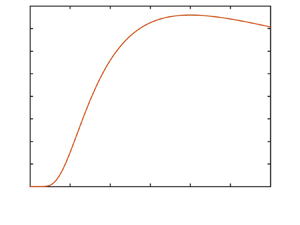
It is theoretically known that an isotropic chemically active particle in an unbounded solution undergoes symmetry breaking when the intrinsic Péclet number ${{Pe}}$ exceeds a finite critical value (Michelin et al., Phys. Fluids, vol. 25, 2013, 061701). At that value, a transition takes place from a stationary state to spontaneous motion. In two dimensions, where no stationary state is possible in an unbounded domain, a linear stability analysis in a large bounded domain (Hu et al., Phys. Rev. Lett., vol. 123, 2019, 238004) reveals that the critical ${{Pe}}$ value slowly diminishes as the domain size increases. Motivated by these findings, we here consider an unbounded domain from the outset, addressing the two-dimensional problem of steady self-propulsion with a focus on the limit ${{Pe}}\ll 1$. This singular limit is handled using matched asymptotic expansions, conceptually decomposing the fluid domain into a particle-scale region, where the leading-order solute transport is diffusive, and a remote region, where diffusion and advection are comparable. The expansion parameter is provided by the product of ${{Pe}}$ and $U$, the unknown particle speed (normalised by the standard autophoretic scale). The problem is unconventional in that the scaling of $U$ with ${{Pe}}$ must be determined in the course of the perturbation analysis. The resulting approximation, $U=4\exp ({-2/{Pe}-\gamma _{E}-1})/{{Pe}}$ ( $\gamma _{E}$ being the Euler–Mascheroni constant), is in remarkable agreement with the numerical predictions of Hu et al. in the common interval of validity.


Reduced-order models of aeroacoustic sources for sound radiated in twin subsonic jets
-
- Journal:
- Journal of Fluid Mechanics / Volume 972 / 10 October 2023
- Published online by Cambridge University Press:
- 04 October 2023, A33
-
- Article
-
- You have access
- Open access
- HTML
- Export citation
-
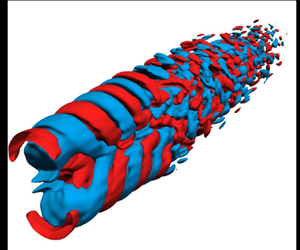
We construct reduced-order models of aeroacoustic sources for single and twin subsonic jets ( $M_j=0.9$, $Re=3600$), with the goal of accurately recovering the far-field sound over a wide band of frequencies $St=[0.07,1.0]$ and directivity angles $\phi = [30^{\circ },120^{\circ }]$ within a subdecibel level accuracy. These models are realized via combining spatio-temporally coherent spectral proper orthogonal decomposition (SPOD) modes extracted directly from Lighthill's stress tensor, itself calculated using large-eddy simulation (LES). We consider two sets of twin subsonic jets of diameter $D$ each, with spacings of $0.1D$ and $1D$, where the jets merge upstream and downstream of breakdown, respectively. The closely spaced twin jet decays the slowest due to reduced turbulent stresses which are, however, more broadband due to early merging. Such jets show strong shielding in the plane of jets, especially at shallow directivity angles where sound levels may drop below that of the single jet. The farther spaced twin jets have dynamics more akin to the constituent single jet with turbulent fluctuations peaking here at $St=0.34$, but showing very little shielding, with their overall sound pressure level (OASPL) mostly linked to the nature of extra flow structures created during merging. Three-dimensional, energy-ranked, coherent structures for twin jets exhibit rather poor low-rank behaviour, especially at the far-field spectral peak $St=0.14$. At $St \gtrsim 0.3$, the SPOD wavepackets show strong visual coherence, resembling Kelvin–Helmholtz instability modes upstream of breakdown, while at the lower frequencies, there is very little spatial coherence with wavepackets peaking downstream of breakdown. Although the leading SPOD modes radiate poorly, reduced-order models using a subset of them, up to $45$ SPOD modes per frequency, show a remarkable match (within $1$ dB) against the LES-predicted sound over $0.1 \lesssim St \lesssim 0.5$, at all angles investigated. At other frequencies, the closely spaced twin jet shows more error, due to its greater hierarchy of spatio-temporal structures, showing slower convergence at the shallower angles.


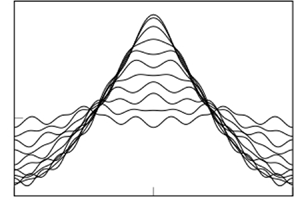
On the structure of parasitic gravity-capillary standing waves in the small surface tension limit
-
- Journal:
- Journal of Fluid Mechanics / Volume 972 / 10 October 2023
- Published online by Cambridge University Press:
- 04 October 2023, R6
-
- Article
-
- You have access
- Open access
- HTML
- Export citation
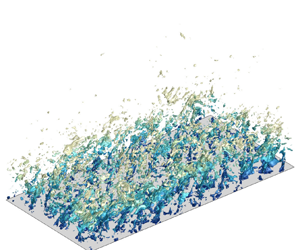
Compressibility effects in supersonic and hypersonic turbulent boundary layers subject to wall disturbances
-
- Journal:
- Journal of Fluid Mechanics / Volume 972 / 10 October 2023
- Published online by Cambridge University Press:
- 04 October 2023, A32
-
- Article
- Export citation
-
In the present study, we investigate the compressibility effects in supersonic and hypersonic turbulent boundary layers under the influence of wall disturbances by exploiting direct numerical simulation databases at Mach numbers up to 6. Such wall disturbances enforce extra Reynolds shear stress on the wall and induce mean streamline curvature in rough wall turbulence that leads to the intensification of turbulent motions in the outer region. The turbulent and fluctuating Mach numbers, the density and the velocity divergence fluctuation intensities suggest that the compressibility effects are enhanced by the increment of the free-stream Mach number and the implementation of the wall disturbances. The differences between the Reynolds and Favre average due to the density fluctuations constitute approximately $9\,\%$ of the mean velocity close to the wall and $30\,\%$ of the Reynolds stress near the edge of the boundary layer, indicating their non-negligibility in turbulent modelling strategies. The comparatively strong compressive events behaving as eddy shocklets are observed at the free-stream Mach number of $6$ only in the cases with wall disturbances. By further splitting the velocity into the solenoidal and dilatational components with the Helmholtz decomposition, we found that the dilatational motions are organized as travelling wave packets in the wall-parallel planes close to the wall and as forward inclined structures in the form of radiated waves in the vertical planes. Despite their increased magnitudes and higher portion in the Reynolds normal and shear stresses, the dilatational motions show no tendency of contributing significantly to the skin friction and the production of turbulent kinetic energy due to their mitigation by the cross-correlation between the solenoidal and dilatational velocity components.


