To save content items to your account,
please confirm that you agree to abide by our usage policies.
If this is the first time you use this feature, you will be asked to authorise Cambridge Core to connect with your account.
Find out more about saving content to .
To save content items to your Kindle, first ensure no-reply@cambridge.org
is added to your Approved Personal Document E-mail List under your Personal Document Settings
on the Manage Your Content and Devices page of your Amazon account. Then enter the ‘name’ part
of your Kindle email address below.
Find out more about saving to your Kindle.
Note you can select to save to either the @free.kindle.com or @kindle.com variations.
‘@free.kindle.com’ emails are free but can only be saved to your device when it is connected to wi-fi.
‘@kindle.com’ emails can be delivered even when you are not connected to wi-fi, but note that service fees apply.
Chapter 1 describes the restoration of Damascus in the fifth/eleventh and sixth/twelfth centuries under successive Seljuk, Zangid, and Ayyubid dynasties, with a focus on the revival of religious and intellectual life in the city through the patronage of political elites and the influx of scholars from other parts of the Muslim world. The chapter traces the formation of two competing Shāfiʿī legal traditions in Damascus. The dominant and longer-established tradition was formalist, traditionalist, and transmission-oriented, and it combined centuries-old indigenous Damascene scholarly culture with the Iraqi Shāfiʿī tradition, which had taken root in Damascus starting in the second half of the fifth/eleventh century. The second minority tradition drew on the Khurasani strand of Shāfiʿism, which had arrived in Damascus in the second half of the sixth/twelfth century, and it was more analytical, exploratory, and rationalist in orientation.
Chapter 2 examines Ibn ʿAbd al-Salām’s life in Damascus, with an emphasis on his intellectual formation. I reconstruct his formative influences in the Damascene milieu to show that he was a prominent representative of Khurasani Shāfiʿism who was linked to that tradition through his teachers, the works he studied and taught, and the ideas of leading Khurasani Shāfiʿīs that he adopted and transformed. Beyond shedding light on Ibn ʿAbd al-Salām’s life, the biographies of Ibn ʿAbd al-Salām, his teachers, and his contemporaries illuminate the politics of Ayyubid state patronage and call into question the depiction of post-Abbasid scholars on the state payroll as quietist and obsequious to the political establishment.
Chapter 6 traces the influence of Ibn ʿAbd al-Salām’s legal philosophy both during his lifetime and after his death. Its impact is visible in the scholarship of his students and in the continuing transmission, circulation, and teaching of his ideas and writings across regions and legal schools. I attribute the enduring appeal of Ibn ʿAbd al-Salām’s legal philosophy to the novel legal concepts and forms of legal reasoning that he introduced and developed and that were subsequently taken up by his students and their intellectual descendants. These concepts have given rise to dedicated literatures that evolved into diverse genres whose genealogies, I argue, can be traced back to Ibn ʿAbd al-Salām’s Qawāʿid.
Chapter 5 returns to Ibn ʿAbd al-Salām’s biography to examine his attempts to embody, apply, and disseminate his legal philosophy among diverse classes: scholars, students of the law, and a non-specialist public in Damascus and later in Cairo, where he retired. I demonstrate that Ibn ʿAbd al-Salām’s public activism and frequent embroilment in political controversy are best understood as manifestations of these efforts. I outline the connections between his legal philosophy and the socioreligious goals he pursued, highlighting the continuity between his theoretical scholarship and his embodied activism.
Veiling meant many things to the ancients. On women, veils could signify virtue, beauty, piety, self-control, and status. On men, covering the head could signify piety or an emotion such as grief. Late Roman mosaics show people covering their hands with veils when receiving or giving something precious. They covered their altars, doorways, shrines, and temples; and many covered their heads when sacrificing to their gods. Early Christian intellectuals such as Origen and Gregory of Nyssa used these everyday practices of veiling to interpret sacred texts. These writers understood the divine as veiled, and the notion of a veiled spiritual truth informed their interpretation of the bible. Veiling in the Late Antique World provides the first assessment of textual and material evidence for veiling in the late antique Mediterranean world. Susanna Drake here explores the relation between the social history of the veil and the intellectual history of the concept of truth as veiled/revealed.
Some philosophers and theologians argue that if God will save everyone, then earthly life is pointless. No matter how good earthly life is, heaven would be far better. So we would have been better off if God had started us off in heaven. I present and defend two objections to this argument. First, time on earth does not result in a deduction from time in heaven. Pick whatever amount of time you might wish to spend in heaven. You will spend that much time in heaven whether you are on earth first or not. Second, given origin essentialism, we could not start off in heaven rather than earth. Our very existence depends on our earthly origins.
Much is known about the manifold ways in which ancient Greek religious beliefs and practices map onto the social and political structures of the ancient Greek polis. The way in which the individual served as the basic unit of ancient Greek religion, and the personal dimension of ancient Greek religion associated with it, is much less well understood. This book offers the first comprehensive study of ancient Greek personal religion since the major paradigm changes that affected the study of ancient Greek religion in recent years. An international cast of scholars explores ancient Greek personal religion in all its different facets. They do not treat the personal dimension of ancient Greek religion as an antipode of civic religion but rather as a complementary perspective that evolves within, alongside, and occasionally in opposition to the civic dimension of ancient Greek religion.
This Element provides a historical overview of the sources and key scholarship related to literate workers in early Christianity. It argues that literate workers were indispensable for the creation, production, maintenance, interpretation, and preservation of ancient Christian thought, theology, and literature. This Element centres the embodiment and lived experience of literate workers-as much as is able to be retrieved from our extant Christian sources. Who were they? What did they look like? What was their relationship with named authors? What kinds of aspirations and career trajectories did they have? The aim of this project is to help researchers reconfigure their perspectives on ancient works, that such documents not only represent the genius of named authors but also of (enslaved) literate workers as well.
Perry Hendricks (2025) argues that theism is not only compatible with what he calls ‘pointless atheism’ (instances of non-resistant non-belief that do not serve a greater good) but also makes it expected. His case combines the Responsibility Objection (RO) – the view that God permits non-resistant non-belief because it’s required for theists to bear responsibility for bringing others into relationship with God – with a William Hasker-inspired argument concerning motivation and rationality. Hendricks’s core argument can be expressed in two distinct yet interrelated ways: a ‘motivation’ formulation and a ‘rationality’ formulation. I examine each in turn. I argue that, even granting (RO) and the rest of Hendricks’s assumptions, each formulation fails. (RO), together with a few further assumptions to which Hendricks also seems committed, leads to conclusions that undermine rather than support his argument. Thus, we have at least as much reason to reject as to accept his conclusion, and without further clarification and support, his case remains incomplete.
Augustine and Aquinas assume that Moses’s law figures Christ. In this piece, I show how their complementary accounts of the old law rest upon other doctrinal emphases, namely providence, God the Father, and created things as participations in divine goodness. By drawing out these themes, I advance reflection on the worth of Moses’s law, unfolding how other doctrines structure loving attention to the law as indicative of Christ.
After reviewing several stances in modern theology on the historicity of the resurrection of Jesus, this article argues that a common feature of the worldviews of Baroque Catholicism, classical Reformation theology, and the Enlightenment, namely, their separation of the supernatural and natural realms into ‘two orders’, explains the attractiveness of the apologetical strategy of affirming the reality of the resurrection as a non-historical, supernatural event. Drawing on the temporal and spatial imaginary of Henri de Lubac’s theology of grace, it concludes by pressing the case for a theological understanding of the resurrection of Jesus as a historical event that valorises the eschatological resonance of time.
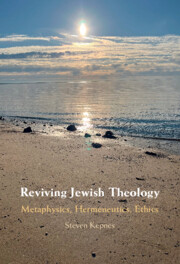
In this study, Steven Kepnes constructs a 'positive' Jewish theology, one that gives expression to God's nature and powers and that opposes 'apophatic' Holocaust and postmodern theologies that deny the ability of language to express God's nature. Drawing from the Pentateuch, Prophets, and Jewish prayer, Kepnes also uses methods from medieval philosophy, analytic philosophy, and hermeneutics. From medieval philosophy and the Bible, Kepnes develops what he calls a 'soft' metaphysics with principles of God and the revealed Torah at its center. Identifying a fundamental contradiction between the transcendent God of philosophy and the personal God of the Bible, he demonstrates how analytic philosophy, Jewish hermeneutics, and Jewish liturgy offer constructive strategies to negotiate this contradiction. Kepnes also argues that Jewish theology can neither remain in the domain of metaphysics nor the nature of God, but must turn toward the practical and ethical. He concludes with a call for a prophetic theological ethics to address the pressing issue of climate change.
The commentary examines 2 Peter in 7 major divisions (1:1-2; 1:3-12; 1:13-21; 2:11-11; 2:12-22; 3:1-13; 3:14-18), arranged through an analysis of rhetorical, theological, and discourse structures. The major challenge of the letter are false teachers whose denial of the return of Christ and libertinism pose threats to 2 Peter’s audience. The solution of the letter is to proclaim the surety of the judgment which God will bring on the ungodly, false teachers, included, and to urge its audience to continue pursuit of transformative communion with God in the hope of the salvation and renewal which the Day of the Lord and coming kingdom will bring. Attention is given throughout to historical, cultural, rhetorical, linguistic, and theological dimensions of the letter which help readers appreciate its message in its ancient context and its relevance for Christians today.