Published on behalf of The London Mathematical Society
We partner with a secure submission system to handle manuscript submissions.
Please note:
Click Proceed to submission system to continue to our partner's website.
In this paper we compute the topological Hochschild homology of quotients of discrete valuation rings (DVRs). Along the way we give a short argument for Bökstedt periodicity and generalizations over various other bases. Our strategy also gives a very efficient way to redo the computations of  $\operatorname {THH}$ (respectively, logarithmic $\operatorname {THH}$) of complete DVRs originally due to Lindenstrauss and Madsen (respectively, Hesselholt and Madsen).
For a formal scheme  $\mathfrak {X}$ of finite type over a complete rank-one valuation ring, we construct a specialization morphismfrom the de Jong fundamental group of the rigid generic fiber to the Bhatt–Scholze pro-étale fundamental group of the special fiber. The construction relies on an interplay between admissible blowups of
  \[ \pi^{\mathrm{dJ}}_1(\mathfrak{X}_\eta) \to \pi^{{\textrm{pro}}\unicode{x00E9}{\textrm{t}}}_1(\mathfrak{X}_k) \] $\mathfrak {X}$ and normalizations of the irreducible components of $\mathfrak {X}_k$, and employs the Berthelot tubes of these irreducible components in an essential way. Using related techniques, we show that under certain smoothness and semistability assumptions, covering spaces in the sense of de Jong of a smooth rigid space which are tame satisfy étale descent.
We introduce Poisson boundaries of II $_1$ factors with respect to density operators that give the traces. The Poisson boundary is a von Neumann algebra that contains the II $_1$ factor and is a particular example of the boundary of a unital completely positive map as introduced by Izumi. Studying the inclusion of the II $_1$ factor into its boundary, we develop a number of notions, such as double ergodicity and entropy, that can be seen as natural analogues of results regarding the Poisson boundaries introduced by Furstenberg. We use the techniques developed to answer a problem of Popa by showing that all finite factors satisfy his MV property. We also extend a result of Nevo by showing that property (T) factors give rise to an entropy gap.
We show that if  $\mathcal {A}\subset \{1,\ldots,N\}$ has no solutions to $a-b=n^2$ with $a,b\in \mathcal {A}$ and $n\geq 1$, thenfor some absolute constant
 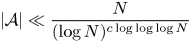 \[ \lvert \mathcal{A}\rvert \ll \frac{N}{(\log N)^{c\log\log \log N}} \] $c>0$. This improves upon a result of Pintz, Steiger, and Szemerédi.