Published on behalf of The London Mathematical Society
We partner with a secure submission system to handle manuscript submissions.
Please note:
Click Proceed to submission system to continue to our partner's website.
In this paper we investigate the quantity of diagonal quartic surfaces  $a_0 X_0^4 + a_1 X_1^4 + a_2 X_2^4 +a_3 X_3^4 = 0$ which have a Brauer–Manin obstruction to the Hasse principle. We are able to find an asymptotic formula for the quantity of such surfaces ordered by height. The proof uses a generalization of a method of Heath-Brown on sums over linked variables. We also show that there exists no uniform formula for a generic generator in this family. ${B^+_{{\rm dR}}}$-Grassmannian
We establish a Harder–Narasimhan formalism for modifications of  $G$-bundles on the Fargues–Fontaine curve. The semi-stable stratum of the associated stratification of the ${B^+_{{\rm dR}}}$-Grassmannian coincides with the variant of the weakly admissible locus defined by Viehmann, and its classical points agree with those of the basic Newton stratum. When restricted to minuscule affine Schubert cells, the stratification corresponds to the Harder–Narasimhan stratification of Dat, Orlik and Rapoport. We also study basic geometric properties of the strata, and the relation to the Hodge–Newton decomposition.
We consider rational representations of a connected linear algebraic group  $\mathbb {G}$ over a field $k$ of positive characteristic $p > 0$. We introduce a natural extension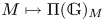 $M \mapsto \Pi (\mathbb {G})_M$ to $\mathbb {G}$-modules of the $\pi$-point support theory for modules $M$ for a finite group scheme $G$ and show that this theory is essentially equivalent to the more ‘intrinsic’ and ‘explicit’ theory $M \mapsto \mathbb {P}\mathfrak{C}(\mathbb {G})_M$ of supports for an algebraic group of exponential type, a theory which uses $1$-parameter subgroups $\mathbb {G}_a \to \mathbb {G}$. We extend our support theory to bounded complexes of $\mathbb {G}$-modules, $C^\bullet \mapsto \Pi (\mathbb {G})_{C^\bullet }$. We introduce the tensor triangulated category $\mathit {StMod}(\mathbb {G})$, the Verdier quotient of the bounded derived category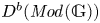 $D^b(\mathit {Mod}(\mathbb {G}))$ by the thick subcategory of mock injective modules. Our support theory satisfies all the ‘standard properties’ for a theory of supports for $\mathit {StMod}(\mathbb {G})$. As an application, we employ $C^\bullet \mapsto \Pi (\mathbb {G})_{C^\bullet }$ to establish the classification of $(r)$-complete, thick tensor ideals of $\mathit {stmod}(\mathbb {G})$ in terms of locally $\mathit {stmod}(\mathbb {G})$-realizable subsets of $\Pi (\mathbb {G})$ and the classification of $(r)$-complete, localizing subcategories of $\mathit {StMod}(\mathbb {G})$ in terms of locally $\mathit {StMod}(\mathbb {G})$-realizable subsets of $\Pi (\mathbb {G})$.
Bershadsky, Cecotti, Ooguri and Vafa constructed a real-valued invariant for Calabi–Yau manifolds, which is now called the BCOV invariant. In this paper, we extend the BCOV invariant to such pairs  $(X,D)$, where $X$ is a compact Kähler manifold and $D$ is a pluricanonical divisor on $X$ with simple normal crossing support. We also study the behavior of the extended BCOV invariant under blow-ups. The results in this paper lead to a joint work with Fu proving that birational Calabi–Yau manifolds have the same BCOV invariant.
We consider the Weil–Petersson gradient vector field of renormalized volume on the deformation space of convex cocompact hyperbolic structures on (relatively) acylindrical manifolds. In this paper we prove the conjecture that the flow has a global attracting fixed point at the unique structure  $M_{\rm geod}$ with minimum convex core volume.
Let  $G_\Gamma \curvearrowright X$ and $G_\Lambda \curvearrowright Y$ be two free measure-preserving actions of one-ended right-angled Artin groups with trivial center on standard probability spaces. Assume they are irreducible, i.e. every element from a standard generating set acts ergodically. We prove that if the two actions are stably orbit equivalent (or merely stably $W^*$-equivalent), then they are automatically conjugate through a group isomorphism between $G_\Gamma$ and $G_\Lambda$. Through work of Monod and Shalom, we derive a superrigidity statement: if the action $G_\Gamma \curvearrowright X$ is stably orbit equivalent (or merely stably $W^*$-equivalent) to a free, measure-preserving, mildly mixing action of a countable group, then the two actions are virtually conjugate. We also use the works of Popa and Ioana, Popa and Vaes to establish the $W^*$-superrigidity of Bernoulli actions of all infinite conjugacy classes groups having a finite generating set made of infinite-order elements where two consecutive elements commute, and one has a nonamenable centralizer: these include one-ended nonabelian right-angled Artin groups, but also many other Artin groups and most mapping class groups of finite-type surfaces.