Contents
Research Article
Projective Modules over Higher-Dimensional Non-Commutative Tori
-
- Published online by Cambridge University Press:
- 20 November 2018, pp. 257-338
-
- Article
-
- You have access
- Export citation
Irreducibility Criteria for Polynomials with non-negative Coefficients
-
- Published online by Cambridge University Press:
- 20 November 2018, pp. 339-351
-
- Article
-
- You have access
- Export citation
-
In [7, b.2, VIII, 128] Pólya and Szegö state the following theorem of A. Cohn:
THEOREM 1. Let dndn−x … d0 be the decimal representation of a prime. Then
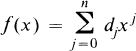
is irreducible.
Thus, for example, since 1289 is prime, x 3 + 2x 2 +8x + 9 is irreducible. Brillhart, Odlyzko, and the author generalized Cohn's Theorem in three different directions. As examples of these types of generalizations, we note the following results, the first two of which are special cases of a result in [1] and the third of a result in [3].
THEOREM 2. Let dndn−x … d0 be the base b representation of a prime where b is an integer ≧2. Then
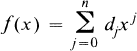
is irreducible.
THEOREM 3. Let
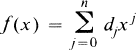
be such that f(10) is prime and 0 ≦ dj ≦ 167 for j = 0, 1, …, n. Then f(x) is irreducible.
On the Intersection of a Family of Maximal Subgroups Containing the Sylow Subgroups of a Finite Group
-
- Published online by Cambridge University Press:
- 20 November 2018, pp. 352-359
-
- Article
-
- You have access
- Export citation
-
Given a finite group G, the Frattini subgroup of G, Φ(G) is defined to be the intersection of all the maximal subgroups of G. Of late there have been several attempts to consider generalizations of Φ(G). For example, Gaschutz [7] and Rose [13] have investigated the intersection of all non-normal, maximal subgroups of a finite group. Deskins [6] has discussed the intersection of the family of maximal subgroups of a finite group whose indices are co-prime to a given prime. In [4-5, 12] we have considered the investigation of the family
 of all maximal subgroups of a finite group whose indices are composite and co-prime to a given prime. We have obtained several results about the family . In this paper which is a sequel to [4] we prove some further results about this family indicating the interesting role it plays especially when G is solvable or p-solvable. First we recall the main definition from [4].
 of all maximal subgroups of a finite group whose indices are composite and co-prime to a given prime. We have obtained several results about the family
 Sur Les Isométries De Lp(X) Et Le Théorème Ergodique Vectoriel
-
- Published online by Cambridge University Press:
- 20 November 2018, pp. 360-391
-
- Article
-
- You have access
- Export citation
-
Etant donné un opérateur T sur un espace LP (1 < p < ∞), la théorie ergodique s'intéresse à la convergence presque sûre des moyennes de Césaro
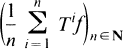
des itérés d'un point f de Lp par T. On dit que T vérifie le théorème ergodique si cette convergence a lieu pour tout f de Lp .
Parmi les nombreux résultats sur cette question (cf. [21]) nous citerons d'abord ceux de A. Ionescu-Tulcea ([19]) et R. Chacon-S. A. McGrath([10]) que l'on peut réunir dans l'assertion suivante:
“Si 1 < p < ∞ et T une isométrie positive de Lp , ou si 1 < p ≠ 2 < ∞ et si T est une isométrie surjective de Lp , alors T vérifie le théorème ergodique”.
Nous nous intéressons ici à une version vectorielle de ce théorème. Plus précisément, si X est un espace de Banach réel, un opérateur linéare T sur l'espace LP(X) est dit vérifier le théorème ergodique vectoriel si la suite des moyennes de Césaro
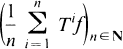
converge presque sûrement en norme dans X, quel que soit f ∊ Lp(X).
The Eta Invariant and Equivariant SpinC Bordism for Spherical Space form Groups
-
- Published online by Cambridge University Press:
- 20 November 2018, pp. 392-428
-
- Article
-
- You have access
- Export citation
-
A finite group G is a spherical space form group if it admits a fixed point free representation τ:G → U(k) for some k; for the remainder of this paper, we assume G is such a group. The eta invariant of Atiyah et al [2] defines Q/Z valued invariants of equivariant bordism. In [6], we showed the eta invariant completely detects the reduced equivariant unitary bordism groups
 and completely detects all but the 2-primary part of the reduced equivariant SpinC bordism groups
  . The coefficient ring
  is without torsion; all the torsion in
  is of order 2. The prime 2 plays a distinguished role in the discussion of equivariant SpinC bordism and
  is quite different from
  at the prime 2. Let ker*(η, G) denote the kernel of all eta invariants and let ker*(SW, G) denote the kernel of the Z 2-equivariant Stiefel-Whitney numbers (see Section 1 for details). Then:
THEOREM 0.1. Let
 . If M = ker*(η, G) ∩ ker*(SW, G), M = 0.
 and completely detects all but the 2-primary part of the reduced equivariant Spin
 . The coefficient ring
  is without torsion; all the torsion in
  is of order 2. The prime 2 plays a distinguished role in the discussion of equivariant Spin
 is quite different from
  at the prime 2. Let ker
 .
. On Fixed Points and Multiparameter Ergodic Theorems in Banach Lattices
-
- Published online by Cambridge University Press:
- 20 November 2018, pp. 429-458
-
- Article
-
- You have access
- Export citation
Inclusions for Classes of Lacunary Sets
-
- Published online by Cambridge University Press:
- 20 November 2018, pp. 459-476
-
- Article
-
- You have access
- Export citation
-
A sequence, a 1 < a 2 < a 3 < …, of positive integers is called lacunary if the difference sequence dn = a n+l — an tends to infinity as n → ∞.
In several recent papers we have made use of these sequences in analysis and combinatorics. In [6] we show that the class
 of all sets which are either finite or the range of a lacunary sequence is “full” in the sense that if (tk) is a real sequence and
  for each
  then (tk ) is an l1 sequence, that is,
In [3] the class
 of all finite unions of sets of is shown to consist of exactly those sets of integers, A, whose characteristic sequence, χA , is in the well known summability space bs + c 0. More recently, in [1], we study lacunary sequences in connection with the conjecture of P.
 of all sets which are either finite or the range of a lacunary sequence is “full” in the sense that if
  for each
  then (
 of all finite unions of sets of
 Asymptotic Maximum Principles for Subharmonic and Plurisubharmonic Functions
-
- Published online by Cambridge University Press:
- 20 November 2018, pp. 477-486
-
- Article
-
- You have access
- Export citation
-
Let Ω be a bounded open set in R n. An immediate consequence of the maximum principle is that if s is a function continuous on
 and subharmonic on Ω, then
(1)
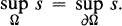
Of course (1) is no longer true if Ω is not bounded. For example in C ∼ R 2 consider the functions

However, if we restrict the growth of s, then (1) may still hold even if the open set Ω is no longer bounded and such is the theme of Phragmèn-Lindelöf type theorems. If we assume even more, namely, that s is upper-bounded, then we can again infer (1) for unbounded open sets Ω. We shall return to this point later.
In the present note, we wish to prove (1) for an arbitrary subharmonic function s on an open subset Ω of R n . In particular, we do not assume that s is bounded or even of restricted growth. Rather, we impose restrictions on the (possibly unbounded) set Ω.
 and subharmonic on Ω, then
Large Deviations for Gaussian Stochastic Processes with Sample Paths in Orlicz Spaces
-
- Published online by Cambridge University Press:
- 20 November 2018, pp. 487-501
-
- Article
-
- You have access
- Export citation
-
Let X be a complete, separable metric space, and
 a family of probability measures on the Borel subsets of X. We say that obeys the large deviation principle (LDP) with a rate function I( · ) if there exists a function I( · ) from X into [0, ∞] satisfying:
-
(i) 0 ≦ I(x) ≦ ∞ for all x ∊ X,
-
(ii) I( · ) is lower semicontinuous,
-
(iii) for each 1 < ∞ the set {x:I(x) ≦ 1} is compact set in X,
-
(iv) for each closed set C ⊂ X

-
(v) for each open set U ⊂ X

It is easy to see that if A is a Borel set such that

then

where A 0 and Ā are respectively the interior and the closure of the Borel set A.
-
 a family of probability measures on the Borel subsets of

The Heat Equation for the
 -Neumann Problem, II
-
- Published online by Cambridge University Press:
- 20 November 2018, pp. 502-512
-
- Article
-
- You have access
- Export citation
-
Let Ω be a compact complex n + 1-dimensional Hermitian manifold with smooth boundary M. In [2] we proved the following.
THEOREM 1. Suppose
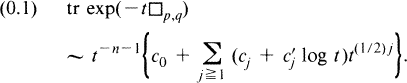
 satisfies condition Z(q) with 0 ≦ q ≦ n. Let □p,q denote the
  -Laplacian on (p, q) forms onwhich satisfy the -Neumann boundary conditions. Then as t → 0;,
(0.1)
(If q = n + 1, the
-Neumann boundary condition is the Dirichlet boundary condition and the corresponding result is classical.)Theorem 1 is a version for the
-Neumann problem of results initiated by Minakshisundaram and Pleijel [8] for the Laplacian on compact manifolds and extended by McKean and Singer [7] to the Laplacian with Dirichlet or Neumann boundary conditions and by Greiner [5] and Seeley [9] to elliptic boundary value problems on compact manifolds with boundary. McKean and Singer go on to show that the coefficients in the trace expansion are integrals of local geometric invariants.
 -Neumann Problem, II
 satisfies condition Z(q) with
 -Laplacian on (p, q) forms on