Book contents
- Frontmatter
- Contents
- List of Contributors
- Acknowledgements
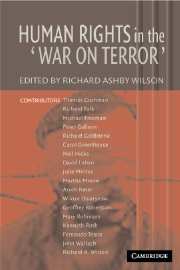
- HUMAN RIGHTS IN THE ‘WAR ON TERROR’
- Introduction
- 1 Order, Rights and Threats: Terrorism and Global Justice
- 2 Liberal Security
- 3 The Human Rights Case for the War in Iraq: A Consequentialist View
- 4 Human Rights as an Ethics of Power
- 5 How Not to Promote Democracy and Human Rights
- 6 War in Iraq: Not a Humanitarian Intervention
- 7 The Tension between Combating Terrorism and Protecting Civil Liberties
- 8 Fair Trials for Terrorists?
- 9 Nationalizing the Local: Comparative Notes on the Recent Restructuring of Political Space
- 10 The Impact of Counter Terror on the Promotion and Protection of Human Rights: A Global Perspective
- 11 Human Rights: A Descending Spiral
- 12 Eight Fallacies About Liberty and Security
- 13 Our Privacy, Ourselves in the Age of Technological Intrusions
- 14 Are Human Rights Universal in an Age of Terrorism?
- 15 Connecting Human Rights, Human Development, and Human Security
- 16 Human Rights and Civil Society in a New Age of American Exceptionalism
- Index
- References
2 - Liberal Security
Published online by Cambridge University Press: 18 August 2009
Edited by

Book contents
- Frontmatter
- Contents
- List of Contributors
- Acknowledgements
- HUMAN RIGHTS IN THE ‘WAR ON TERROR’
- Introduction
- 1 Order, Rights and Threats: Terrorism and Global Justice
- 2 Liberal Security
- 3 The Human Rights Case for the War in Iraq: A Consequentialist View
- 4 Human Rights as an Ethics of Power
- 5 How Not to Promote Democracy and Human Rights
- 6 War in Iraq: Not a Humanitarian Intervention
- 7 The Tension between Combating Terrorism and Protecting Civil Liberties
- 8 Fair Trials for Terrorists?
- 9 Nationalizing the Local: Comparative Notes on the Recent Restructuring of Political Space
- 10 The Impact of Counter Terror on the Promotion and Protection of Human Rights: A Global Perspective
- 11 Human Rights: A Descending Spiral
- 12 Eight Fallacies About Liberty and Security
- 13 Our Privacy, Ourselves in the Age of Technological Intrusions
- 14 Are Human Rights Universal in an Age of Terrorism?
- 15 Connecting Human Rights, Human Development, and Human Security
- 16 Human Rights and Civil Society in a New Age of American Exceptionalism
- Index
- References
Summary
How should democracies respond to security threats? How can governments respond to heightened forms of violence, such as terrorism, internal uprising, or external aggression, while remaining true to the rule of law, human rights, and democratic values? Commentators and courts in democratic countries, while divided on important issues, seem reluctantly to converge on the view that some adjustment on our individual freedoms is justified to face these threats. But when, if ever, is such a curtailment defensible? And isn't curtailment of human rights self-defeating – as the cliché goes, aren't governments who curtail freedom destroying democracy under the guise of defending it?
I tackle this subject with great trepidation. I am Argentine, and lived through the horrors of the military régime that ruled Argentina between 1976 and 1984. The government then argued that unless civil liberties were restricted, Argentine society would succumb to the terrorist threat (posed then by violent radical left-wing groups). The result is well known: the government unleashed abominable forms of state terror, torturing and murdering between 10,000 and 30,000 persons (see Nunca Más 1984). What is worse, the government, vile as it was, could not be accused of manufacturing the terrorist threat: there was one. When the smoke cleared, I joined most Argentines of my generation in the view that human rights should never be violated, regardless of the magnitude of the threat.
Information
- Type
- Chapter
- Information
- Human Rights in the 'War on Terror' , pp. 57 - 77Publisher: Cambridge University PressPrint publication year: 2005
References
& (Eds.). (1982). Terrorism in Europe. London: Center for Strategic and International StudiesGoogle Scholar
(2003). ‘National Security versus Civil Liberties’. Presidential Studies Quarterly, vol. 33, no. 3, p. 547–67CrossRefGoogle Scholar
(2004, September 24). ‘The Cult of Che: Don't Applaud The Motorcycle Diaries’. Available at: http://slate.msn.com/id/2107100Google Scholar
Coady, C. A. J. (2002). ‘Terrorism, Just War, and Supreme Emergency’. In and (Eds.), Terrorism and Justice. Melbourne: Melbourne University PressGoogle Scholar
(2003). ‘Promoting Freedom and Democracy: Fighting the War of Ideas Against Islamic Terrorism’. Comparative Strategy, vol. 22, no. 3, p. 207CrossRefGoogle Scholar
(2004). ‘The Priority of Morality: The Emergency Constitution's Blind Spot’. Yale Law Journal, vol. 113, p. 1753CrossRefGoogle Scholar
European Convention of Human Rights. Available at: http://www.hrcr.org/docs/Eur_Convention/euroconv.html
(2003). ‘What Happens Now? The United Nations after Iraq’. American Journal of International Law, vol. 97, p. 607CrossRefGoogle Scholar
(2001, Fall). ‘Terrorism, Innocence, and War’. Philosophy and Public Policy Quarterly, vol. 21, p. 9Google Scholar
Hamdi v. Rumsfeld, 124 S. Ct. 2633, 2648, 159 L. Ed. 2d 578, 601, 2004 U.S. LEXIS 4761 (2004)
(2003). Terrorism, Freedom and Security: Winning Without War. Cambridge, MA: MIT Press, pp. 87–113Google Scholar
(1996). The Clash of Civilizations and the Remaking of World Order. New York: Simon & SchusterGoogle Scholar
Ireland v. The United Kingdom (5310/71) [1978] ECHRI (18 January 1978)
(2002). ‘An Interim Assessment of September 11: What Has Changed and What Has Not’. Political Science Quarterly, vol. 117, no. 1CrossRefGoogle Scholar
Kapitan, T. (2003). ‘The Terrorism in “Terrorism”’. In (Ed.), Terrorism and International Justice, vol. 21, p. 47. Oxford: Oxford University PressGoogle Scholar
(2001). Rethinking Evil: Contemporary Perspectives. Berkeley: University of California PressGoogle Scholar
Lawless v. Ireland (No. 2)(332/57) [1961] ECHRI (7April 1961)
Nunca Más: Informe de la Comisión Nacional sobre la desaparición de personas, 3rd ed. (1984). Buenos Aires, Argentina: EUDEBA
(2002, August 6). ‘The Myth of Preemptive Self-Defense’. Available at: http://www.asil.org/taskforce/oconnell.pdfGoogle Scholar
Pincione, G. & Tesón, F. R. (2005). Discourse Failure: A Philosophical Essay on Deliberation, Democracy, and Consent, ch. 6. Unpublished
(2004). ‘Self-Defense in International Law and Rights of Persons’. Ethics and International Affairs, vol. 18, no. 1, p. 87CrossRefGoogle Scholar
(2003). ‘Security and Liberty: The Image of Balance’. The Journal of Political Philosophy, vol. 11, no. 2, p. 191CrossRefGoogle Scholar
Walzer, M. (2001). ‘Double Effect’. In (Ed.), The Doctrine of Double Effect, p. 261. Notre Dame, IN: University of Notre Dame PressGoogle Scholar
Williams, B. (1973). ‘A Critique of Utilitarianism’. In and (Eds.), Utilitarianism: For & Against. Cambridge: Cambridge University PressCrossRefGoogle Scholar
Accessibility standard: Unknown
Why this information is here
This section outlines the accessibility features of this content - including support for screen readers, full keyboard navigation and high-contrast display options. This may not be relevant for you.Accessibility Information
Accessibility compliance for the PDF of this chapter is currently unknown
and may be updated in the future.
- 4
- Cited by